pancho villa

You are currently browsing articles tagged pancho villa.

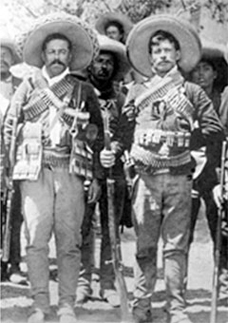
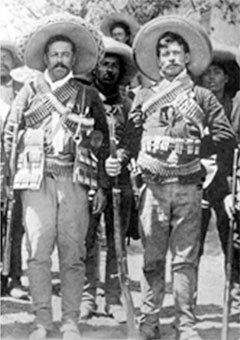
Francisco "Pancho" Villa and Ricardo Gonzalez

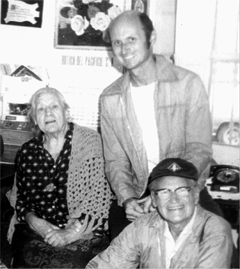
Ricardo Gonzalez, great uncle of Bessie "Crickett" Quijada.

A few weeks ago we received a very interesting comment from Bessie "Crickett" Quijada regarding our article, A Visit With Mrs. Pancho Villa. I contacted her and she agreed to share some of her photos with us.

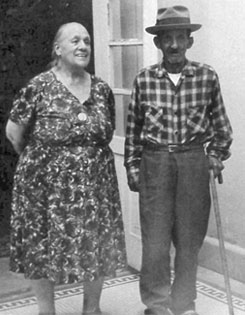
In her comment Mrs. Quijada told us “My grand mother’s brother, Ricardo Gonzales, rode with The General Pancho Villa. In the Military Classics Illustrated (News Letter) there is a photo of My great uncle Ricardo on horseback along with Pancho Villa and about 5 or 6 other riders. My uncle is to Pancho Villas left. I have a photo of my uncle with Mrs Pancho Villa (Dona Luz) taken at La Quinta Manor where she lived until her death. The Villa’s manor is a museum in Chihuahua, MX. In the Military Classics Illustrated along with the photo of my uncle with Pancho Villa there is an article titled, The Villistas: Soldiers in Sombreros and Suit Coats By Don Fuchik.”

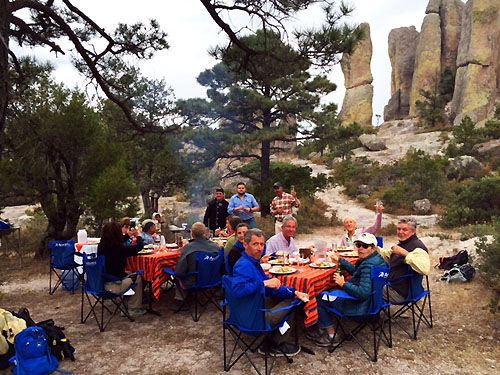
The author she refers to, Don Fuchik, was a very close friend of mine from the time we were 13-years old until his death a few years ago. He was also a consultant for The California Native and led many of our trips through Mexico’s Copper Canyon.

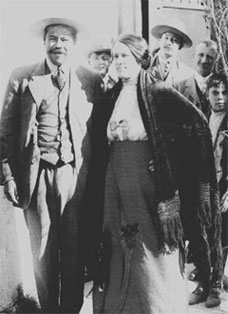
Pancho Villa and Luz Corral de Villa Dona Luz Corral de Villa with Ricardo Gonzalez
Pancho Villa and his wife, Luz Corral de Villa, in 1914. Dona Luz Corral de Villa with Ricardo Gonzalez in 1967.

Crickett was born in Denver, Colorado and grew up in Stockton, California. She now lives in Fresno. She describes herself as being 67 going on 12, and never wants to grow up. She has eight children, two which she adopted, and two male pet hooded rats whom she adores (she claims that rats make great pets). Her nickname is Crickett and that is what she prefers to be called.

Bookmark and Share

Tags: , , , , , ,

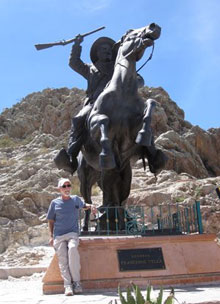
Lee Klein, California Native founder, stands beside a statue of Pancho Villa in the city of ZacatecasPancho Villa, so the saying goes, was “hated by thousands and loved by millions.” He was a Robin Hood to many and a cruel, cold-blooded killer to others. But who was this colorful controversial hero of the Mexican Revolution and where did he come from?
Doroteo Arango, for that was Pancho Villa’s real name, was born in the state of Durango in 1878, a share-cropper peasant on a hacienda. According to the legend, one day when he was sixteen, he returned home from the fields to find that his sister had been raped by the owner of the hacienda, Don Agustin López Negrete. Doroteo took up his revolver, shot Don Agustin, and escaped into the mountains on a horse.

He became a cattle rustler and later joined a band of rustlers that was led by a man named Francisco “Pancho” Villa. In one of their many skirmishes with the law, the group was surprised by a group of rurales (mounted police) and Francisco was killed. Doroteo then took command of the gang and also assumed the name of the fallen leader. He may have done this to throw off those who hunted him for the murder of the hacienda owner or he may have done this to insure his authority over the group. Anyway, from that time on it was he who was known as Francisco “Pancho” Villa.

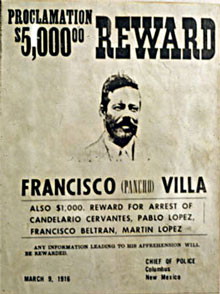
Wanted poster for Pancho Villa after he raided Columbus, New Mexico in 1916.Pancho Villa was a natural leader and was very successful as a bandit, leading raids on towns, killing, and looting. He was also involved in more legitimate ventures, including being a contractor on the Copper Canyon railroad.
In 1910, when the Mexican Revolution broke out, Villa was recruited by the revolutionary leader, Abraham Gonzalez. Villa put together an army of armed cowboys and ruffians and became the revolutionary general who led the war in the northern part of Mexico. His charisma and victories made him an idol of the masses.

In 1916, when an American merchant refused to deliver the arms to Villa’s army which they had paid him for, Villa entered the United States and raided the town of Columbus, New Mexico. He was pursued by General “Black Jack” Pershing through the mountains of the State of Chihuahua. Pershing’s pursuit of Villa ended in failure, causing him to telegraph back to Washington that “Villa is everywhere, but Villa is nowhere.”

The war ended in 1920, and many attempts were made on Villa’s life by relatives of persons he had killed. On July 20, 1923, while driving his car through the town on Parral, Chihuahua, he was assasinated. The men responsible were never identified.

Bookmark and Share

Tags: , , , ,

Sitting in her simple wooden chair, Doña Luz Corral de Villa, widow of Pancho Villa, began a rambling discourse on her life with the famous—or infamous—bandit, general, and hero of the Mexican Revolution.

The year was 1974, seven years before her death, when I first met Mrs. Villa. My father and I were touring Copper Canyon, and we were introduced to her at her home in the city of Chihuahua.

Sharing her memories with us, eighty-two year old Doña Luz told us of her life as a child, living with her widowed mother in the town of San Andres. One day, when she was a teenager, Villa and his soldiers rode in and demanded monetary contributions from the townspeople. Her mother asked to be excluded, and Villa visited her small store to see if she was really as poor as she claimed to be. There he met Luz. The courtship was very brief, and over the objections of her mother, Luz married Villa. The attending priest asked Villa to make his confession. The General refused, stating that it would take days to list all his sins.

Luz was not the only woman in Villa’s life. He was linked with several in bogus marriages, but later Luz was able to produce a valid certificate proving that she was his only legal wife.

The couple had one child, a daughter, who died within a few years. Luz had no other children, but she took in children Villa had fathered with other women. Perhaps she felt that he would always return to her, knowing that several of his children were with her. Villa built the quinta (manor) during the Revolution, and Luz lived there until her death in 1981. Villa was assassinated in 1923, and several of his “wives” claimed the manor. The marriage certificate might not have been sufficient to safeguard her claim, but Luz had an important ally, Alvaro Obregon, President of Mexico. During the Revolution, Obregon had visited the Villas at the quinta. There Villa had plotted to have Obregon killed, but Luz had interceded, saving the future president’s life. The favor was not forgotten, and Obregon used his considerable influence to protect Luz’s claim.

Eventually the house became a museum, with Luz the resident caretaker, and she tried personally to meet each visitor. Luz traveled through Mexico and the United States, and in Los Angeles received the key to the city.

Shortly before her death she wrote a book about her life with Villa, Pancho Villa: an Intimacy, published by Centro Librero La Prensa, in the city of Chihuahua. In it she loyally defends Villa against most of the accusations against him for his many excesses while leading the Army of the North. While this book must be read with a skeptical eye, her account provides interesting insights into Villa and the Revolution.

The above story was written by Don Fuchik (1941-2004). A long-time travel consultant and guide for The California Native, Don was also my close friend for 51 years. Don held a Master’s Degree in Latin American history and received grants from the National Endowment for the Humanities for his studies of this region.
Lee Klein

Bookmark and Share

Tags: , , , , ,