Yucatan and Chiapas

You are currently browsing the archive for the Yucatan and Chiapas category.

Beach at Cancun, Mexico

The beaches at Cancun give the traveler a chance to unwind at the beginning of a trip exploring Mexico

When you travel with us on our Yucatan Explorer Trips, you now have the option of beginning and ending your vacation in either city, Cancun or Merida.

With the large number of airlines flying into Cancun daily, starting your Yucatan adventure in Cancun allows you to take advantage of the competitive airfares and direct flights from the U.S. and Canada.

Cancun is renowned for its beaches, restaurants and nightlife, with all the glitter of an upscale beach resort. Merida, on the other hand, is a cosmopolitan but at the same time tranquil and charming colonial city.

Pyramid of the Magician at the ruins of the Mayan city of Uxmal

Abandoned for more than ten centuries, the Pyramid of the Magician is the tallest structure at the Mayan ruins of Uxmal.

The Yucatan Peninsula is the homeland of the Mayan people, whose mighty empire lasted over a thousand years. Throughout the peninsula are the amazing archaeological ruins of their great cities. In addition, the Yucatan has lovely colonial cities and beautiful Caribbean beaches.

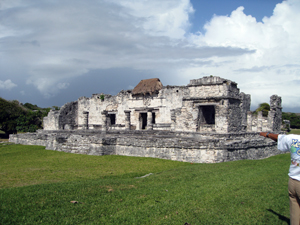
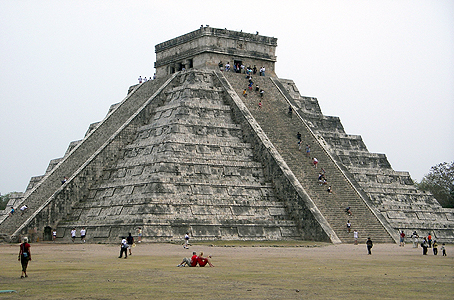
All of our Yucatan tours visit the Mayan ruins of Chichén Itzá, Uxmal, El Balam and Edzna, as well as the city of Campeche—its fort was built by the Spaniards as defense against the Caribbean pirates.

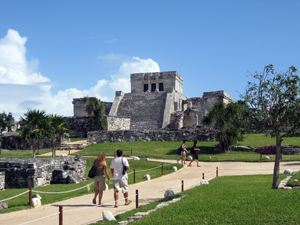
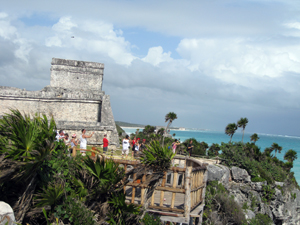
The tours which begin in Cancun also visit the ruins of the Mayan port city of Tulum, built alongside a beautiful Caribbean beach. and the archaeological site of Coba.

Read the rest of this entry »

Bookmark and Share

This year in Mexico is a year for celebration. It is the bicentennial of Mexico’s War of Independence as well as the centennial of the Mexican Revolution. Two hundred years ago the first of these events set our neighbor on the path to becoming the 14th largest independent nation on Earth, as well as the world’s largest Hispanic country. It was the inspiration and leadership of one man which led to Mexico’s throwing off the shackles of Spain after almost three centuries.

Father Miguel Hidalgo is considered to be the "Father of Mexico."

Father Miguel Hidalgo's speech, known as the Grito de Dolores, the “Cry of Dolores,” set off the Mexican War of Independence.

That man was a 57-year-old priest whose parish was in the city of Dolores, Guanajuato. The date was September 16, 1810. Early that morning Father Miguel Hidalgo y Costilla had the church bells rung to summon the townspeople to the church, where he told his followers that the time had come to expel the Spaniards who had misgoverned Mexico for so long. His speech, known as the Grito de Dolores, the “Cry of Dolores,” set off the Mexican War of Independence, which resulted in Mexico’s becoming an independent country.

Hidalgo was born in 1753 on the hacienda where his father was administrator. At twenty years of age he received his Bachelor of Theology degree and lectured in philosophy and theology at San Nicolás Obispo and, after being ordained as a priest, became rector of the school. His ideas and conduct were extremely liberal, which led to his being dismissed from that post, and twice being investigated by the Inquisition, who accused him of reading prohibited books, advocating doctrines of the French Revolution, doubting the virgin birth of Mary, gambling, and keeping a mistress. His last clerical position was that of parish priest in the little town of Dolores.

Hidalgo worked hard to improve the lives of his parishioners, mastering their Indian language and teaching them crafts and skills to improve their economic condition. He also introduced winemaking and silk culture, two industries which the government declared illegal in the colonies, and one day government officials came to the village and destroyed the vines and mulberry trees.

Late in the eighteenth century it became fashionable among cultured criollos, persons of Spanish descent who were born in Mexico, to form literary societies, which met for tea and cakes and discussed the classics. They also smuggled into the country books which were banned by the Church, such as the works of Rousseau, Voltaire, and Descartes. The literary societies gradually became political societies. Father Hidalgo belonged to one of these societies whose members were plotting a revolution to separate Mexico from Spain.

Read the rest of this entry »

Bookmark and Share

There is a local legend revolving around Chiapas, Mexico’s, Canyon del Sumidero. Legend states that the local tribes were fanatic about remaining out of bondage. So in order to escape slavery by the Spaniards, they committed mass suicide by diving into the canyon, believing that they would be free in the afterlife if they did so.

Sumidero Canyon, Chiapas, Mexico

In Mexico's Sumidoro Canyon, local Indians thew themselves over the cliffs rather than be enslaved by the Spaniards.

There is some historical fact associated with this legend. When the Spanish first came to Mexico, they conquered the Aztec empire, which was located to the north and west of Chiapas for the most part. Later, when Cortes sent tax collectors to Chiapas, they were met with fierce resistance. Eventually, in a fierce battle between indigenous forces and Spanish conqueror Diego de Mazariegos, many Indian warriors threw themselves into the Canyon del Sumidero, preferring death to slavery.

This canyon is located in extreme southeastern Mexico, in the central state of Chiapas. It was formed by a fault that still runs through the canyon, through which the Grijalva river still runs. The river and canyon are the primary feature of what is now known as Cañón del Sumidero National Park. The Mexican government named the site a National Park in 1980, in order to protect the area around it, as well as the flora and fauna. The canyon is one of Mexico’s most beautiful features, though it is not well known outside the country. It is the central tourist attraction for the state of Chiapas; important enough that it features on the state’s coat of arms.

Crocodile awaits prey in Mexico's Sumidero Canyon

A crocodile blends in with his surroundings as he waits for his unwary dinner in Mexico's Sumidero Canyon.

The park is formed by two features; the Canyon del Sumidero itself, and the plains that the canyon-forming Grijalva river runs through. A series of tremendous earthquakes thrust the plains in some places more than a kilometer above sea level millions of years ago. Some time after, the Grijalva river cut down through the basalt and granite, creating the canyon seen today.

A speed boat tour down the canyon and the Grijalva river leads to many beautiful sights. Lucky boaters might see some of the native American Crocodiles. One particular sight that any visitor would be lucky to see is what happens to the canyon during the rainy season. Nearby streams and trickles of water all lead down into the canyon and the sides of the canyon cascade with beautiful waterfalls.

California Natives enjoy boat trip through Mexico's Sumidero Canyon.

California Natives enjoy the tropical scenery and wildlife as they tour Mexico's Sumidero Canyon by speed boat.

Read the rest of this entry »

Bookmark and Share

Lee Klein, California Native founder, stands beside a statue of Pancho Villa in the city of ZacatecasPancho Villa, so the saying goes, was “hated by thousands and loved by millions.” He was a Robin Hood to many and a cruel, cold-blooded killer to others. But who was this colorful controversial hero of the Mexican Revolution and where did he come from?

Doroteo Arango, for that was Pancho Villa’s real name, was born in the state of Durango in 1878, a share-cropper peasant on a hacienda. According to the legend, one day when he was sixteen, he returned home from the fields to find that his sister had been raped by the owner of the hacienda, Don Agustin López Negrete. Doroteo took up his revolver, shot Don Agustin, and escaped into the mountains on a horse.

He became a cattle rustler and later joined a band of rustlers that was led by a man named Francisco “Pancho” Villa. In one of their many skirmishes with the law, the group was surprised by a group of rurales (mounted police) and Francisco was killed. Doroteo then took command of the gang and also assumed the name of the fallen leader. He may have done this to throw off those who hunted him for the murder of the hacienda owner or he may have done this to insure his authority over the group. Anyway, from that time on it was he who was known as Francisco “Pancho” Villa.

Wanted poster for Pancho Villa after he raided Columbus, New Mexico in 1916.Pancho Villa was a natural leader and was very successful as a bandit, leading raids on towns, killing, and looting. He was also involved in more legitimate ventures, including being a contractor on the Copper Canyon railroad.

In 1910, when the Mexican Revolution broke out, Villa was recruited by the revolutionary leader, Abraham Gonzalez. Villa put together an army of armed cowboys and ruffians and became the revolutionary general who led the war in the northern part of Mexico. His charisma and victories made him an idol of the masses.

In 1916, when an American merchant refused to deliver the arms to Villa’s army which they had paid him for, Villa entered the United States and raided the town of Columbus, New Mexico. He was pursued by General “Black Jack” Pershing through the mountains of the State of Chihuahua. Pershing’s pursuit of Villa ended in failure, causing him to telegraph back to Washington that “Villa is everywhere, but Villa is nowhere.”

Read the rest of this entry »

Bookmark and Share

In the United States we honor the Irish on Saint Patrick’s Day, the Italians on Columbus Day, and the Mexicans on Cinco de Mayo. But what the heck is Cinco de Mayo?

California Native founder, Lee Klein, gets into the spirit of Cinco de MayoMost Americans think that Cinco de Mayo (the 5th of May) celebrates Mexican Independence Day. Not so. Mexican Independence Day is September 16. Then what is Cinco de Mayo?

After Mexico won its independence from Spain in 1821, it went through forty years of internal power struggles and rebellions. By 1861 the country’s finances were so bad that the nation owed 80 million pesos in foreign debts. Mexico’s president, Benito Juarez, pledged to pay off these debts eventually but, as an emergency measure, he suspended all payment for two years.

In France, Napoleon III saw this as an opportunity to establish French colonies in Latin America. He believed that the United States was too involved with the Civil War to try and enforce the Monroe Doctrine, and that if the South won the war—and after the Battle of Bull Run it looked like they might—opposition to his plan would be minimal.

Emperor Maximilian didn't enjoy Cinco de MayoNapoleon enlisted England and Spain to join him in a mission to encourage Mexico to pay off its foreign debts. The mission began with the landing of French, English and Spanish troops at Vera Cruz. The French minister then demanded that Mexico pay 12 million pesos to France, an impossible amount, given the state of the Mexican treasury.

Napoleon then set up a provisional government with his personal emissary as its head, and brought in a much larger French army to enforce it. England and Spain, now realizing Napoleon’s scheme for French domination, protested France’s moves and withdrew their forces.

The French, now alone, marched 6000 dragoons and foot soldiers to occupy Mexico City. On May 5 (Cinco de Mayo), 1862, on their way to the capital, the French soldiers entered the town of Puebla. To stop the French, the Mexicans garrisoned a rag-tag army of 4000 men at Puebla, most of them armed with fifty-year-old antiquated guns. The French general, contemptuous of the Mexicans, ordered his men to charge right into the center of the Mexican defenses.

Read the rest of this entry »

Bookmark and Share

In Copper Canyon, a California Native group tastes tequilaWe’ve spent an exciting day exploring the remote regions of Mexico’s Copper Canyon, and as sunset repaints the canyon walls, what better way to usher in the evening than with a cool refreshing margarita? Contreau or triple-sec, lime juice, ice, and, most important, tequila. But how much do we really know about this delightfully intoxicating beverage?

Before the arrival of the Spaniards, fermented sap from the Maguey plant was extracted into a beverage known as ‘pulque.’ Pulque holds the esteem of being North America’s first distilled drink. Aside from that, origins of the liquor seem as ethereal as the effects it produces. Tequila branches from this phantom lineage by way of a small town with the same name in the state of Jalisco. In the ancient Nuahatl language, “tequila” translates to “place of the plant harvest” and represents the relationship between the region and the raw material—the Blue Agave.

There are over 130 species of agave. However, only one variety is used in the production of tequila according to standards set by the Mexican government. That variety is the Blue Agave, or Agave Tequilana Weber Azul. A common misconception is that tequila is made from a cactus. The Agave is actually closer in relation to succulents like the Lily or the Amaryllis even though it looks spiky in appearance. Only the hearts of the plant are used in distillation while the thick leaves are processed into fiber. Other varieties may be used in the formulation of tequila’s kindred spirit Mezcal, but only the Blue Agave is used to distill tequila. Mature agave at the time of harvest can grow 5 to 8 feet tall, span 7 to 12 feet across and, although not a cactus, can live up to 15 years!

Another myth infusing the agave spirits of tequila and mezcal turns over the worm. Drinkers and non-drinkers alike recognize the connection. However, like all things Tequila, origins of this curious practice of adding worms to bottles survives mostly as folklore, even though many believe it is more marketing strategy than authentic Mexican Tradition. In fact, only Mezcal carries the worm, this again due to the Mexican standards authority, Norma Oficial Mexicana (NOM). The worms are the thoroughly pickled larvae of the moth species Hypopta Agavis and, although not found in higher-priced bottles of Mezcal, are believed to enhance the flavor as well as act as an aphrodisiac. Viewed as a delicacy by many in Mexico, the Gusano Rojo (Red Worm) and the Gusano Blanco (White Worm) are safe to eat, even if their properties and histories are debatable.

Knowing tequila is not cactus and has no worm, it now comes down to the matter of taste. Tequilas divide into three groups agreed upon by aficionados in the industry. Like many beverages, Tequilas are classified according to their age. Blanco (white), also referred to as Plata (silver), is the youngest of the three types. Tequila Blanco is aged less than two months and is distinguished through its abrasive flavor. Also identified in this category is Tequila Oro (gold). This is a blend of the young Tequila Blanco and a more-aged variety, often mixed with coloring to resemble older vintages. Second of the three classes is Tequila Reposado (rested). This mid-aged tequila is known for its peppery aftertaste and has an age greater than two months but less than one year. The third and final variety is Tequila Anejo (aged). Tequila Anejo mellows for a period between one year and three years and finishes smoother on the palate as a result.

Read the rest of this entry »

Bookmark and Share

Burrowed into the southeast part of the Yucatan Peninsula stands the walled fortress of Campeche—a city born from warfare and piracy.

Before the arrival of the Spanish Conquistadors, Campeche was the principal town of the Mayas, who called it Ah Kin Pech (serpent tick), which the Spanish interpreted as “Campeche.”

Led by Hernandez de Cordova, Spanish explorers set sail from Cuba in 1517 to search for new lands. Cordova is credited with the discovery of the Yucatan Peninsula.

Their first landing was at the Mayan village of Catoche where the natives greeted the conquistadors with an ambush and drove them back to sea. After fifteen days adrift without adequate supplies or water they ventured ashore again, this time at Campeche. Here, what seemed to begin as a friendly welcome turned into a simple choice—the high priest of the village set fire to a pile of reeds and told the sailors if they were not back to their boats before the blaze burned out, they would be used to rekindle the flames.

Back at sea, the Spanish sailors worked their way down the coast until they arrived at Champotón. Locating food and water, the conquistadors also found themselves surrounded by Mayan warriors whose legions “seemed to multiply” until they outnumbered the Spanish 200 to one. The Mayans paid close attention to Captain Cordova, filling him with ten arrows that would eventually, five agonizing days later, claim his life. The Spaniards afterwards called the site costa de la mala pelea “the coast of the bad fight.”

In 1541, after the Mayans were finally subdued, the Spanish town of Campeche was founded. Once conquered, the harvest of the area’s abundant natural resources began. Before long, Campeche grew to be one of the richest cities in Mexico, second only to Veracruz in its wealth.

One commodity in particular led to this boom, the precious logwood tree, a medium-sized evergreen with yellow flowers. Profiteers quickly learned that the tree was also the source of rich violet and black dyes used by the natives to color their textiles. In Europe, these hues were produced by indigo dyes, exotic and affordable only to royalty and the rich. The introduction of the logwood dye provided a less-expensive alternative.

Read the rest of this entry »

Bookmark and Share

When you think about the history of wine, it’s easy to picture France, Italy, and Spain as popular destinations for the grape lover. Read MEXICO and WINE in the same sentence and you’re likely to think Tequila?, and rightly so, but did you know that a number of award-winning wines come out of the country as well?Wine in Mexico

Winemaking in Mexico has its own history and can be traced back to the arrival of the Spanish. Early settlers predicted that Mexico’s tropical climate would not be suitable for growing grapes, but that did not stop the explorer Hernando Cortes who enacted legislation calling for landholders to plant new vines every year. The Catholic Church was on board with this plan as they brought the Mission grape to be grown on land owned by the church. The vines prospered in the hot, dry climate and helped support the economic health of the colony. In fact, it could be said that in some ways, Mexico owes its independence to the grape. One man in particular, Miguel Hidalgo, was instrumental in planting the vines of revolution.

Miguel Hidalgo was born in 1753 and is credited with cultivating the spirit of rebellion against Spanish oppression. Because of his patriotism, his championing of human rights and his personal courage, he is considered by Mexicans to be the father of their nation and a symbol of Mexican independence. At twenty years of age Hidalgo received his Bachelor of Theology degree and lectured in philosophy and theology at San Nicolás Obispo and, after being ordained as a priest, became rector of the school. Hidalgo worked hard to improve the lives of his parishioners, mastering their native languages and teaching them crafts and skills to improve their economic condition. In his parish at Dolores and throughout Mexico, he promoted winemaking and silk culture.

Wine production continued robustly until the mid-to-late 17th century when the Spanish Monarchy saw the New World competition too great a risk to their profits. The cottage industry of winemaking was declared illegal in the colonies. The Spanish crown called for the eradication of vineyards and deployed Franciscan missionaries to ensure that only wine imported from Spain was used in the sacrament. However, this did not stop the Jesuits, who continued fermenting grapes on the sly. Father Hidalgo was a staunch supporter of this rebellious activity because he wanted self sufficiency for the people in his parish and was intolerant to the subjugation of those in a lower economic situation by those acting on behalf of the king. The ceasing of wine production along with other economic hardships imposed by the king led Hidalgo to organize protest and then revolt.

Today, Mexico is gaining recognition as a player on the world wine market. And, rightly so, with Baja wineries such as Monte Xanic earning acclaim with it’s award winning Chardonnay and Cabernet Sauvignon; and Bodegas Santo Tomas, in operation for 120 years, regarded as the oldest continuously producing commercial winery in Mexico, there’s no doubt that Mexican wine is a force to be reckoned with.

Bookmark and Share

California Native's Ellen Klein relaxes in a hammock at a jungle resort.Some say the it was the ancient Greeks, some argue that it was indigenous Americans like the Mayans of the Yucatan or the Urarina of the Peruvian Amazon, and while there is some debate over the origins of the hammock and which civilization can claim the rights of ownership, no one can deny the functionality of design. Some of the earliest hammocks developed have been found in the Bahamas. These were made from bark stripped off the hamack tree–the likely origin for the name. Over the years, the bark used in construction was replaced by sisal fibers and today hammocks can be crafted from many materials such as canvas or nylon.

Sisal fiber was instrumental in the fabrication of hammocks giving weavers in the Yucatan an important role. From the mid 19th century all the way to World War I, sisal fiber was considered the major cash crop for this area. In fact, the town of Sisal is located just 53 miles north of the Yucatan’s capital city of Mérida and still contains an abundance of the plants from which the fiber is produced.

The popularity of hammocks spread due to their function in the Royal Navy. Here, hammocks benefited sleeping sailors because they rocked in synchronicity with the pitch and roll of the ship. These sleeping arrangements were preferred because hammocks take up less room than traditional bunk beds and protected sailors from falling out while asleep on rough seas.

The widespread use of the hammock may have come from their utility on the ocean, but their safety benefits evolved from necessities on land. The elevated support of the hammock allowed the ancient Mayans a better alternative to lying on the wet jungle floor filled with biting insects and other vermin.

Hammock: just saying the word causes you to imagine swaying in a breeze on the beach or relaxing in the backyard on your day off. Known for their cocoon-like comfort, there is no disputing the practical design of a hammock. And over the years, artisans have honed their craft and now hammocks are made in a variety of colors and styles. In the capital city of Merida and its surrounding villages, the hammock has become a symbol of the Yucatan. Travelers to this part of Mexico can readily find hammock vendors in the central plazas of towns they visit. Adding to their unique design is the fact that Mayan Hammocks are lightweight and easy to pack, making them great souvenirs from your next trip to the Yucatan peninsula, the Peruvian Amazon, or Costa Rica with The California Native.

Bookmark and Share

The Summer/Fall 2009 edition of The California Native Newsletter is now in the mail. The newsletter, published by The California Native since 1984, has more than 10,000 readers (not counting those who download from the web). If you are not already a subscriber to this free newsletter you can signup now.

This issues feature stories include:

Lee Klein prepares to fly over the Nazca Lines on The California Native Peru ToursREVISITING PERU’S NAZCA LINES

The desert markings, believed to have been made thousands of years ago, made little impression on occasional travelers who viewed them from ground level, but when they were spotted by aircraft in the 1930’s they caught the world’s attention. They have since been surveyed, mapped and studied. Only two questions remain—who made them, and why?

Rafting is one of the many options for guests on The California Native Costa Rica ToursRAPID TRANSIT: COSTA RICA STYLE

Costa Rica has long been a favorite destination for both the beginner and the experienced river runner. With ample annual rainfall, mountainous landscapes, and plenty of road-to-river access, the country prides itself on being a whitewater paradise.

GHOSTS OF THE GALAPAGOS

Packing a pearl-handled revolver, a riding crop and three lovers, the Baroness Eloisa von Wagner Bosquet disembarked on the Island of Floreana, in 1932, and declared herself “Empress of the Galapagos.”

Read the rest of this entry »

Bookmark and Share

The question most frequently asked by guests going on trips with The California Native to Mexico’s Copper Canyon or the Yucatan is, “What weather can I can expect?”

Having an idea of what the weather will be makes it much easier to pack. For those going to the Yucatan, packing is easy. Lightweight clothing (preferably from natural fibers), light-colors (they reflect the sun’s rays), and a  wide-brimmed hat (to protect your face and ears from the sun). And, of course, don’t forget your swim-suit!

If you are traveling to Copper Canyon, predicting the weather is a bit more difficult.  Mexico has three climate zones, tropical, temperate and cold, and the Copper Canyon tours traverse all three of them.

Upon arrival in the town of El Fuerte (around sea level), you can expect temps in the 70’s even in January. This changes dramatically as you climb high into the Sierra Madre Mountains to the town of Creel where elevations around 6500 feet can cool the air considerably. Expect frost in the early mornings from mid-October through the middle of March. It may even snow. Dress in layers. Avoid taking bulky overcoats—a comfortable jacket on a couple layers of long sleeves or a sweater should suffice. Don’t forget a pair of gloves. In the winter, if the day is sunny, you can expect the air to be mild (highs in the low 60’s). Don’t get too acclimated to the chillier air because from Creel, an excursion to the town of Batopilas in the bottom of the canyon brings you back to the heat of Mexico. It is a fact that the folks who live in Batopilas only acknowledge three seasons; summer, fall, and spring.

As winter approaches, people in the United States and Canada look to Mexico as a top vacation spot to escape the cold. Providing  respite from the temperatures in the higher latitudes, Mexico has long been a sun-lover’s paradise.  From the splendid heat and humidity of the Yucatan Peninsula, to the coastal climate at the tranquil town of La Paz, Mexico is renown for short sleeves, sandals, and sunscreen. But this time of year is also the perfect time to visit the wonders of Copper Canyon, with its scenery, cultural diversity and wide range of temperatures for everyone to enjoy.

Bookmark and Share

Nothing can compare to a fresh, hot, homemade tortilla. I remember as a kid, my mom would give us tortillas right off the griddle sprinkled with a little cinnamon, sugar and butter. They were heavenly and  simple to make (if you use the prepared flour).

Mayo Indian Lady Making Tortillas in Mexico's Copper Canyon
Mayo Indian lady making
tortillas in Mexico’s Copper
Canyon

When you order a tortilla in Spain or South America you’ll receive an omelette—layers of eggs, potatoes and seasonings. But in the U.S., we are familiar with the tortillas of Mexico, kind of flat bread or pancakes. Meals are served with, in or on tortillas made of corn or wheat flour. Tortillas are very versatile and can be wrapped around fillings to make burritos and enchiladas, folded and filled to make tacos, served flat like a plate for a tostada, baked into a bowl for salads, or served like bread with a meal. Since 1985, NASA shuttle missions have been using tortillas to solve their food handling problems and eliminate bread crumbs in the instrument panels.

The Tortilla has become a regular food staple in most kitchens and can be found in every local grocery store. They are almost as common as a loaf of bread.

Of course you can’t beat the tortillas made in the traditional way in Mexico, such as the ones we enjoy on our trips to Mexico’s Copper Canyon , the Yucatan and Chiapas, but you can do a pretty good job of making them yourself.

The traditional way of making tortillas includes curing the corn in lime water until the hulls peel off, then grinding it with a stone mano (a cylinder-shaped stone similar to a rolling pin) and metate (a stone with a concave top for holding the corn). I usually skip this step, as it can be very time consuming.

Tortillas
3 cups flour (wheat, all-purpose or maza harina /corn flour)
1 teaspoon salt
2 teaspoons baking powder
5-6 tablespoons lard or vegetable shortening
1 1/4 cups warm water (mas o minos/more or less)

Read the rest of this entry »

Bookmark and Share

« Older entries