“AAARRGH! The yeti, “Abominable Snowman,” or mirgu, as it’s called in Bhutan, has been a legend throughout the Himalayas for centuries. They are even depicted in ancient Tibetan and Bhutanese manuscripts.
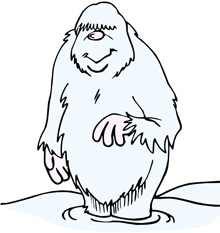 The Kingdom of Bhutan has set aside an area specifically for the yeti, the Sakten Wildlife Sanctuary—a sanctuary for a creature that local lore claims is invisible! While in Bhutan, I was told that not only is the yeti invisible, but his feet point backwards to avoid being tracked.
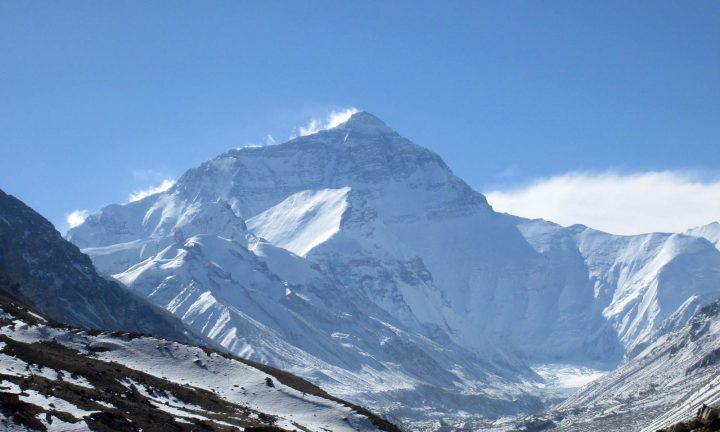
On their unsuccessful attempt to climb Mount Everest in 1923, a British expedition spotted a line of creatures moving along a cliff face. When they arrived at the location they found huge humanoid footprints in the snow. Twenty-six years later, Tenzing Norgay, who along with Sir Edmund Hillary, was the first to reach Everest’s summit, saw a Yeti playing in the snow.
The yeti has been described as a wildman, half-man half-beast, covered with reddish brown hair but with a hairless face. The descriptions are similar to North America’s “Big Foot.” Many theories have been advanced as to the identify of this “abominable snowman.” Some scientists believe that the yeti is a form of ancient man, a “missing link.” It has been theorized that it is a form of Homo Giganticus, an unproven subspecies of humans. So far expeditions which have set out to capture or photograph the yeti have returned without positive proof of the creature’s existence.
Reinhold Messner is a writer, film maker, and a member of the European Parliament. He is also considered to be one of the world’s greatest mountaineers, having climbed all of the world’s 8,000 meter peaks, and being the first man to climb Everest without oxygen and to climb it solo. In 1986, while leading an expedition in Nepal, he encountered a yeti.
“I thought it was a fairy tale (until) I saw a yeti for myself. I could only see a shadow because it was very late. When I approached the place where the yeti (had) stood, I found a footprint of a two-leg-going animal.”
This led Messner on a twelve year quest for the yeti. His conclusion, “The yeti is the sum of many tellings of a legend. The local people have a lot of fantasy creatures because they live without television and without Hollywood, so they have to create their own myths. Most of these figures, like the yeti, are built on real, existing beings out of nature. The local people tell each other the story. And from time to time somebody brings along a new part because they’ve been in touch, in the night, with one of these creatures. So the yeti is the sum of this fantasy figure and the zoological reality behind it—a Tibetan bear!”
The Tibetan bear, a rare species related to the grizzly, while traveling through snow, puts his back foot in the footprint of his forefoot, giving the appearance of a two-legged animal.
“The legends all describe the yeti as two and a half meters [eight feet] high. If it’s big, they say it is black. If it’s very small, they say it’s reddish, because the small Tibetan bears are reddish. Everything matches perfectly. It goes on two legs when it meets people, to show that he is big and strong.”
Messner came across the footprints of a yak, followed by the footprints of a yeti. He followed them to the carcass of the yak, killed by a single blow. It had been stored underground in the same manner a bear stores his kill.
He journeyed to a remote village in Pakistan, where legends tell of a woman who was kidnapped by a yeti and lived with it for two years. Traveling with a local guide, Messner came across a sleeping “yeti” and got to within 20 yards of it. It turned out to be a Tibetan bear, and very angry at being awakened. Messner jumped and yelled and the bear ran away.
Adolph Hitler sent an SS man, Professor Ernst Schaefer, to search for the yeti in the hope that it would turn out to be the progenitor of the Aryan race. Schaefer reached the conclusion that the yeti was the Tibetan bear, but kept this theory to himself, “If I had said this to the Nazis, they would have killed me.”
And what about our own Big Foot or Sasquatch? Messner believes it is probably a grizzly bear.