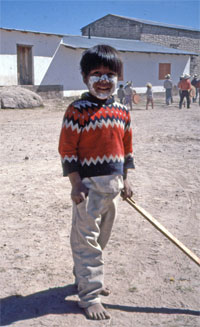
Easter is fast approaching and one of the most colorful and interesting places to celebrate is in Mexico’s Copper Canyon. The sleepy small towns are full of tourists—both Mexican and foreign—who have come to see the Easter celebrations of the Tarahumara Indians. The Tarahumara are outwardly Catholic, but their version of Catholicism is unlike any form we are familiar with.
Of all the religious ceremonies throughout the year, The Easter celebrations are the most important. Hundreds of men, women, and children converge on the local church from villages as far away as fifteen miles. These celebrations are for socializing and having a good time, but the Indians also expect their efforts to please God so that He will give them long lives, abundant crops, and healthy children.
To read the whole story behind these celebrations and traditions, Click here.
The celebrations begin on the Saturday prior to Palm Sunday, with speeches and ritualized dances. The Pharisees, their bodies smeared with white earth, and the Soldados dance to the beating of drums and the melody of reed whistles. About midnight, a mass is held in the church. Shortly after sunrise, bowls of beef stew, stacks of tortillas and tamales and bundles of ground, parched maize, are lifted to the cardinal directions, allowing the aroma to waft heavenward to be consumed by God. The food is then distributed among the people. At mid-morning the Soldados and Pharisees set up wooden crosses marking the stations of the cross, a mass is held, and the priest leads a procession around the churchyard, with the participants carrying palm branches.
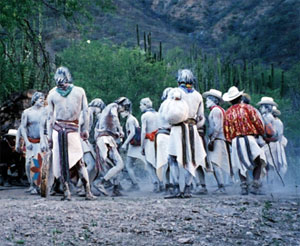
Three days later, on Holy Wednesday, the ceremonies resume, and for the next three days there are processions around the church, to protect the church and, by extension, God and God’s wife.
On the afternoon of Good Friday, the Pharisees appear with three figures made of wood and long grasses representing Judas, Judas’s wife, and their dog. Judas and his wife wear Mexican-style clothing and display their oversized genitalia prominently. The Pharisees and Soldados parade the figures around the church, dancing before them. The Pharisees then hide the figures away for the night.
On Saturday morning, the Soldados and Pharisees engage in wrestling matches, battling symbolically for control of Judas. The Soldados then take possession, shoot arrows into the three figures and set them afire. The people retire to continue the celebrations at the many tesguino drinking parties.

 Its summer vacation time! As many of us travel this summer, we see longer lines, airline cut backs and fees, not to mention unpredictable weather. Here are a few simple tips to make your trip a wonderful adventure to remember.
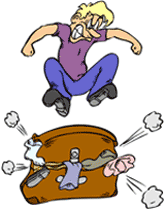 Pack light. This can’t be emphasized enough. If you plan carefully, you’ll have everything you need and you can carry it on the plane, avoiding luggage fees. Pack layers instead of bulky items for cold weather. Pick a color scheme and pack mix- and-match items you can wear in many combinations. Have a master packing list on your computer. Before each trip, print it out, modifying it for the length of the trip and the weather.
 Time your airport arrival to give yourself enough time to get through security, but don’t arrive so early that you spend hours sitting around. Check to see which carriers fly from the same terminal. A lot of short-haul airlines usually mean a longer security line. Check your airline’s website for flight status updates which send text or voice messages to your cell phone advising you of your gate number, and changes, delays, etc. Since most U.S. domestic flights no longer provide meals, we like to get to the airport for a morning flight in time to get through security, then sit down and have a nice breakfast.