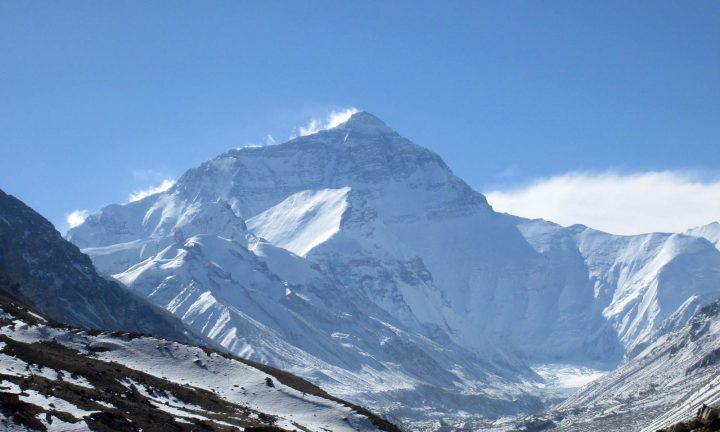
Long ago, about a hundred million years, a huge plateau arose in an area that is now part of northern Mexico. Seventy million years passed before volcanoes erupted and flooded the plateau with molten rock. Rivers then sliced this lava-covered plateau into deep twisting canyons—the largest area of canyons in North America.
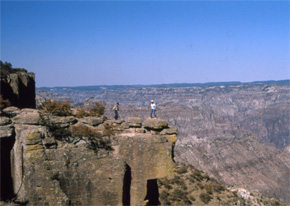
At the interface between the volcanic layers and the old plateau are rich mineral deposits. The depth of the canyons exposes this interface, making the gold, silver, and copper accessible for mining. It is from the abundant copper ore, previously mined here, that the area derives its name—Copper Canyon.
The first people to mine the ore were the Spaniards, in 1632. Over the centuries, hundreds of mines were worked, peaking at the end of the 19th century when 20 million ounces of silver were extracted from the mines at Batopilas, making Copper Canyon one of the richest silver mining areas in the world.
The longest term residents of the canyon are the Tarahumara Indians. No one knows how long they have lived here, but archaeologists have found artifacts of people living in the area around 3000 years ago.
Francisco Vasquez de Coronado’s expedition, which passed through the Sierra Madres in 1540, in search of the legendary Seven Golden Cities of Cibola, may have been the first contact between the Tarahumara and Europeans.
Then, in 1607, the Jesuits established the first of their 29 missions to be built in the canyons and introduced the Tarahumara to Catholicism, domestic animals and the plow. When the Spaniards discovered the rich mineral wealth in the canyons, they forced the Indians to work as slaves in the mines. This led to many bloody revolts throughout the 17th century.
The influence of the Jesuits came to a halt in 1767 when the King of Spain expelled their order from the New World. The Franciscans took over from the Jesuits, but the Indians were pretty much left alone until the Jesuits returned in 1900.
Today the Tarahumara number around 50,000. They live in caves and small cabins and practice subsistence farming. The majority practice a form of Catholicism liberally intermixed with their traditional beliefs and ceremonies. Among the peoples of North America, they are considered to be the least touched by modern civilization and the most unmixed of any of the Indian tribes of Mexico.
I first became aware of Copper Canyon about twenty-five years ago when a travel writer friend of mine returned from a journey to Northern Mexico.
“Lee, you have to go to Copper Canyon,” he insisted. “It’s magnificent!!” After seeing his slides I became excited and put together our first Copper Canyon trip. Since then, we have introduced thousands of people to this beautiful area of mountains, rivers and canyons, and the unique people who make it their home.
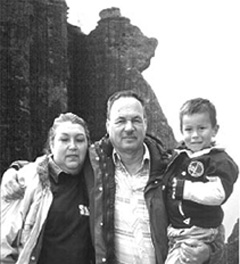 Born in a rural Ohio farming community, Doug has followed many diverse paths. He was an army sergeant, a NASA electrical technician, an editor, a deputy sheriff, a bodyguard, and now an inn keeper. His greatest passion is horses—he owns at least a dozen, and he brags that they are the best trained and equipped in Northern Mexico.
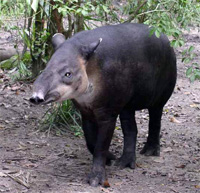 Tapirs are rather strange, primitive creatures. They are big animals—measuring about six to eight feet between their short little trunk and their stubby little tail, and weighing up to 700 pounds. Unlike elephants, who pick up food with their trunks, the tapirs move their trunks aside and browse like horses. Tapirs are the only animals native to the Americas which have four toes on their front feet and three toes on their hind feet.
 Located on forty square miles on the east bank of the Ayeyarwady River, 300 miles north of Yangon (Rangoon),
  The Kingdom of Bhutan has set aside an area specifically for the yeti, the Sakten Wildlife Sanctuary—a sanctuary for a creature that local lore claims is invisible! While in Bhutan, I was told that not only is the yeti invisible, but his feet point backwards to avoid being tracked.
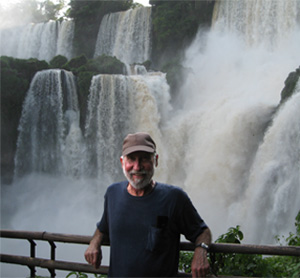 At California Native, we are always exploring new and exciting destinations to develop unique itineraries to offer our fellow travel enthusiasts.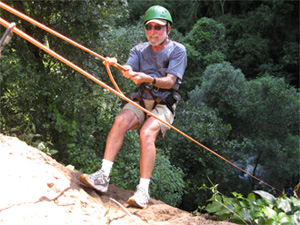
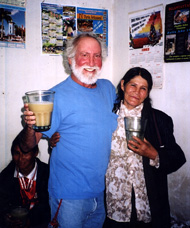 The strange-tasting drink, yellowish in color with a bubbly froth, is served warm for just a few coins, and is quite strong. It is not usually found in restaurants (a similar drink, chicha morada, made from blue corn, is sweet and sold everywhere like a soft-drink), but is sold by individuals, usually in the lower socioeconomic bracket, who have passed down the traditional recipes since pre-Inca times.