We appreciate it when our guests share their stories, comments and photos with us and allow us to post them on our blog. Allan & Mildred Karlin, from Morgantown, WV, traveled with us on a 7-day Peru Explorer and wrote us this quick letter about their trip:
We really did not have any expectations, the way the trip worked out was far better than we imagined it would be. This was the first time we took a trip like this and didn’t make all of the arrangements ourselves. We had a very enjoyable, stressless, and educational jouney. We would definitely travel this way again.
We appreciate it when our guests share their stories, comments and photos with us and allow us to post them on our blog. Barbara & Ashley Blankenship, from Los Angeles, California, traveled with us on our 5-Day Peru Explorer with Add-ons and had this to report:
It was the trip of a lifetime – actually 3 trips in one, since the experiences were so different in the Inca region, the rainforest, and the coastal desert.
We loved it all but these were unanticipated pleasures. We especially recommend the Larco Museum in Lima and the museum of Pre-Columbian Art in Cusco for their elegant coverage of pre-Inca materials. We hadn’t expected the Islas Ballestas to be so magnificent. We are glad we dropped by there on our way back from Nasca.
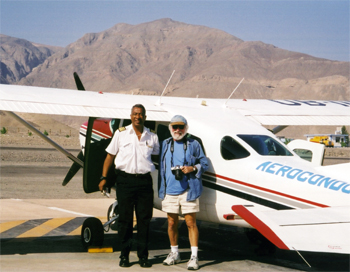
In the arid desert of Peru, California Native founder, Lee Klein, and Peruvian pilot return from another flight over the ancient Nazca lines. The giant figures and geometric patterns were unknown in the modern world until they were spotted by aircraft in the 1930's.
As our Cessna again circled over the giant figures on the ground I shot the final slide on my roll of film and, leaning at a 45 degree angle, attempted to reload my camera. Another pass over a monkey larger than a football field and we headed back to the dirt landing strip on Peru’s Nazca Desert. This was my first trip to Nazca, and the year was 1979.
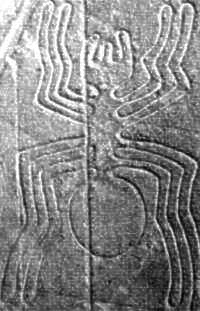
The Nazca Desert is a high arid plateau which stretches 37 miles between the towns of Nazca and Palpa in southern Peru. Hundreds of square miles of this dry, rocky plain are marked with lines, triangles and other geometric shapes, some running for more than five miles in a straight line. There are also giant drawings including a monkey, a spider, birds, reptiles, and whales.
A giant spider the size of half a football field sprawls on the Nazca Plain.
The desert markings, believed to have been made thousands of years ago, made little impression on occasional travelers who viewed them from ground level, but when they were spotted by aircraft in the 1930’s they caught the world’s attention. They have since been surveyed, mapped and studied. Only two questions remain—who made them, and why?
In his 1968 book, “Chariots of the Gods,” Swiss writer Eric von Daniken suggested that the lines were built by “ancient astronauts” as a landing field. Looking at the lines from the sky they do resemble an airport, but it doesn’t seem reasonable that advanced extraterrestrial spacecraft would require landing strips. Besides, Nazca’s soft, sandy soil is hardly suitable for an airport. Forgetting the “Twilight Zone” theories, we can imagine a more down to earth explanation. We know that the region has been inhabited for thousands of years—by the Paracas, 900–200 BC, by the Nazcas, 200 BC–600 AD, and by others. The figures are generally attributed to the Nazcas since they resemble those on Nazca pottery.
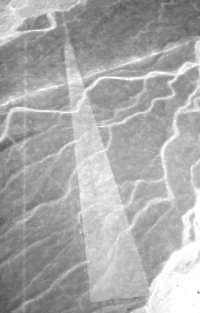
From the sky, this wedged shape figure at Nazca resembles a landing strip.
But why create figures which can be seen only from the sky? A reasonable explanation is that they were not intended to be viewed by humans but by gods. A local school teacher in the area explained his theory to me. The lines all point toward the Andes—the source of the water which flows into the area through underground aquifers. The figures, he believed, represent the bounty made possible by this water. The Indians probably conducted rituals on these giant drawings to thank the gods and ensure that the water would continue to flow.
They created the lines that extend for miles by placing two stakes in a row, sighting along them to place a third stake, then repeating the process. By moving the desert’s stones and scraping its surface coating, in the absence of rain, the lines have survived the centuries. Hopefully, they will survive many more centuries for future generations to marvel at.
Not far from the lines is the ancient Nazca cemetery at Chauchilla. The Nazcas buried their dead, along with many of their possessions, in underground vaults lined with mud bricks. The bodies were dressed in embroidered cotton clothes, placed in a fetal position, and coated with resin. The hot, dry climate mummified the bodies. Over the centuries the tombs were looted by huaqueros, grave robbers, who located the chambers by sticking poles into the ground.
On my first visit to the site, the scene was of a desolate desert, pockmarked with holes, and littered with human skulls and bones, broken pottery, with colored designs still vivid on their surfaces, and strands of mummy-cloth blowing in the wind. No other person was there except for the Peruvian school teacher, who was my guide, and two German tourists. While the Peruvian and I talked, the Germans were busy stuffing skulls into their backpacks for souvenirs.
Now, more than thirty years later, things are different at the ancient cemetery. The desecrated graves are roped off and trails lead to observation kiosks where mummies and artifacts are displayed. The two German tourists would no longer be able to take a long-deceased Nazcan home with them.
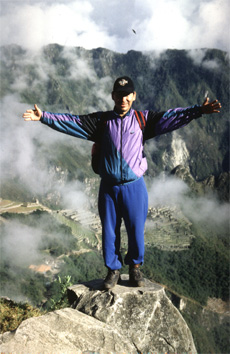
A Peruvian guide stands on a rock overlooking Machu Picchu at the end of the Inca Trail.
We appreciate it when our guests share their stories with us and allow us to post them on our blog. Tom Thiss, from Excelsior, Minnesota, had this to say about his Adventure in Peru and Hiking the Inca Trail:
Machu Picchu cannot be adequately described. One has to experience it, and trekking the trail heightens the anticipation like a good story. The Sun Gate sunrise experience was shrouded in clouds yet for me, it did not matter. What mattered to me at that moment was the euphoria of restored health and energy and the sense of real accomplishment. Machu Picchu’s capacity to evoke the power of imagination not only offsets the “Inca Travail” it supercedes it. This to me is the true testimony of its potency.
Tom Thiss
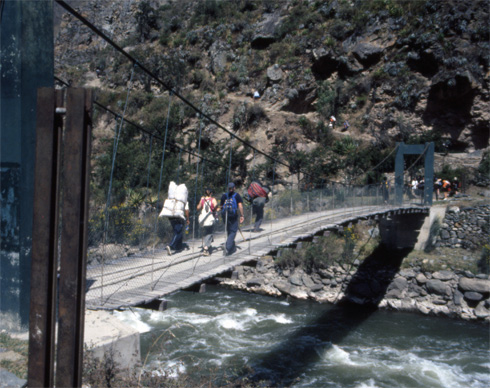
This footbridge over the Urubamba River is the start of the four-day trek on the Inca Trail to Machu Picchu.
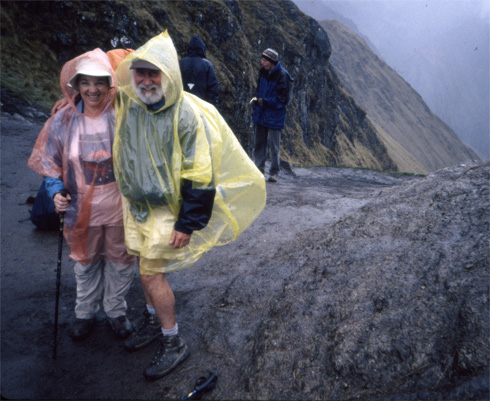
A little rain feels good at “Dead Woman’s Pass,” at 13,860 feet, the highest point on the Inca Trail to Machu Picchu.
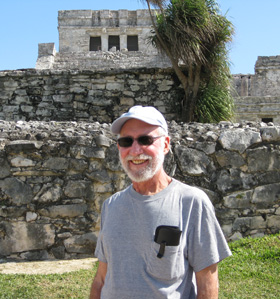
California native founder, Lee Klein, at a Mayan ruin in Mexico's Yucatan. What a way to make a living.
This June we are celebrating our 30th Anniversary—30 years of leading fantastic trips to exotic destinations around the world.
This anniversary comes as a proud moment for our company’s founder, Lee Klein, who continues to scout new locations world-wide in search of new destinations for the active traveler. Klein, who holds an MBA in Management and a BS in International Marketing, spent more than two decades as a corporate manager and college professor until, in 1983, while climbing Ayer’s Rock in the Australian Outback, he decided to drop out of the corporate world, take off his suit and tie, and create an adventure travel company based on the lessons he taught his students on how to succeed in business: “keep the quality high, keep it affordable, and treat people the way you would like to be treated.”
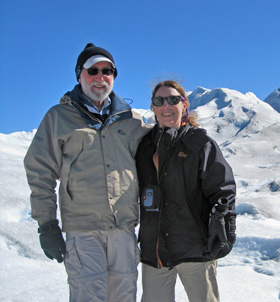
Lee and Ellen Klein hiking on Patagonia's Perito Moreno Glacier.
The initial offering from The California Native was a tour billed as “The Other Los Angeles.” This day-long excursion traced the route of the San Andreas Fault from the Mojave Desert to the San Gabriel Mountains without ever leaving Los Angeles County. The tours became so popular that colleges in three California counties offered them as part of their community-education programs. From this, the company expanded its offerings to include tours to the Channel Islands, Death Valley, Yosemite, and other uniquely California destinations, as well as white-water rafting, ballooning, spelunking (caving), sailplane gliding, and other outdoor adventures. “My family has lived in Los Angeles for generations,” writes Klein in the company newsletter, “hence the name The California Native.”
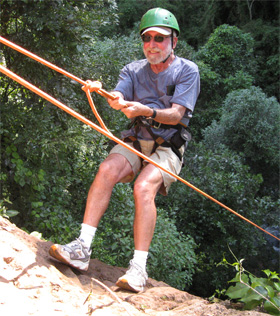
Lee rappelling in Argentina. Hey, this is research.
Satisfying the growing client base led to the development of The California Native’s most popular destination—Mexico’s Copper Canyon. These escorted and independent tours feature the Chihuahua al Pacifico Railroad (labeled as one of the most spectacular train rides in the western hemisphere) and highlight one of the most primitive indigenous cultures still subsisting in North America—the Tarahumara Indians. The California Native has become a leading source of information on this remote area and the company and it’s guides are known throughout the area for their work with the Tarahumara.
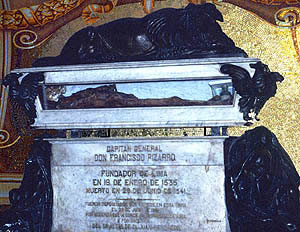
At the cathedral in Lima, Peru, this mummy was mistakenly displayed for almost a century as the remains of Francisco Pizarro.
I first visited the Cathedral in Lima, Peru, in 1979, and saw the mummy of Francisco Pizarro. The mummy had been placed there back in 1891, when Peruvian officials, wanting to prominently display the “Founder of Lima,” had the body moved from the chapel in which it had lain for the previous 350 years.
But was this really Pizarro? Just prior to my visit, workers cleaning a crypt beneath the altar found two wooden boxes, one containing the bones of five people—one missing a head! The other box held a lead casket on which was inscribed in Spanish, “Here is the skull of the Marquis Don Francisco Pizarro, who discovered and won Peru and placed it under the crown of Castile.”
Francisco Pizarro died a violent death. On June 16,1541, while he was having dinner in his governor’s palace, a group of men, led by the son of his ex-partner, Diego de Almagro, broke in and stabbed him to death. As he lay dying from multiple sword wounds, he drew a cross on the ground in his own blood, kissing it, and crying “Jesus.” In 1892, his mummy was exhumed and displayed for almost a century in the Lima, Peru Cathedral, but was discovered to be an imposter when the underground crypt was discovered.
Pizarro had lived a cruel but exciting life. Born in poverty and illiterate all of his life, he sailed with several expeditions to the Americas, including Balboa’s journey to the Pacific. After settling in Panama, he formed a partnership with Almagro, a soldier, and Hernando de Luque, a priest, to explore the territory south of Panama, they discovered the Inca Empire. Pizarro then sailed to Spain to enlist the support of Emperor Charles V, from whom he received the charter to conquer and rule Peru. The
After the bloody conquest of the Incas, where 2000 Indians were slaughtered and Emperor Atahuallpa strangled, Pizarro alienated his partner, Almagro. This eventually led to armed conflict between the former partners, and Pizarro’s brother, Hernando, having Almagro garroted.
The skull in the lead box matched the headless skeleton and, when reunited, turned out to be a man approximately the right age and height for Pizarro at the time of his death. Additionally, the skeleton showed that the man had been murdered by multiple sword thrusts, unlike the mummy which, upon reexamination, showed no wounds, leading Peruvian and American scientists to conclude that the skeleton was indeed that of Pizarro. It is now believed that the mummy who had sat in for Pizarro for so many years, was a church official. He is now retired, and the “real” Pizarro’s bones have taken his place on display.
As we come to the end of another year, it’s time to reflect on what we have accomplished in the last year and what we are looking forward to in the new year.
Last year was quite an eventful year for The California Native. We made another exploration trip to Patagonia, sailing around Cape Horn on a wonderful expedition cruise, hiking on glaciers with crampons, and whitewater rafting through Argentina’s beautiful countryside. We also made several trips to Mexico, one at the invitation of President Calderon to attend a luncheon with him and celebrate the initialization of a campaign to promote the wonders of Mexico’s colonial cities.
For the upcoming year we will be offering new trips in Patagonia and China, as well as additional departure dates for our Copper Canyon trips. And of course we’ll continue to offer our exciting tours of Costa Rica, Peru, Galapagos, Bhutan, Myanmar and Ireland, and our other off-the-beaten-track destinations.
The world is a fascinating collage of cultures, each with its own traditions, customs and history, which gives them a uniqueness and sets them apart from all of the others. But the more we travel the more we find that so many things are the same and we are more united by our similarities than divided by our differences. In our series, Images of the World, we group our similarities to enjoy them and appreciate their cultural differences.
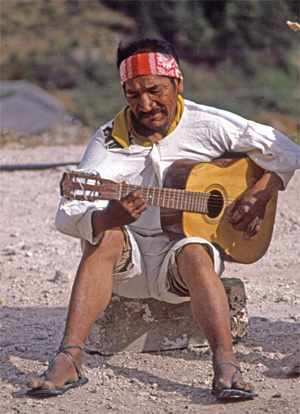
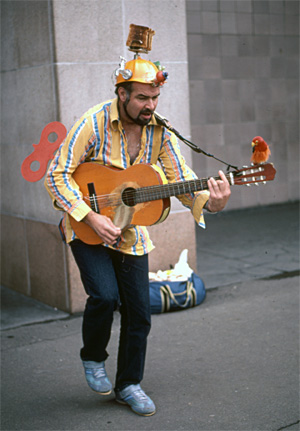
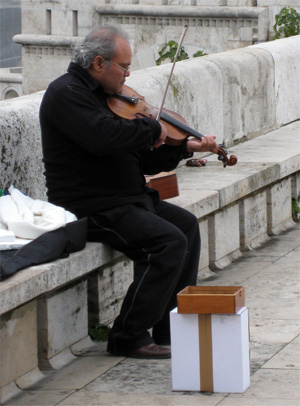
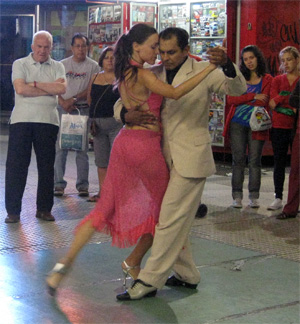
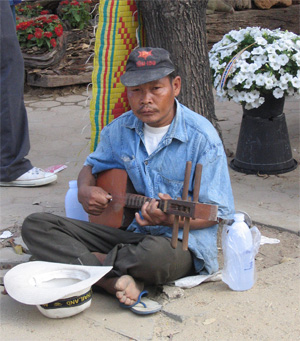
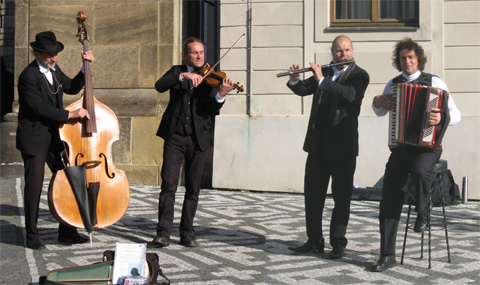
The Street Musicians: No matter where you are in the world, everyone enjoys music, and entertainment provided by street musicians is universal.
In Iquitos, Peru, a musician plays huayno music, the traditional music of the Andes, on his mandolin.
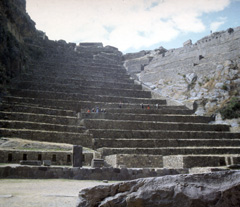
The huge stone ruins of Ollantaytambo in Peru's Sacred Valley stand as silent witnesses to the bloody battles which took place here five centuries ago between the Incas and the invading Spaniards.
Standing guard over the Urubamba Valley, the Sacred Valley of the Incas, Ollantaytambo’s great terraces and massive stoneworks served as a ceremonial center and fortress, protecting the heart of the Incan empire from its enemies. Its massive structures were crafted by moving giant stones for miles using sheer manpower and ingenious engineering devices. The builders even re-channeled a river to allow the giant stones to be maneuvered across. It was here at Ollantaytambo that the Incas staged their last victory over the Spanish.
In 1536, the Inca ruler Manco Inca led a rebellion against the Spanish invaders. To quell the rebellion, Francisco Pizarro dispatched his younger brother, Hernando, to Ollantaytambo to capture Manco. With a force of 70 cavalry, 30 foot soldiers, and a “large contingent of native auxiliaries,” the confident Spaniards planned a dawn attack to surprise the sleeping Indians, but it didn’t work. The Spaniards were overwhelmed by showers of arrows, spears and boulders, which rained down from the high terraces above the city. Then, by diverting the Patachanca River through previously dug channels, the Incas flooded the plains below the fortress, and the bewildered Spaniards found themselves mired in mud and water up to their horses’ bellies. They had no choice but to retreat.
Pizarro returned, this time with four times the force. The city fell but Manco escaped. Two years later Pizarro captured Manco’s sister and, when Manco refused to negotiate, had her stripped naked, flogged, and shot to death with arrows. He then had her body tied to a raft and floated down the Urubamba River. Pizarro was not a guy to mess with!
After landing at Cusco Peru‘s two-mile high airport, we are greeted by colorfully-dressed Incas who hand us cups of hot tea. “¡Bienvenidos a Cusco!” A delightful welcome to the former center of the Incan Empire. but the tea also serves an important purpose—the prevention of altitude sickness.
The tea we are offered at the airport, and again in our hotel lobby, is mate de coca—brewed from leaves of the coca plant. Coca is best known to North Americans as the source of the drug cocaine, which is actually a highly processed derivative of the coca leaf. Because of its association with the drug, coca is banned in the U.S.
In the Andes, where it is legal, coca is an age-old tonic and a remedy for many ailments. It enhances mood, without dependency or toxicity; is a natural energizer, similar to coffee; is rich in vitamins and minerals; relieves dizziness, headaches and stomach problems; and aids in weight loss and child-birth.
Coca leaves can be chewed, brewed, smoked, or made into candy and baked goods. Shamans in the Andes smoke it for “magical” purposes—to enter the spirit world and to prognosticate the future in the tea leaves.
In the Incan empire, coca was considered to be very special, sometimes magical, and its use was controlled. After the conquest, the Catholic Church tried to forbid it, because of its ties to the old religion, but they found that in the high altitude without the coca, the natives had trouble working the fields and mining the gold, so the church itself cultivated the plants and distributed the leaves to the workers.
The world’s most popular coca product is Coca Cola™. Made from the extract of coca leaves mixed with kola nuts, it was created in 1885, and sold as a tonic. Coca Cola™ did contain cocaine (commonly used in 19th century patent medicines) until 1929! When it became known that cocaine was potentially harmful, the company had a problem. If it removed the coca from its recipe, could it still call its product Coca Cola™? On the other hand, if it did not remove the cocaine, there could be a boycott of the drink. Their solution was to devise an extraction process in which the coca leaves were ground, mixed with sawdust, soaked in bicarbonate of soda, percolated with toluene, and steam blasted. The result was then mixed with powdered kola nuts and pasteurized—preserving the taste while eliminating the drug effects. Pepsi™, by the way, does not use coca leaves in its recipe!
Today there are opponents and supporters of coca, but for visitors to Peru and other Andean countries, the tasty coca tea is a harmless antidote to the ills of altitude.
 As we come to the end of another year, it’s time to reflect on what we have accomplished in the last year and what we are looking forward to in the new year.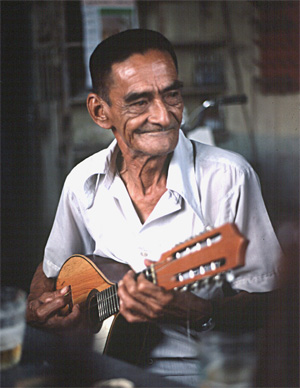
 The tea we are offered at the airport, and again in our hotel lobby, is mate de coca—brewed from leaves of the coca plant. Coca is best known to North Americans as the source of the drug cocaine, which is actually a highly processed derivative of the coca leaf. Because of its association with the drug, coca is banned in the U.S.