
A Tisket A Tasket a Copper Canyon Basket

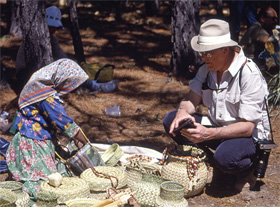
California Native guest purchases crafts in Mexico's Copper Canyon
A California Native guest purchases crafts from a Tarahumara weaver in Mexico

Visitors to the Copper Canyon area are always pleasantly surprised by the wide variety of craftsware and folk art available for purchase. The remote life and character of the Tarahumara Indians has fostered a tradition of crafts making as a part of their life-style.

While traveling through the region you will find very inexpensively priced baskets, belts, dolls, pottery and musical instruments.

The baskets are made out of the leaves of the agave as well as pine needles and range in size from tiny to large. Visitors purchasing baskets find that they can pack them one inside the other to conserve space during their trip. Once at home, the baskets of pine needles hold their scent of pine forests and become a wonderful reminder of the trip, and they are utilitarian as well as beautiful. The Tarahumara pottery is quite sturdy and is designed to be more functional then decorative.

Music is an important part of the Indians daily living and also plays an important roll in their ceremonies and festivals. Their musical instruments include violins, drums and wooden flutes. They learned the art of violin making from the Spaniards in the 18th century.

Carved wooden dolls dressed in typical Tarahumara fashion are for sale in a variety of sizes and portray the various activities of Tarahumara life—mothers wearing shawls while carrying babies on their backs, ladies weaving on hand-looms, and men carrying tools or musical instruments and wearing their traditional headgear.

Crafts can be purchased from the Indians who set up their merchandise on rocks along the trails and in all sorts of unlikely nooks and crannies. Crafts are also available in stores, and one that we recommend is the Mission Store in Creel, located right on the town square. Profits go to the hospital which serves the Tarahumara Indians.
Guarding the Sacred Valley of the Incas

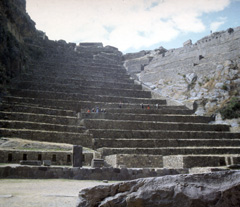
Ruins of Ollantaytambo in Peru's Sacred Valley
The huge stone ruins of Ollantaytambo in Peru's Sacred Valley stand as silent witnesses to the bloody battles which took place here five centuries ago between the Incas and the invading Spaniards.

Standing guard over the Urubamba Valley, the Sacred Valley of the Incas, Ollantaytambo’s great terraces and massive stoneworks served as a ceremonial center and fortress, protecting the heart of the Incan empire from its enemies. Its massive structures were crafted by moving giant stones for miles using sheer manpower and ingenious engineering devices. The builders even re-channeled a river to allow the giant stones to be maneuvered across. It was here at Ollantaytambo that the Incas staged their last victory over the Spanish.

In 1536, the Inca ruler Manco Inca led a rebellion against the Spanish invaders. To quell the rebellion, Francisco Pizarro dispatched his younger brother, Hernando, to Ollantaytambo to capture Manco. With a force of 70 cavalry, 30 foot soldiers, and a “large contingent of native auxiliaries,” the confident Spaniards planned a dawn attack to surprise the sleeping Indians, but it didn’t work. The Spaniards were overwhelmed by showers of arrows, spears and boulders, which rained down from the high terraces above the city. Then, by diverting the Patachanca River through previously dug channels, the Incas flooded the plains below the fortress, and the bewildered Spaniards found themselves mired in mud and water up to their horses’ bellies. They had no choice but to retreat.

Pizarro returned, this time with four times the force. The city fell but Manco escaped. Two years later Pizarro captured Manco’s sister and, when Manco refused to negotiate, had her stripped naked, flogged, and shot to death with arrows. He then had her body tied to a raft and floated down the Urubamba River. Pizarro was not a guy to mess with!

What in the World is a Tico?

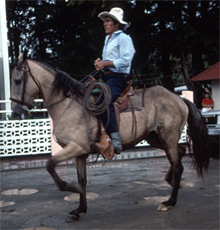
In Costa Rica, a 'Tico' rides his horse down the street.What in the world is a Tico? Sounds exotic. Maybe it’s something like a Piña Colada or a Cappuccino. Or maybe it’s one of those little biting pests that you find in tropical places. Wrong! A Tico is a very special group of people that inhabit one of the most beautiful, tropical and hidden paradises in the world—Costa Rica. “Tico” is simply the name commonly used to refer to the native inhabitants of Costa Rica.

But why “Tico“? In the Spanish world, the diminutive, formed by dropping the final “o” or “a” and adding an “ito” or “ita” depending on the gender, is commonly used out of friendliness and familiarity. It’s much more cariñoso (affectionate) to call your amigo (friend) an amigito (little friend).

About a century ago many Costa Ricans made the mistake of forming the diminutive by adding an “ico” to the end of words. So poquito (the Spanish diminutive of the word poco, little, few) would be poquiTICO when spoken by a Costa Rican. Because of their friendly and warm-hearted manner, the people of Costa Rica commonly used the diminutive in their everyday speech patterns and thus earned the nickname “Ticos” from outsiders.

Although the Costa Rican educational system has now taught most of the Ticos the correct grammatical usage of the diminutive forms in Spanish, the term “Tico” remains to commemorate this charming affection of the past.

Allllll….Aboard The Copper Canyon Train!!!

California Native founder, Lee Klein, aboard the Copper Canyon train.
California Native founder, Lee Klein, invites guests to join us for the spectacular ride on the Copper Canyon train.

A whistle blows, and a conductor shouts the Spanish equivalent of “All aboard.” The diesel engines rev up, people relax in their seats, and off they go on one of the most famous and spectacular rail trips in the Western Hemisphere—the Copper Canyon train trip.

Officially called the Chihuahua al Pacifico Railroad, the rail line runs 406 miles from Los Mochis, on the Gulf of California, to the inland City of Chihuahua. Enroute, the train passes through the incredibly scenic area of rugged mountains and deep canyons in Northern Mexico’s Sierra Madre Occidental.

The rail line was first conceived in 1872 as the Kansas City Topolobampo Railroad by an American entrepreneur named Albert Kinsey Owen. By building a railroad from Kansas City across Mexico to the Pacific Coast, he could shorten the distance of the existing route by half, saving over 400 miles. Agricultural products from the interior of the United States could be transported over this shorter route to Topolobampo Bay, a natural seaport, and then carried on by ship to the Orient and western South America.

Construction of the railroad began in 1885. The project faced numerous difficulties, including lack of funds, poor management, some of the most rugged country in North America, the Mexican Revolution, and the building of the Panama Canal.

The rail line was finally completed in November of 1961, almost 90 years from its conception. The trains never did make it all the way to Kansas, but by this time improvements in U.S. domestic transportation had eliminated the need. It did, however, open up one of the most remote areas of Mexico and is still the only method of reliable transportation through the western Sierra Madres.

In order to complete the route, 86 tunnels and 37 bridges were constructed, totaling almost eleven miles of tunnels and 2¼ miles of bridges. The train climbs 8000 feet, plunges into a series of canyons and clings to sheer rock walls. At one point along the route it makes a 360 degree loop. At another point it enters a tunnel, makes a 180 degree turn, and exits the tunnel with the canyon now on the opposite side of the train. The views made possible by this masterful engineering feat, considered to be one of the most outstanding achievements of railway engineering in the world, are truly spectacular.

Pack your bags and join us on this remarkable journey. Along with experiencing this spectacular train ride, you will meet the people who make this area of Northern Mexico their home, including the cave-dwelling Tarahumara Indians, who have managed to preserve their traditional life-style despite the encroachment of Spain, Mexico, and the coming of the railroad.