
Deep in the heart of Mexico’s Sierra Madres, in
the town of Creel, the center of Copper Canyon country, is the
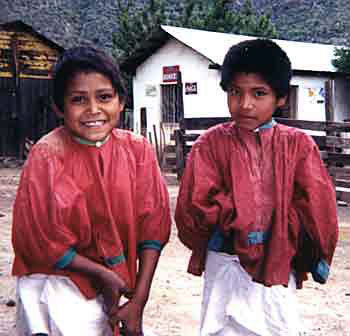
clinic of Santa Teresita. The lives of thousands of Tarahumara
Indian children have been saved here because of the dreams and
dedication of one man, Father Luis Verplancken.
Father Verplancken is a Jesuit priest who first visited the Tarahumaras
in the late 1950s. He saw a great need for health care for these
Indians who inhabit this remote area of mountains and canyons.
At the time their children had an alarmingly high mortality rate.
Verplancken put his ideas into action by starting a traveling
health care facility, housed in a 4-wheel drive station wagon.
He quickly discovered that a little help went a long way—one
dollar’s worth of penicillin, for example, could treat
hundreds of children.
The word spread and by 1964, Verplancken and his volunteers received
enough donations to establish a small hospital in an old railroad
warehouse. The demand for medical care was so great that some
Tarahumaras walked three days from their remote villages to reach
the hospital.
A major obstacle that both the town and the hospital faced was
the lack of a dependable water supply. With the help of more
donations, a pipeline was built from the nearest fresh water
source, which was four miles away over extremely harsh terrain.
Three handcrafted pumping stations had to be constructed to lift
the water 600 feet up to the level of the town. For the first
time, Creel and the hospital had a dependable supply of fresh
water.
In the mid-1970s, plans were drawn for a more modern hospital.
With the help of his nephew, who was studying architecture at
the time, Verplancken designed what today is known as the clinic
of Santa Teresita. This clinic was literally “hand-made.” Along
with a dedicated group of volunteers, Father Verplancken quarried
the stone, crafted the brick and cut the trees.
The clinic opened in 1979, and houses a seventy-bed hospital
with x-ray and laboratory facilities, a pharmacy, dental facilities
and an outpatient clinic.
After 52 years of service to the Tarahumara community, Father
Verplanken died of cancer, but the clinic lives on.
Today, the clinic still depends on volunteers and donors. Over
90% of the services and medications are provided free of cost,
and the remainder are provided to the local residents at a token
fee.
Many participants on California Native Copper Canyon trips have
visited the clinic and donated money, medicines and supplies.
One woman, after returning from a recent trip, sent four sets
of crutches that she purchased at a garage sale in the United
States.
Click Here for information
on our Copper Canyon Tours.