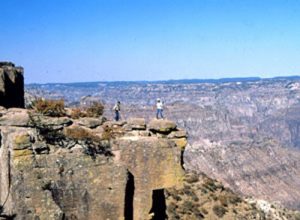
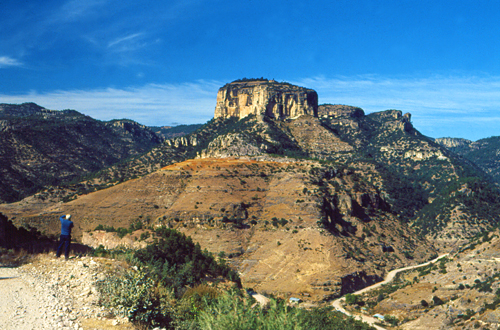
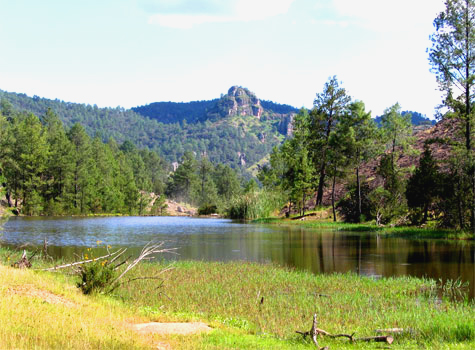
Mexico’s Copper Canyon is four times larger than the Grand Canyon.
We appreciate it when our guests share their stories, comments and photos with us and allow us to post them on our blog. Janie DeCelles, from Cardiff-by-the-Sea, CA, traveled with us on our Copper Canyon 5-day Independent Tripand reported this:
The trip was simply wonderful! The enormity of the canyon is really incredible to witness!
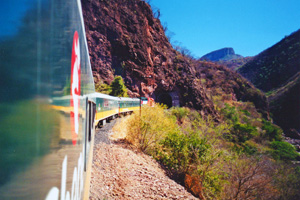
Some of my favorite parts of the trip were the train ride to/from El Fuerte to Creel, hanging out between the cars and enjoying the fantastic scenery.
All of the transfers you planned worked out absolutely perfectly! The hotels you chose —in El Fuerte and El Mirador were amazing!
I have already recommended CalNative to several friends and will continue to do so!,
We appreciate it when our guests share their stories, comments and photos with us and allow us to post them on our blog. Larry R Hanson, from Carrabassett Valley, ME, traveled with us on our Copper Canyon 6-day Independent Tripand wrote us this quick letter about their trip:
Greetings Laurie,
Sending you a thank you for putting together a wonderful trip to Mexico. It was surly a vacation of a lifetime. Wonderful people, beautiful country and all of your itinerary masterful.
Thank you again, Larry R Hanson Carrabassett Valley, ME
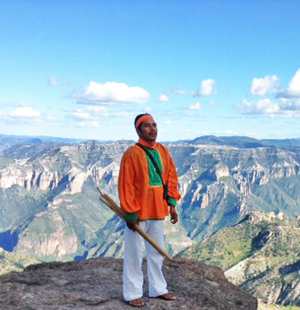
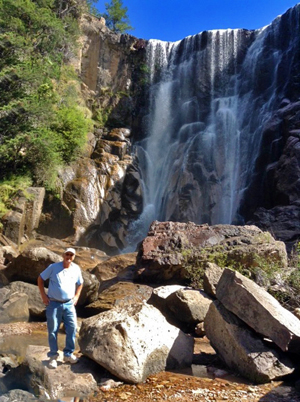
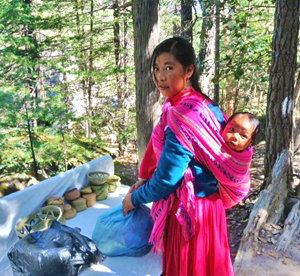
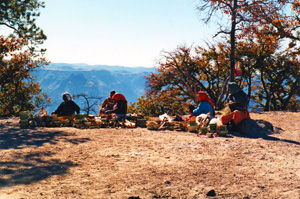
Tarahumara indian at one of the many beautiful Copper Canyon view points.Larry Hanson enjoying the view at Cusarare Falls in Copper Canyon.Tarahumara indian girl sells baskets in Copper Canyon
We appreciate it when we receive comments and photos to share. From our story “Her Uncle Rode With Pancho Villa” we received many interesting comments by family members of people associated with Pancho Villa:
Crickett Quijada
Hi Lee, thank you for writing this article on my great uncle Ricardo Gonzalez with Francisco Villa and his wife Maria Luz Corral de Villa. He had three brothers. Jose, Simon and Daniel who was killed in WW11. Also he had three sisters, my grandmother Prajedes, Epifania and Isabel, all children of Estefana (Fanny) Gagen and Pedro Gonzalez.
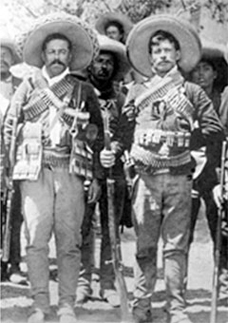
Pancho Villa with Ricardo Gonzalez, great uncle of Bessie “Crickett” Quijada.
Alberto Gonzalez
Crickett is my cousin. I remember my Grandfather always with the funny hat and cane, I was with my Dad and my Grandfather (Ricardo Gonzalez) when this visit occurred
Rebecca Hughes
This is so cool, Ricardo was my Great-Grandfather and Crickett and Alberto are my cousins.
Matt Holguin
Ricardo was my great grandfather too! Small world!
Jonathan Corral
My family and I have been building a family tree of our family, the Corral’s, and since we only know of the Corral side. Everyone has passed away in our blood line from the elderly side and can only hope to find out more about Maria through her family or if we could find out if Francisco Villas side of the family happen to know more about Maria Corral. We have all been told by our (now deceased) grandparents that our family is related to Francisco Villas wife Dona Maria de la Luz Corral de Villa. I’m told my grandfather Joseph Louis Corral (born 1927) had a father named Leopoldo Corral (a Police Officer in Mexico and was assassinated as well) and his wife Maria Ortiz Figueroa Corral (born 1888). We know Maria Luz had a father named Jose de Jesus Corral, but we haven’t pin pointed exactly if she had any brothers our cousins. We’re told Leopoldos aunt was Maria Luz Corral.
Javier Solis
Jonathan my mother Alejandra Corral’s grandmother was Benigna Corral which was Luz Corral Sister. She still has memories of her grandmother and my grandmother (my mother’s mom) knew Luz Corral around Durango and Buena Sevi. My great great grandfather talked a lot about Pancho Villa.
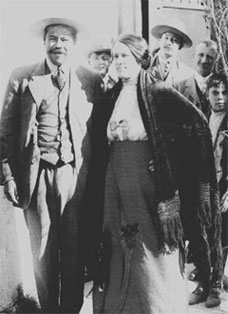
Pancho Villa and his wife, Luz Corral de Villa, in 1914.
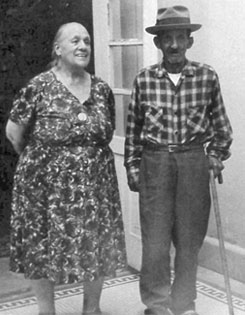
Dona Luz Corral de Villa with Ricardo Gonzalez in 1967.
The California Native has been leading tours to Copper Canyon for more than 30 years. Located in the Sierra Madre Mountains, Copper Canyon is four times larger than the Grand Canyon. This area is rich in history from Pancho Villa and the Mexican Revolution to the booming silver town of Batopilas.
We offer a full range of itineraries from small group escorted tours to worry-free adventures designed for the independent traveler.
We appreciate it when our guests share their stories, comments and photos with us and allow us to post them on our blog. Linda & John Gowdy, from Poestenkill, NY, traveled with us on our Copper Canyon 8-day to the Bottomand wrote us this quick letter about their trip:
Laurie-
I wanted to thank you for all your help and arrangements for our Copper Canyon trip! We got back Saturday night after a week of very relaxing travel. Everything was exactly as planned and we were very pleased with the accommodations and the trip. We had a very good time and the scenery was spectacular. Martín was an excellent driver on the “road” to Batopilas. He even put up with my bad Spanish!
Thanks again!
Linda Gowdy Poestenkill, NY
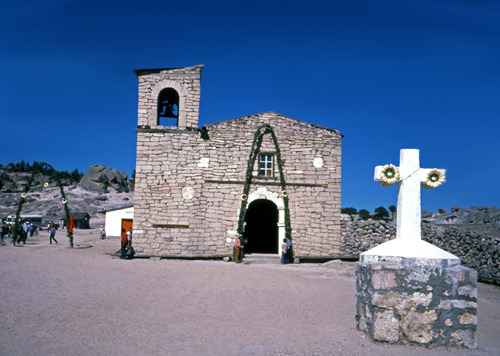
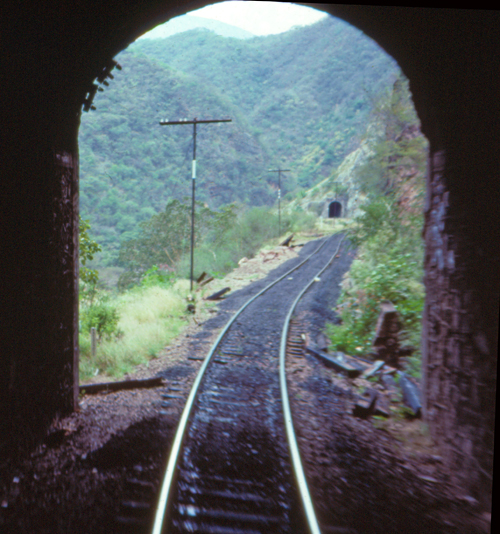
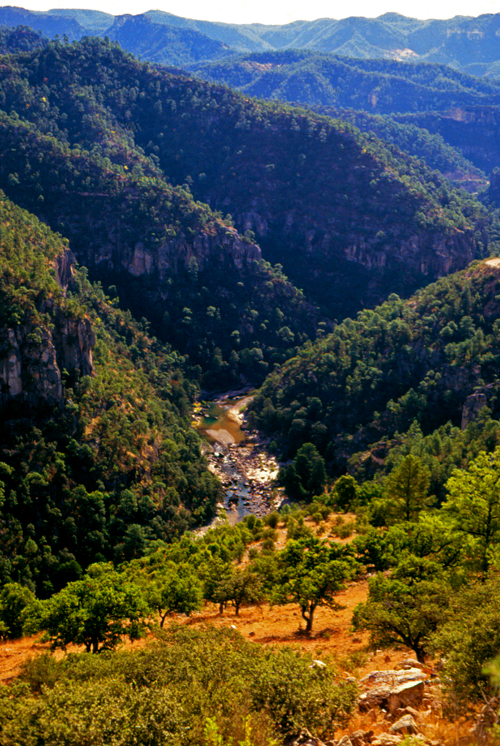
Tarahumara church in the Copper Canyon.El Chepe train exiting one of the 86 tunnels it will pass through as it travels through Copper Canyon.Spectacular Copper Canyon view!
We appreciate it when our guests share their stories with us and allow us to post them on our blog. Leslye Dentch, from Fishkill, NY, wrote us this short letter about her adventure with us in the Copper Canyon:
We just recently returned from your 7 day Copper Canyon tour and I just wanted to tell you how impressed we were with our guide, Rob. He was professional and well informed but it was his people skills – his knowing the nuances and subtleties of our group that made the difference.
We were a group of ten family members ranging in age and attitude from 13 to 80 and Rob not only managed to handle everyone’s needs – he anticipated them – even before we ourselves could. It was not an easy task given the diverse age and interests in our group and Rob did it with ease, style and grace. Watching him “wrangle” my 13 year old nephew, pacify my brother and his outspoken negativity and entertain my 80 year old mom was like watching an artist at work. It was truly impressive.
Sincerely, Leslye Dentch Fishkill, NY
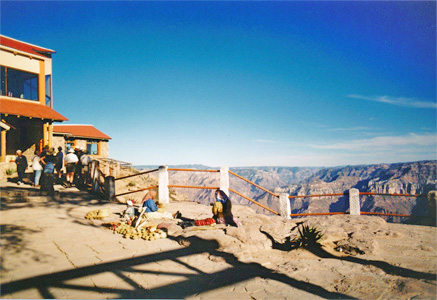
Tarahumara women selling baskets and small items at the Divisadero area
We appreciate it when our guests share their stories, comments and photos with us and allow us to post them on our blog. Dianne Raymond, from Fort Fraser, BC Canada, who recently traveled with us on one of our Copper Canyon Independent Trips and had this to report:
I really enjoyed it all. Some of the favorite parts of the trip were the visits to Urique, Batopilas and the train trip. The local guides and drivers were helpful and friendly, especially the guide at Divisadero. We had a lovely river tour in El Fuerte. Our driver in Batopilas took us to see the entrance of a mine, he definitely knew his way around.
I liked having our train tickets, accommodations and transportation organized for us. We then had the freedom to do what we wanted the rest of the time.
Everything was well organized and seamless, good organization up front. It was grand and we felt safe. I have many memories that I will cherish. Thank you.
Dianne Raymond
Fort Fraser, BC Canada
Quick stop for a photo on the way down to Batopilas.
We appreciate it when our guests share their stories, comments and photos with us and allow us to post them on our blog. Recently, Steve Donaldson, from Calgary, Alberta, Canada, traveled with us on our Copper Canyon 8-day Independent Tour and wrote us this letter:
Hi Dave. We finished our Copper Canyon Tour a few days ago and I thought I would provide some feedback on our trip. First, thanks for setting it all up. Everything worked out great and we had an incredible experience. I will certainly recommend The California Native to others. Attached is a day by day run-down.
El Chepe train starts it’s journey from El Fuerte into the Copper Canyon
Day One
Taxi from Los Mochis airport to El Fuerte: We went to the taxi dispatch booth as recommended and secured a taxi to El Fuerte as you suggested. Excellent hotel and the staff were very accommodating which we enjoyed very much.
Days Two and Three
Check-out and transfer to the train worked well and the conductor had our tickets for the rest of the train ride.
We were met at the train station in Bahuichivo by Hugo from Paraisio del Oso.
El Chepe train into the Copper Canyon
His English is perfect and he was very helpful and informative our entire stay at the lodge. Hugo suggested we hike up to Yogi Bear, it was great. Back down then into town where we had some wine at the Hotel Mission.
As I said, Hugo was great and very helpful and informative our whole stay. We had a great trip into Urique then a hike to the caves with his nephew and the next morning a horseback ride.
Day Four
All transfers worked out great and our room at the Best Western Lodge in Creel was excellent. A great example of rustic appearance with added amenities such as internet and even TV (even though we didn’t need TV it was a nice addition). We were also introduced to our guide by Salvadore from S&G Tours for the next day tour.
Across one of the many bridges
Day Five
Martin from S&G picked us up at 0930 and we were off on the tour. He was very accommodating to our needs and was helpful and we saw all the key sights – waterfall, lake, mission, Valley of the Monks, and caves.
Day 6
Check-out, train transfers and check-in to Mirador all worked out great. Hotel Mirador lives up to the pictures. I took two great hikes for a couple of hours, unguided, and loved it. Dinner was excellent.
Tarahumara indians at an overlook
Day 7
Great breakfast and lunch. Had time for a couple of great hikes – not a cloud in the sky. Check-out seamless as was the transfer to the train. The staff at Mirador were excellent and very professional.
Again, thanks for making it happen and especially for your flexibility in our tour modifications and the personal contact to arrange everything.
We appreciate it when our guests share their stories, comments and photos with us and allow us to post them on our blog. Recently, Sandy and Harry Scott, from Asheville, North Carolina, traveled with us on our Copper Canyon 11-day Independent Tour to the Bottom and had this to report:
Keep making your excellent itineraries, everything was so easy! We loved having reservations made. Not needing to get taxis was a welcome luxury to have. All our needs taken care of. Going the extra mile exceeded our expectations – example: having the driver take us to our Air BnB at the end of the trip. Laurie was particularly helpful. Participating in the Christmas Posado was very meaningful, I was very positively and emotionally impacted by the experience. We will call you again!
Sandy & Harry Scott
Asheville, NC
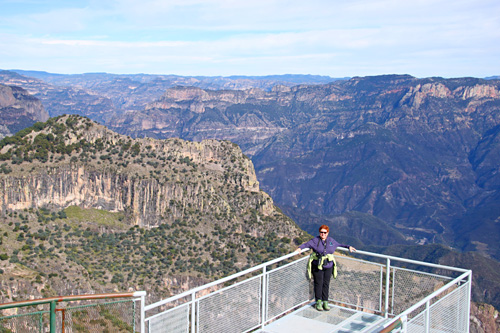
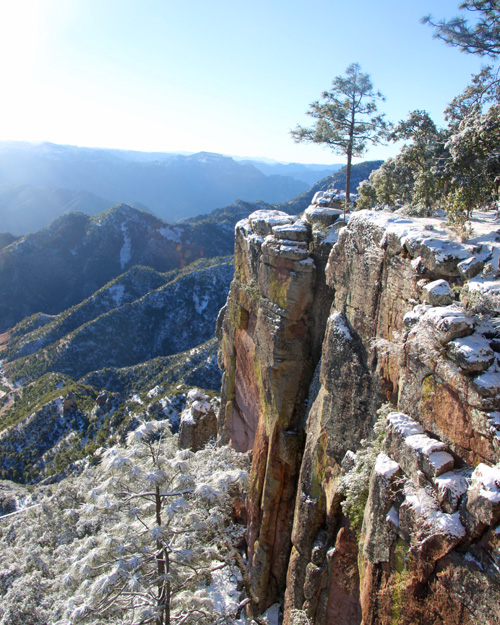
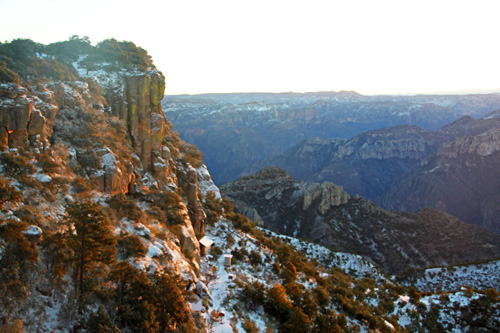
Sandy Scott enjoying the spectacular view of one of the many canyons in Copper Canyon. Photo by Harry ScottSnowy covered canyon in Copper Canyon. Photo by Harry ScottCopper Canyon has so many amazing canyon views! Photo by Harry Scott
We appreciate it when our guests share their stories with us and allow us to post them on our blog. Carol Schlafly, from Nashville, TN, wrote us about her recent escorted adventure in the Copper Canyon:
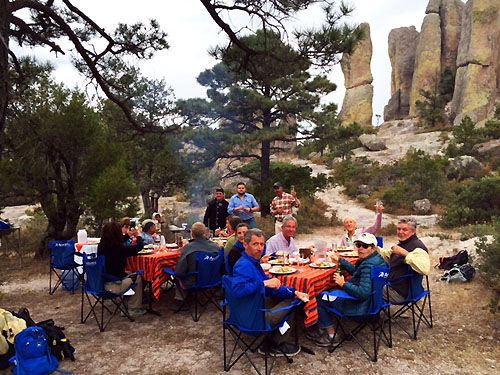
It was all just wonderful, food was great, all arrangements were just great, the hotels were great too! Rob [California Native guide] is wonderful — whatever we needed, he made it happen. Our al fresco lunch on the way to Batopilas was an unexpected and very sweet surprise.
I thought the prep work was great — wonderful info, all arrangements were very smooth, instructions were good. All the local guides and drivers were wonderful. A+ for all, lunch on the beach after petting the dolphins was great!
It was an adventure, we saw and did things I would not have ordinarily done, we saw some amazing terrain and some excitement along the way! Very exciting!
Rob Aikins is amazing. I could write a book on all the things he handled & how patient and understanding he was. His knowledge of the area and the contacts (he knows everyone) are fabulous. I would definetly recommend this tour to friends.
We appreciate it when our guests share their stories with us and allow us to post them on our blog. Charlie Stephens, from Olympia, WA, wrote us this short letter about his independent adventure with us in the Copper Canyon:
Thanks for organizing a wonderful trip for us in the Copper Canyon (we took the 5-day independent.) It was just the right “taste” of this spectacular and fascinating area. My 72 year old mom, who’s a little hobbled, had a great time, and didn’t have too much trouble getting around. Accommodations and food were great too. Thanks for a great trip!