Bhutan

You are currently browsing articles tagged Bhutan.

“AAARRGH! The yeti, “Abominable Snowman,” or mirgu, as it’s called in Bhutan, has been a legend throughout the Himalayas for centuries. They are even depicted in ancient Tibetan and Bhutanese manuscripts.
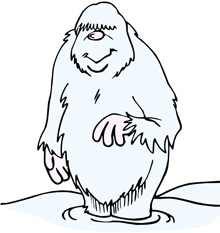
There is a sanctuary for the Yeti in BhutanThe Kingdom of Bhutan has set aside an area specifically for the yeti, the Sakten Wildlife Sanctuary—a sanctuary for a creature that local lore claims is invisible! While in Bhutan, I was told that not only is the yeti invisible, but his feet point backwards to avoid being tracked.

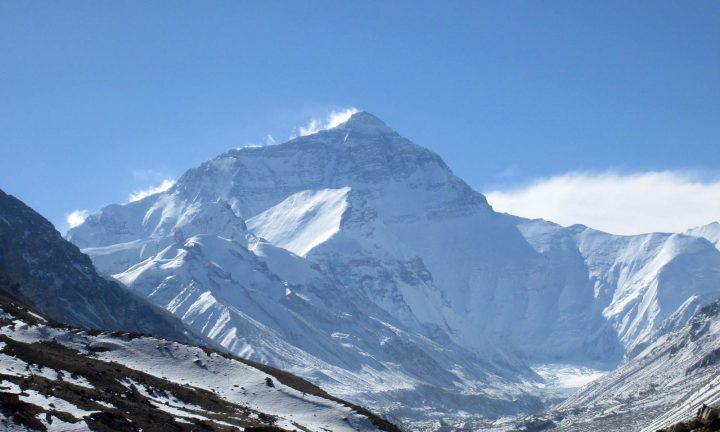
On their unsuccessful attempt to climb Mount Everest in 1923, a British expedition spotted a line of creatures moving along a cliff face. When they arrived at the location they found huge humanoid footprints in the snow. Twenty-six years later, Tenzing Norgay, who along with Sir Edmund Hillary, was the first to reach Everest’s summit, saw a Yeti playing in the snow.

The yeti has been described as a wildman, half-man half-beast, covered with reddish brown hair but with a hairless face. The descriptions are similar to North America’s “Big Foot.” Many theories have been advanced as to the identify of this “abominable snowman.” Some scientists believe that the yeti is a form of ancient man, a “missing link.” It has been theorized that it is a form of Homo Giganticus, an unproven subspecies of humans. So far expeditions which have set out to capture or photograph the yeti have returned without positive proof of the creature’s existence.

Reinhold Messner is a writer, film maker, and a member of the European Parliament. He is also considered to be one of the world’s greatest mountaineers, having climbed all of the world’s 8,000 meter peaks, and being the first man to climb Everest without oxygen and to climb it solo. In 1986, while leading an expedition in Nepal, he encountered a yeti.

“I thought it was a fairy tale (until) I saw a yeti for myself. I could only see a shadow because it was very late. When I approached the place where the yeti (had) stood, I found a footprint of a two-leg-going animal.”

This led Messner on a twelve year quest for the yeti. His conclusion, “The yeti is the sum of many tellings of a legend. The local people have a lot of fantasy creatures because they live without television and without Hollywood, so they have to create their own myths. Most of these figures, like the yeti, are built on real, existing beings out of nature. The local people tell each other the story. And from time to time somebody brings along a new part because they’ve been in touch, in the night, with one of these creatures. So the yeti is the sum of this fantasy figure and the zoological reality behind it—a Tibetan bear!”

Read the rest of this entry »

Bookmark and Share

As Bhutan celebrates it’s one year anniversary as a democracy, ABC will be airing a special, “Michael J. Fox: Adventures of an Incurable Optimist” on May 7.

On the show, Fox, who suffers from Parkinson’s disease, traveled around the world interviewing optimists. One of his favorite stops was Bhutan, dubbed the happiest place on earth by many visitors – because locals live in a state of permanent joy. In Bhutan, a country which measures its success with a figure for “Gross National Happiness” instead of Gross National Product, Fox revealed that his symptoms actually eased during his visit. When questioned about his impression of the people of Bhutan, the film and television star was quoted as saying, “They really are (the happiest people). It’s amazing. They’re just beautiful people. I don’t know whether it was the altitude or the thinning of the blood or whatever, but I had much less symptoms,” he added.

For many years The California Native has been offering private tours of this magical Himalayan kingdom.

Bookmark and Share

Traveling around the world, an important part of the experience is tasting the local cuisine. From Mexico to China, from Hungary to Bhutan, no trip is complete without sampling the regional specialties.

But on a long trip, after days or weeks of eating the local dishes, I always develop a craving for the universal comfort food—pizza. And so, I make it a part of each of my journeys to try the local pizza, the one food, besides a ham-and-cheese sandwich, that can be found almost everywhere.

In Mandalay, Myanmar (Burma), we found excellent pizza at the Rudyard Kipling Bar & Grill. In LeJiang, Yunnan Province, China, after many days of Chinese banquets for lunch and dinner, in spite of protests by our Chinese host, we headed for the nearest pizza parlor and enjoyed our pizza and beer feast.

Traveling through Thailand, we discovered excellent pizza was at the Slow Food Italian Restaurant in Chang Mei, where the proprietor, an Italian expat in a wheelchair, greeted each guest. All of his staff were also wheelchair bound or disabled.

On a dark and stormy night, in a remote corner of Mexico’s Sierra Madre Mountains, Doug Rhodes, the owner of the Paraiso del Oso Lodge, outside of the little village of Cerocahui, in Mexico’s Copper Canyon, proudly served us what he declared was the “best pizza in Northern Mexico.” Kerosene lanterns lighted the dining room and the pizza was covered in generous portions of olives, which my wife, Ellen, hates, and had great difficulty trying to remove in the dim light. I, however, tended to agree with Doug’s assessment.

Last year, while visiting Budapest, Hungary, we enjoyed the pizza at Al Capone’s, a chain of pizza parlors in Eastern and Western Europe, which is now owned by Australian pizza giant Domino’s Pizza.

Wherever in the world we go we are not that far from home when we can take a break from the ethnic food and enjoy a great pizza. My favorite toppings are ham, pineapple, mushrooms and olives. What are yours?

Bookmark and Share

This is the second in our series of Images of the World taken over the course of the last twenty-five years since the founding of The California Native.

In Mexico’s Copper Canyon, a Tarahumara girl carries her baby sister on her back. In Mexico's Copper Canyon, a Tarahumara girl carries her baby sister on her back.
In Chilean Patagonia youngsters demonstrate traditional dances. In Chilean Patagonia youngsters demonstate traditional dances.
In a remote Laotian village, near the Mekong River, villagers wear traditonal clothing. A young student in a remote Laotian village wears traditonal clothing.
Young monks eating their once-a-day meal in a monastery in Myanmar (Burma). Young monks eating at monastery in Myanmar (Burma)
Boys from a small Laotian village have fun swimming in a tributary of the Mekong River. Boys swimming in tributary of Mekong River.
A mother selling produce in a market stall keeps her baby safe in a cardboard box, in China’s Yunan Province. Lady with baby in a cardboard box in Yunan, China.

Read the rest of this entry »

Bookmark and Share

Over the more than 25 years that The California Native has been traveling the world, we have accumulated a large gallery of photos that we have taken around the globe. I thought it might be fun if we arranged a series of them by subject. So here is the first in our series of Images of the World.

I took this photo of a Tarahumara lady with a shy smile, weaving a basket in Mexico’s Copper Canyon. In Mexico's Copper Canyon, a Tarahumara lady weaves a basket.
A weaver in Thailand concentrates on her work in spite of the tourist (my wife) taking her photo. A village lady in Thailand, weaves cloth while a tourist takes a photo.
In a small village in the Mexican state of Chiapas, a pretty young girl laughs as she weaves. In Mexico's state of Chiapas, a smiling lady weaves hand-made cloth.
A man in the remote Himalayan Kingdom of Bhutan, prepares fiber for weaving. In the Himalayan kingdom of Bhutan, a man prepares fiber for weaving.

Read the rest of this entry »

Bookmark and Share

The Fall/Winter 2008 edition of The California Native newsletter is now in the mail. The newsletter, published by The California Native since 1984, has more than 10,000 readers (not counting those who download from the web). If you are not already a subscriber to this free newsletter you can signup now.

This issues feature stories include:

CALIFORNIA NATIVES FOLLOW THE TEA HORSE ROADA centuries-old monastery overlooks the town of Shangra-La, along the ancient Tea-Horse Road on The California Native China Tours
“My grandfather dipped his silver bracelet into the water, to make sure it was not poisoned,” related Chen Dong Mei, her eyes sparkling as she related stories of her grandfather who drove horses along the historical Tea Horse Road. The tea horse road, leading from Jing Hong, China, to Llhasa in Tibet, has been a major trade route for almost 5000 years.

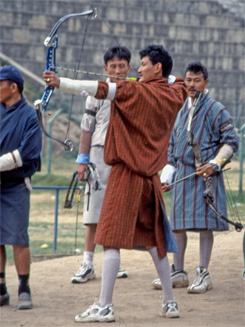
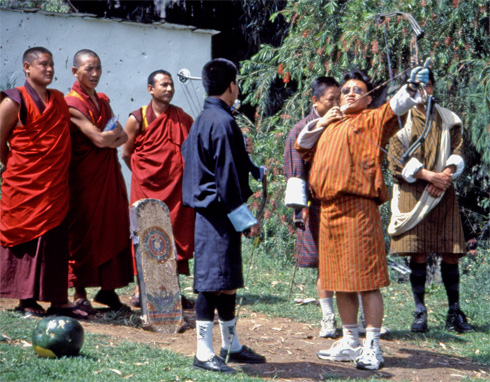
THE BOWMEN FROM BHUTANIn Bhutan, the national sport is archery and you can visit this Himalayan Kingdom on The California Native Bhutan Tours
Dancing about and shouting sexual insults at the opposing team, Bhutanese sports fans enjoy their favorite pastime, which is, of all things, archery!

COPPER CANYON TRIPS FEATURED IN NATIONAL GEOGRAPHIC PUBLICATION
A new book, published by National Geographic, features The California Native’s tours through Mexico’s Copper Canyon.

THE LADY OF GUADALUPE
Throughout Mexico, in churches, roadside shrines, restaurants,  and automobile decals, the Virgin of Guadalupe is a sacred icon for both Catholic faith and nationalism.

TELL THEM TO “GO TO XIBALBA”The artifact of a Mayan diety warns us of the Mayan 'Place of Fear' on The California Native Yucatan Tours
It is the darkest place in Mayan lore, the underworld, the Place of Fear. It is ruled by the spirits of disease and death. And archaeologists believe that it actually existed in a series of underground chambers and passages.

Read the rest of this entry »

Bookmark and Share

Launched in June 1983, our company is celebrating its 25th year leading wonderful trips to unique destinations. ThisCalifornia Native founder Lee Klein silver anniversary comes as a proud moment for our company’s founder, Lee Klein, who continues to scout new locations world-wide in search of new destinations for the active traveler. Klein, a graduate from Loyola Marymount University with a MBA in Management spent more than two decades as a corporate manager and college professor until, while climbing Ayer’s Rock in the Australian Outback, he decided to venture into the adventure travel business. As he did, he took to heart the lessons he taught his students on how to succeed in business: “keep it simple, and learn to do it right before adding new products and services.”

The initial offering from The California Native was a tour billed as “The Other Los Angeles.” This day-long excursion traced the route of the San Andreas Fault from the Mojave Desert to the San Gabriel Mountains without ever leaving Los Angeles County. The tour became so popular that colleges in three California counties offered them as part of their community-education programs. From this, the company expanded its offerings to include tours to the Channel Islands, Santa Barbara Wine Country, Death Valley, and other uniquely California destinations, as well as white-water rafting, ballooning, spelunking (caving), sailplane gliding, and other outdoor adventures. “My family has lived in Los Angeles for generations,” writes Klein in the company newsletter, “hence the name The California Native.”

Satisfying the growing client base led across the border to the development of The California Native’s most popular destination—escorted and independent tours of Mexico’s Copper Canyon. These tours feature the Chihuahua al Pacifico Railroad (labeled as one of the most spectacular train rides in the western hemisphere) and highlight one of the most primitive indigenous cultures still subsisting in North America—the Tarahumara Indians. The California Native has become a major source of information on this remote area of Mexico, and it’s guides are known throughout the area for their work with the Tarahumara.

Today, The California Native offers a wide selection of tours to Costa Rica, Mexico, Patagonia, Peru, the Galapagos Islands, Ireland, Bhutan, Myanmar, China, and Laos, and more destinations are in the planning stages.

Read the rest of this entry »

Bookmark and Share