Articles by The California Native International Adventures

You are currently browsing The California Native International Adventures’s articles.

Beach at Cancun, Mexico

The beaches at Cancun give the traveler a chance to unwind at the beginning of a trip exploring Mexico

When you travel with us on our Yucatan Explorer Trips, you now have the option of beginning and ending your vacation in either city, Cancun or Merida.

With the large number of airlines flying into Cancun daily, starting your Yucatan adventure in Cancun allows you to take advantage of the competitive airfares and direct flights from the U.S. and Canada.

Cancun is renowned for its beaches, restaurants and nightlife, with all the glitter of an upscale beach resort. Merida, on the other hand, is a cosmopolitan but at the same time tranquil and charming colonial city.

Pyramid of the Magician at the ruins of the Mayan city of Uxmal

Abandoned for more than ten centuries, the Pyramid of the Magician is the tallest structure at the Mayan ruins of Uxmal.

The Yucatan Peninsula is the homeland of the Mayan people, whose mighty empire lasted over a thousand years. Throughout the peninsula are the amazing archaeological ruins of their great cities. In addition, the Yucatan has lovely colonial cities and beautiful Caribbean beaches.

All of our Yucatan tours visit the Mayan ruins of Chichén Itzá, Uxmal, El Balam and Edzna, as well as the city of Campeche—its fort was built by the Spaniards as defense against the Caribbean pirates.

The tours which begin in Cancun also visit the ruins of the Mayan port city of Tulum, built alongside a beautiful Caribbean beach. and the archaeological site of Coba.

Read the rest of this entry »

Bookmark and Share

This year in Mexico is a year for celebration. It is the bicentennial of Mexico’s War of Independence as well as the centennial of the Mexican Revolution. Two hundred years ago the first of these events set our neighbor on the path to becoming the 14th largest independent nation on Earth, as well as the world’s largest Hispanic country. It was the inspiration and leadership of one man which led to Mexico’s throwing off the shackles of Spain after almost three centuries.

Father Miguel Hidalgo is considered to be the "Father of Mexico."

Father Miguel Hidalgo's speech, known as the Grito de Dolores, the “Cry of Dolores,” set off the Mexican War of Independence.

That man was a 57-year-old priest whose parish was in the city of Dolores, Guanajuato. The date was September 16, 1810. Early that morning Father Miguel Hidalgo y Costilla had the church bells rung to summon the townspeople to the church, where he told his followers that the time had come to expel the Spaniards who had misgoverned Mexico for so long. His speech, known as the Grito de Dolores, the “Cry of Dolores,” set off the Mexican War of Independence, which resulted in Mexico’s becoming an independent country.

Hidalgo was born in 1753 on the hacienda where his father was administrator. At twenty years of age he received his Bachelor of Theology degree and lectured in philosophy and theology at San Nicolás Obispo and, after being ordained as a priest, became rector of the school. His ideas and conduct were extremely liberal, which led to his being dismissed from that post, and twice being investigated by the Inquisition, who accused him of reading prohibited books, advocating doctrines of the French Revolution, doubting the virgin birth of Mary, gambling, and keeping a mistress. His last clerical position was that of parish priest in the little town of Dolores.

Hidalgo worked hard to improve the lives of his parishioners, mastering their Indian language and teaching them crafts and skills to improve their economic condition. He also introduced winemaking and silk culture, two industries which the government declared illegal in the colonies, and one day government officials came to the village and destroyed the vines and mulberry trees.

Late in the eighteenth century it became fashionable among cultured criollos, persons of Spanish descent who were born in Mexico, to form literary societies, which met for tea and cakes and discussed the classics. They also smuggled into the country books which were banned by the Church, such as the works of Rousseau, Voltaire, and Descartes. The literary societies gradually became political societies. Father Hidalgo belonged to one of these societies whose members were plotting a revolution to separate Mexico from Spain.

Read the rest of this entry »

Bookmark and Share

There is a local legend revolving around Chiapas, Mexico’s, Canyon del Sumidero. Legend states that the local tribes were fanatic about remaining out of bondage. So in order to escape slavery by the Spaniards, they committed mass suicide by diving into the canyon, believing that they would be free in the afterlife if they did so.

Sumidero Canyon, Chiapas, Mexico

In Mexico's Sumidoro Canyon, local Indians thew themselves over the cliffs rather than be enslaved by the Spaniards.

There is some historical fact associated with this legend. When the Spanish first came to Mexico, they conquered the Aztec empire, which was located to the north and west of Chiapas for the most part. Later, when Cortes sent tax collectors to Chiapas, they were met with fierce resistance. Eventually, in a fierce battle between indigenous forces and Spanish conqueror Diego de Mazariegos, many Indian warriors threw themselves into the Canyon del Sumidero, preferring death to slavery.

This canyon is located in extreme southeastern Mexico, in the central state of Chiapas. It was formed by a fault that still runs through the canyon, through which the Grijalva river still runs. The river and canyon are the primary feature of what is now known as Cañón del Sumidero National Park. The Mexican government named the site a National Park in 1980, in order to protect the area around it, as well as the flora and fauna. The canyon is one of Mexico’s most beautiful features, though it is not well known outside the country. It is the central tourist attraction for the state of Chiapas; important enough that it features on the state’s coat of arms.

Crocodile awaits prey in Mexico's Sumidero Canyon

A crocodile blends in with his surroundings as he waits for his unwary dinner in Mexico's Sumidero Canyon.

The park is formed by two features; the Canyon del Sumidero itself, and the plains that the canyon-forming Grijalva river runs through. A series of tremendous earthquakes thrust the plains in some places more than a kilometer above sea level millions of years ago. Some time after, the Grijalva river cut down through the basalt and granite, creating the canyon seen today.

A speed boat tour down the canyon and the Grijalva river leads to many beautiful sights. Lucky boaters might see some of the native American Crocodiles. One particular sight that any visitor would be lucky to see is what happens to the canyon during the rainy season. Nearby streams and trickles of water all lead down into the canyon and the sides of the canyon cascade with beautiful waterfalls.

California Natives enjoy boat trip through Mexico's Sumidero Canyon.

California Natives enjoy the tropical scenery and wildlife as they tour Mexico's Sumidero Canyon by speed boat.

Read the rest of this entry »

Bookmark and Share

We’re halfway through 2010 and it’s a good time to look forward to next year and the exciting places waiting to be visited. As an added bonus for your forward thinking, The California Native will help you save money on your 2011 vacation.

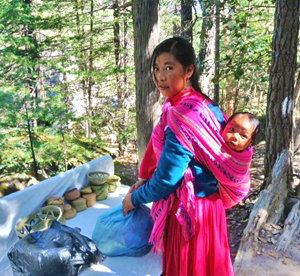
Tarahumara Weaver in Mexico's Copper CanyonIn Mexico’s Copper Canyon

a young Tarahumara lady weaves a basket from leaves of the agave.

Everybody loves a bargain! So, if you book your trip to Mexico’s Copper Canyon, Yucatan or Costa Rica within the next 30 days, you can lock in our 2010 prices for your 2011 trip.

To quote some famous thinkers on the subject of saving money:

“Money frees you from doing things you dislike. Since I dislike doing nearly everything, money is handy.” – Groucho Marx

“Money is better than poverty, if only for financial reasons.” – Woody Allen

“A nickel ain’t worth a dime anymore.” – Yogi Berra

Bookmark and Share

Criminals captured by police are often told metaphorically that they have reached the end of the line. In the case of repeat offenders in Argentina in the early 20th century, that statement was literal—they were sent to the prison at the end of the world.

The Prisoner's Train in Ushuia, Argentina

Ellen Klein stands alongside the Prisoner's Train, in Ushuia, Argentina, on a California Native Patagonia Adventure.

Ushuaia is known as the southernmost city in the world. Located at the southern tip of South America, it is an environment of extremes. The city was founded to establish Argentine sovereignty in the Tierra del Fuego region, and in 1896 a penal colony was set up for repeat offenders. To be sent here was seen as little better than a death sentence.

In order to transport the materials needed for the construction of the prison, a xilocar—a narrow-gauge train with shallow cars that ran on wooden tracks and was pulled by oxen—was constructed. However, it was limited in its ability to transport lumber from the forests, so in 1910 construction of a narrow-gauge railway began. The original steam locomotive that operated on the 15.5-mile line earned the nickname “La Coqueta” because of the little jumps and hops that it made as it chugged along the line.

Convicts exit Prisoner's Train

Between 1910 and 1947, Ushuia's 'Prisoner's Train' transported convicts to their daily labor.

The train was vital to the prison and the town itself. It transported prisoners to the surrounding forests to do the backbreaking work of logging. The lumber was then loaded onto the train for transportation back to Ushuaia. The prisoners’ efforts provided wood for cooking and heating during the harsh winters, as well as for construction. A large portion of the town, including buildings, streets and bridges, was built by the convicts, and it was not uncommon in the early days of the town to see teams of prisoners walking down the street.

After over fifty years of use the prison was shut down by Argentine President Juan Perón in 1947, and the train was decommissioned in 1952.

Read the rest of this entry »

Bookmark and Share

Located near the northeastern corner of Costa Rica, surrounded by rain forest on one side and Caribbean beach on the other, is Tortuguero National Park, whose name means “The Place of Turtles.”

Costa Rica's Tortuguero National Park is the easiest place in the world for viewing sea turtles.

Costa Rica's Tortuguero National Park is the easiest place in the world for viewing sea turtles.

Tortuguero’s 22-mile long beach is the main nesting area for Green Turtles in the Caribbean. It is also the easiest place in the world to view sea turtles.

Green Turtles mate and nest several times during a season. In mating, an amorous male holds onto a female with the sharp hook on his front flippers. If he can’t locate a female, he will improvise and substitute anything that floats, whether it be a piece of driftwood, another male turtle, or a skin diver.

An impregnated female will wait offshore until dark and then head for the beach and a nesting site. During her crawl up the beach, noise or lights will cause her to return to the safety of the sea. Once she has begun digging her nest, however, nothing will distract her. She uses her rear flippers to scoop out a hole about two-feet deep, deposits around one hundred leathery, golf-ball-sized eggs, covers the nest, tamps down the sand, and returns to the sea.

Many of the buried eggs are dug up by coatimundis, dogs, raccoons, and even humans. The remaining eggs hatch in a couple of months. The baby turtles use a temporary egg tooth to tear open their egg shell. It takes the combined power of about 100 cooperating turtles to excavate the two feet of sand which covers them.

The little turtles appear on the beach, usually before dawn, then scramble for the water. On the way many are eaten by hungry crabs and birds. If they do reach the water they stand a high chance of becoming dinner to an eagerly waiting fish. Of the hundreds of thousands who race for the sea, probably fewer than three percent survive. For the next half-century the turtles live nomadic lives, migrating over vast distances of ocean. After fifty years they reach sexual-maturity and return to the beach where they were born, to mate, nest and produce another generation.

In addition to the Green turtles, Tortuguero is also a nesting place for Leatherback, Hawksbill, Olive Ridley and Loggerhead turtles.

Read the rest of this entry »

Bookmark and Share

Lee Klein, California Native founder, stands beside a statue of Pancho Villa in the city of ZacatecasPancho Villa, so the saying goes, was “hated by thousands and loved by millions.” He was a Robin Hood to many and a cruel, cold-blooded killer to others. But who was this colorful controversial hero of the Mexican Revolution and where did he come from?

Doroteo Arango, for that was Pancho Villa’s real name, was born in the state of Durango in 1878, a share-cropper peasant on a hacienda. According to the legend, one day when he was sixteen, he returned home from the fields to find that his sister had been raped by the owner of the hacienda, Don Agustin López Negrete. Doroteo took up his revolver, shot Don Agustin, and escaped into the mountains on a horse.

He became a cattle rustler and later joined a band of rustlers that was led by a man named Francisco “Pancho” Villa. In one of their many skirmishes with the law, the group was surprised by a group of rurales (mounted police) and Francisco was killed. Doroteo then took command of the gang and also assumed the name of the fallen leader. He may have done this to throw off those who hunted him for the murder of the hacienda owner or he may have done this to insure his authority over the group. Anyway, from that time on it was he who was known as Francisco “Pancho” Villa.

Wanted poster for Pancho Villa after he raided Columbus, New Mexico in 1916.Pancho Villa was a natural leader and was very successful as a bandit, leading raids on towns, killing, and looting. He was also involved in more legitimate ventures, including being a contractor on the Copper Canyon railroad.

In 1910, when the Mexican Revolution broke out, Villa was recruited by the revolutionary leader, Abraham Gonzalez. Villa put together an army of armed cowboys and ruffians and became the revolutionary general who led the war in the northern part of Mexico. His charisma and victories made him an idol of the masses.

In 1916, when an American merchant refused to deliver the arms to Villa’s army which they had paid him for, Villa entered the United States and raided the town of Columbus, New Mexico. He was pursued by General “Black Jack” Pershing through the mountains of the State of Chihuahua. Pershing’s pursuit of Villa ended in failure, causing him to telegraph back to Washington that “Villa is everywhere, but Villa is nowhere.”

Read the rest of this entry »

Bookmark and Share

In the United States we honor the Irish on Saint Patrick’s Day, the Italians on Columbus Day, and the Mexicans on Cinco de Mayo. But what the heck is Cinco de Mayo?

California Native founder, Lee Klein, gets into the spirit of Cinco de MayoMost Americans think that Cinco de Mayo (the 5th of May) celebrates Mexican Independence Day. Not so. Mexican Independence Day is September 16. Then what is Cinco de Mayo?

After Mexico won its independence from Spain in 1821, it went through forty years of internal power struggles and rebellions. By 1861 the country’s finances were so bad that the nation owed 80 million pesos in foreign debts. Mexico’s president, Benito Juarez, pledged to pay off these debts eventually but, as an emergency measure, he suspended all payment for two years.

In France, Napoleon III saw this as an opportunity to establish French colonies in Latin America. He believed that the United States was too involved with the Civil War to try and enforce the Monroe Doctrine, and that if the South won the war—and after the Battle of Bull Run it looked like they might—opposition to his plan would be minimal.

Emperor Maximilian didn't enjoy Cinco de MayoNapoleon enlisted England and Spain to join him in a mission to encourage Mexico to pay off its foreign debts. The mission began with the landing of French, English and Spanish troops at Vera Cruz. The French minister then demanded that Mexico pay 12 million pesos to France, an impossible amount, given the state of the Mexican treasury.

Napoleon then set up a provisional government with his personal emissary as its head, and brought in a much larger French army to enforce it. England and Spain, now realizing Napoleon’s scheme for French domination, protested France’s moves and withdrew their forces.

The French, now alone, marched 6000 dragoons and foot soldiers to occupy Mexico City. On May 5 (Cinco de Mayo), 1862, on their way to the capital, the French soldiers entered the town of Puebla. To stop the French, the Mexicans garrisoned a rag-tag army of 4000 men at Puebla, most of them armed with fifty-year-old antiquated guns. The French general, contemptuous of the Mexicans, ordered his men to charge right into the center of the Mexican defenses.

Read the rest of this entry »

Bookmark and Share

Hi Laurie,

We arrived back last night. The trip was F-A-B-U-L-O-U-S !!!!!!

Hotel Torres in the Copper Canyon town of El Fuerte.Thanks to you and California Native and the people you deal with, everything went like clockwork.

The Torres Hotel in El Fuerte absolutely “knocked our sox off.” So glad we ended up having three nights there. The restaurant is world class. Everyone from Jesus Torres to the chefs and the night watchman were charming and looked after us so well.

We could write a book about the rugged beauty and our delightful experiences touring the canyon.

Thank you!!!!!!

Frank and Carol Chandler
Halifax, NS
Canada

Bookmark and Share

Dear California Native,

We thought you might enjoy a different interpretation of a client’s Copper Canyon trip.

Except for a two hour customs wait at El Paso we loved the trip. All arrangements were well planned and executed with care. Rob was an excellent guide and we even survived his bad jokes.

We are professional photographers at work but our “travel photography” belongs to the world and we enjoy sharing it.

Keep traveling,

Eric & Wendy Bardrof
Williamsberg, VA

Bookmark and Share

After landing at Cusco Peru‘s two-mile high airport, we are greeted by colorfully-dressed Incas who hand us cups of hot tea. “¡Bienvenidos a Cusco!” A delightful welcome to the former center of the Incan Empire. but the tea also serves an important purpose—the prevention of altitude sickness.

In the Peruvian Andes, coca tea helps cope with the altitude.The tea we are offered at the airport, and again in our hotel lobby, is mate de coca—brewed from leaves of the coca plant. Coca is best known to North Americans as the source of the drug cocaine, which is actually a highly processed derivative of the coca leaf. Because of its association with the drug, coca is banned in the U.S.

In the Andes, where it is legal, coca is an age-old tonic and a remedy for many ailments. It enhances mood, without dependency or toxicity; is a natural energizer, similar to coffee; is rich in vitamins and minerals; relieves dizziness, headaches and stomach problems; and aids in weight loss and child-birth.

Coca leaves can be chewed, brewed, smoked, or made into candy and baked goods. Shamans in the Andes smoke it for “magical” purposes—to enter the spirit world and to prognosticate the future in the tea leaves.

In the Incan empire, coca was considered to be very special, sometimes magical, and its use was controlled. After the conquest, the Catholic Church tried to forbid it, because of its ties to the old religion, but they found that in the high altitude without the coca, the natives had trouble working the fields and mining the gold, so the church itself cultivated the plants and distributed the leaves to the workers.

The world’s most popular coca product is Coca Cola™. Made from the extract of coca leaves mixed with kola nuts, it was created in 1885, and sold as a tonic. Coca Cola™ did contain cocaine (commonly used in 19th century patent medicines) until 1929! When it became known that cocaine was potentially harmful, the company had a problem. If it removed the coca from its recipe, could it still call its product Coca Cola™? On the other hand, if it did not remove the cocaine, there could be a boycott of the drink. Their solution was to devise an extraction process in which the coca leaves were ground, mixed with sawdust, soaked in bicarbonate of soda, percolated with toluene, and steam blasted. The result was then mixed with powdered kola nuts and pasteurized—preserving the taste while eliminating the drug effects. Pepsi™, by the way, does not use coca leaves in its recipe!

Today there are opponents and supporters of coca, but for visitors to Peru and other Andean countries, the tasty coca tea is a harmless antidote to the ills of altitude.

Bookmark and Share

A dusty cowboy rides his horse down the sunbaked-earth main street, his pistol at his side. A small group of Indians, clad in bright colored blouses, breech cloths and headbands, pack their burros for the long journey back to their remote village, while nearby a group of children play tag around the bougainvilleas in the town square.

Cowboy walking horses up quiet street in BatopilasThis is Batopilas, a small village located in Mexico’s Sierra Madres at the bottom of the deepest canyon in the vast complex of mountains and canyons known collectively as Copper Canyon. Today Batopilas is a sleepy little village, but it was not always this way. At the turn of the century it was one of the richest silver mining areas in the world, but after that period, time seems to have stood still.

The Spaniards first mined ore in Batopilas in 1632, and the mines continued to produce for the next three hundred years. The peak mining period was reached during the late 1800′s when an American named Alexander Shepherd developed the mines to their highest level of production—a level which ranked them among the richest silver mines in the world.

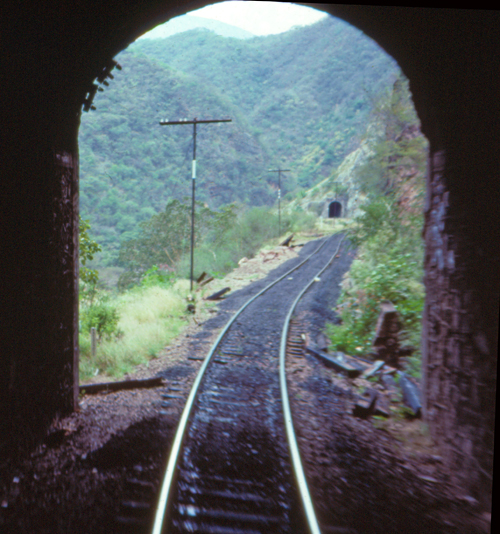
The mining operation at that time employed 1500 workers, and the total length of tunnels was more than 70 miles. Shepherd did much to improve the town, building bridges, aqueducts, and a hydroelectric plant, which made Batopilas the second city in Mexico to have electricity—second only to Mexico City itself. His headquarters was known as the Hacienda de San Miguel—a complex of adobe buildings which included the family residence, the business offices and a mill and reduction plant. He later constructed the Porfirio Diaz tunnel—a tunnel bored through the base of a mountain, where a train hauled out ore which was dropped down shafts from the tunnels above. The train had to be dismantled and hauled in almost 200 miles by burro and human labor, because there was no road to Batopilas. In fact, the road to Batopilas was not built until the 1970′s, almost a century later. The tunnel is still there, now deserted except by the bats.

Today there is no large-scale mining in Batopilas, though a few old prospectors still pan gold and silver from the river or extract small quantities of ore from the abandoned workings.

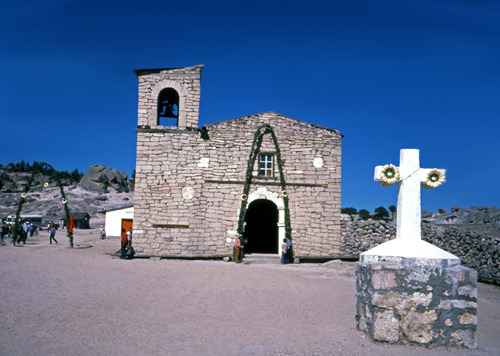
View of Satevo's 'Lost Cathedral', near BatopilasThree miles downstream from Batopilas, past an old suspension bridge, is a 400 year old Jesuit mission. The mission, recently restored, is known as the “Lost Cathedral” of Satevo, because over the course of time all records of it were lost by the Catholic Church.

Read the rest of this entry »

Bookmark and Share

« Older entries