We appreciate it when our guests share their stories with us and allow us to post them on our blog. Two weeks ago David Isaacson from Boston, MA, traveled with us to Copper Canyon and Baja California:
Hi Laurie:
I wanted to thank you, Dave, and Lee for the most perfect trip possible to The Copper Canyon and Baja..I wouldn’t have changed a thing. All the experiences that you planned for me were ideal, the weather was perfect, and great hotels…especially the one that overlooked the Canyon. The only thing I would have changed is having more time in Copper Canyon and Baja…but that is the way a perfect vacation should end! I so appreciate the expertise, and all that you and The California Native have done for me.
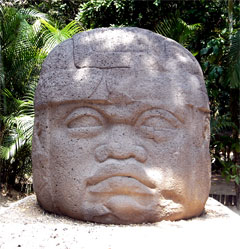
Olmec head, perhaps representing a chief, wears what is believed to be a ballplayers helmet.
Spring has sprung, Little League players are swinging their bats and baseball is in the air. Baseball, football, basketball, hockey, soccer (called football in the rest of the world), these are the games most North Americans think of when the subject of sports comes up. But team sports is not a concept which arrived in the Americas with the landing of Columbus. For almost 3000 years before the coming of the Europeans, teams in Mesoamerica, the region which extends from what is now Mexico south through Nicaragua, were playing ball in a game that was truly was a matter of life or death.
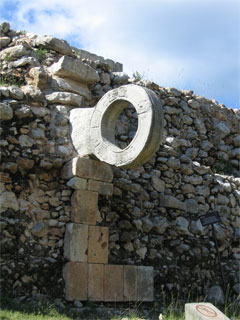
A stone vertical hoop is still prominent in the ruins of a Mesoamerican ballfield.
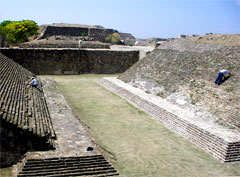
Today, when visiting the ruins of these ancient cultures, travelers can see the courts where these ballgames, considered to be the world’s oldest team sport, were played. Like modern superdomes, these ball courts were a major part of a city’s infrastructure and came to represent its wealth and power. Two high walls composed an alley with end zones making the court resemble the capital letter ‘I’.
Although not much is known about how the sport was enacted, it is speculated that two opposing teams attempted to have the rubber ball penetrate the defense’s end zone without using their hands. As the sport evolved, giant stone rings in the walls of the alley provided more obstacles to pass the ball through in hope of scoring. The balls varied in size from softball to beachball and could weigh up to eight pounds. Some relics of balls have been found with skulls in the middle and were thought to bounce even higher having a hollow core. The earliest rubber ball was found at the Olmec site of El Manati, in the Mexican state of Vera Cruz. It is estimated to be 3600 years old!
Workers work on restoration of a Mayan ballfield.
The stakes were high for the athletes in these games. Their belief systems were based on a balance of forces. These ancient people wanted to keep their gods happy in order to keep the sun rising in the east and rain pouring on their crops. And to keep this balance level, cities would often sacrifice members of the losing team, making the incentive to win greater than any trophy.
Two cultures that were significant in the development of the Ballgame were the Olmec and the Maya. The Olmec are generally thought to be the mother culture from which all other Mesoamerican cultures were derived. The name Olmec means “people of the land of rubber.” Their huge helmeted stone heads, weighing up to 40 tons, are speculated to be portraits of famous ball players.
Succeeding the Olmecs, the Mayan Civilization thrived from 250 AD to 1400 AD. Their zest for the ballgame is evident from the many ruins of their ball courts including the giant court at Chichen Itza, the largest of all the sites. The game was so popular that aspects of the sport are found in the Mayan Creation Story which tells the story of two hero twins who were players. The ballgame was so rooted in the culture that “ballplayer” is used as a ceremonial title of kings.
Like modern sports, the uniform was an essential part of the game. The athletes entered the court wearing their finest jewels, animal skins, and feathered headdresses. The players did not compete in this garb as the fast-paced nature of the game required agility and the aggressive action required protective equipment. Uniforms consisted mainly of a loincloth, sometimes with leather hip guards, a thick girdle made of wood or wicker covered in leather or fabric, and a decorative stone accessory worn on the girdle. Knee guards and helmets were also worn in some communities. A decorative carved stone was sometimes used to hit the ball like a bat or a stick. The balls were made of rubber, produced from plants indigenous to the area.
The rise of Christianity in the Mesoamerican world led to the end of the ballgame. The Spanish viewed the event as pagan ritual and outlawed the sport. Disease, forced labor and massacre, diminished the native populations, taking with them the world’s first team sport. The modern game of Ulamu, played in the Mexican state of Sinaloa, is thought to be its closest equivalent.
We invite you to come with us on a tour of Mexico’s Yucatan Peninsula and visit these ancient sports stadiums and many other archaeological sites of these unique cultures. Can you hear the whispered call of the ancient Mesoamerican equivalent of “Play ball?”
Since 2003, runners have traveled to the depths of Mexico’s Copper Canyon to participate in a 50-mile foot race. This has now become an annual March event, known as the Copper Canyon Ultra Marathon (an ultra is longer than the usual 26.2 miles of a regular marathon).
The races are organized by “Caballo Blanco,” a gringo who has for years lived among the Tarahumara, or Raramuri (the running people), of Copper Canyon. The race begins in the canyon-bottom town of Urique. The participants are taken on hikes along the trails that will be the race course days later. On race day, almost the whole town gathers to cheer on the racers—both the gringos (a group that gets larger every year) and the local Tarahumara, wearing their very “technical” footware—thin sandals made from old tires. The course features three loops of 18, 22 and 10 miles of difficult terrain that begin and end in the town. In this year’s race, which was held on March 6, only two gringos finished in the top 10.
While the Raramuri run from their homes and caves in the mountains to Urique, many make their way to the race by way of Paraiso del Oso near Cerocahui, also a stop on California Native’s popular trips to Copper Canyon.
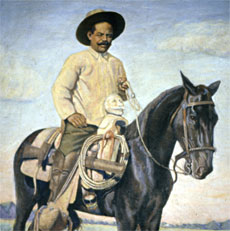
Francisco “Pancho” Villa was a hero to some and an overated hoodlum to others, especially the “Gringos” who made their fortunes in Mexico.
Alexander Robey “Boss” Shepherd, the last territorial governor of the District of Columbia, packed up his family, servants and pets, and headed for Mexico’s rugged Sierra Madre Occidental Mountains.
It was 1880 and in the remote village of Batopilas, at the bottom of the area now known as Copper Canyon, he developed one of the richest silver mining operations in the world. Fifty-seven years later, Shepherd’s oldest son, Grant, who was five years old at the time of the family’s relocation, published a book, The Silver Magnet, recounting tales of growing up in Batopilas. The following excerpt from the book describes an incident between Grant’s younger brother, Conness, who Grant refers to as “The Kid” and Pancho Villa. Shepherd’s views on Villa were less than complimentary:
“Francisco Villa knew quite well who our tribe was, and he knew my young brother. The Kid was a competent horseman, pistol and rifle shot; he stood six feet three in his stockings; weighed one hundred and ninety pounds. There was nothing sticking to his ribs but the very hardest and most efficient and experienced muscle; he possessed a pleasing personality. The Mexicans who knew and worked for him loved him with a devotion not frequently met with. In fact, his position in the estimation of the inhabitants of the sections where his work placed him was one rarely found and much to be desired.
“With the advancement of the revolution, the size and importance of the internationally known Pancho Villa welled with much rapidity. His increase in magnitude and undeniable presence as something actual on the landscape may well be compared to that of a fat mule who had died on the trail, and been subjected to the hot sun of the locality. You soon can see him and smell him from a great distance.
“The Kid was making his way into Chihuahua; he rode into Carretas one afternoon accompanied by a couple of his mozos and a pack animal or two. He had been there only long enough to wash his face and sit down to supper, when into the town rode Villa with a big bunch of followers. Villa swaggered into the main room of the meson where Conness was eating his supper and sat down opposite to him. He had had a few drinks and was bombastic and offensive in elaborating upon the fact that ‘he was a big mad bull who gored whom he pleased and had to account to no one for his goring.’ The Kid is a very quiet, a very silent man … this kind is the most dangerous.
“Villa hated all gringos, but he knew exactly who this gringo was and he also had no particular amount of guts. When he performed his own shooting and killing, which was seldom enough, he needed all the breaks so that this pastime would be a perfectly safe one to be indulged in by Don Francisco Villa.
“The Kid looked him steadily in the eye; that same Kid had a damned mean eye to look into when he felt that way. He then serenely informed Villa that if Pancho started anything it would, of course, result in his, the Kid’s, being killed; but he was positive that Villa was aware of the fact that he himself would go first, and that the news of the Kid’s death would be transmitted to Villa by some of Villa’s many followers in Hell or wherever it was he would be residing when dead. Villa knew that the Kid was right, that when it came to a draw this gringo had him beat a mile, so he decided to laugh it off and be a good friendly boy scout. The Kid went on to Chihuahua that night.”