
The Train at the End of the World

Criminals captured by police are often told metaphorically that they have reached the end of the line. In the case of repeat offenders in Argentina in the early 20th century, that statement was literal—they were sent to the prison at the end of the world.

The Prisoner's Train in Ushuia, Argentina
Ellen Klein stands alongside the Prisoner's Train, in Ushuia, Argentina, on a California Native Patagonia Adventure.

Ushuaia is known as the southernmost city in the world. Located at the southern tip of South America, it is an environment of extremes. The city was founded to establish Argentine sovereignty in the Tierra del Fuego region, and in 1896 a penal colony was set up for repeat offenders. To be sent here was seen as little better than a death sentence.

In order to transport the materials needed for the construction of the prison, a xilocar—a narrow-gauge train with shallow cars that ran on wooden tracks and was pulled by oxen—was constructed. However, it was limited in its ability to transport lumber from the forests, so in 1910 construction of a narrow-gauge railway began. The original steam locomotive that operated on the 15.5-mile line earned the nickname “La Coqueta” because of the little jumps and hops that it made as it chugged along the line.
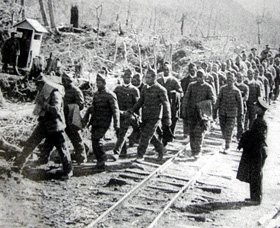
Convicts exit Prisoner's Train
Between 1910 and 1947, Ushuia's 'Prisoner's Train' transported convicts to their daily labor.

The train was vital to the prison and the town itself. It transported prisoners to the surrounding forests to do the backbreaking work of logging. The lumber was then loaded onto the train for transportation back to Ushuaia. The prisoners’ efforts provided wood for cooking and heating during the harsh winters, as well as for construction. A large portion of the town, including buildings, streets and bridges, was built by the convicts, and it was not uncommon in the early days of the town to see teams of prisoners walking down the street.

After over fifty years of use the prison was shut down by Argentine President Juan Perón in 1947, and the train was decommissioned in 1952.

Forty-two years later, in 1994, the prisoners’ train was resurrected under the new name of Ferrocarril Austral Fueguino. It offers tourists a chance to ride along a new line that follows the old right-of-way.

There are three steam locomotives that run on the line, and all are fired by oil, rather than coal, in order to minimize the risk of igniting forest fires. They pull heated antique coaches with large windows that offer great views of spectacular scenery.

California Native founder, Lee Klein, exits Prisoner's Train.
California Native founder, Lee Klein, escapes from the Prisoner's Train in Ushuia, Argentina.

Leaving Ushuaia the train follows the Pipo River through the Cañadon del Toro as a bilingual guide explains the history and ecology of the area. At the Macarena waterfall, passengers can debark to visit a reconstructed campsite of the Yámana Indians. Continuing on through sub-Antarctic forest, passengers may see high stumps that are remnants of trees cut down by prisoners during the harsh winters, when snow could accumulate to tremendous depths. The next stop is at the entrance of Tierra del Fuego National Park. Here passengers can either debark and continue their journey into the park or return on the train to Ushuaia.

Modern Ushuaia, with its hotels, restaurants, internet cafés and shops, is very different from the conditions endured by its early settlers, and it is difficult to imagine the bleak future that loomed before those who were sentenced to imprisonment and forced labor in a time when the town barely existed. Thankfully, we can now leisurely ponder this thought in the comfort of a car on the FCAF line, a huffing and puffing tribute to those who unwillingly toiled to tame the end of the world.
Come Out of Your Shell and Meet the Turtles of Tortuguero

Located near the northeastern corner of Costa Rica, surrounded by rain forest on one side and Caribbean beach on the other, is Tortuguero National Park, whose name means “The Place of Turtles.”

Costa Rica's Tortuguero National Park is the easiest place in the world for viewing sea turtles.

Tortuguero’s 22-mile long beach is the main nesting area for Green Turtles in the Caribbean. It is also the easiest place in the world to view sea turtles.

Green Turtles mate and nest several times during a season. In mating, an amorous male holds onto a female with the sharp hook on his front flippers. If he can’t locate a female, he will improvise and substitute anything that floats, whether it be a piece of driftwood, another male turtle, or a skin diver.

An impregnated female will wait offshore until dark and then head for the beach and a nesting site. During her crawl up the beach, noise or lights will cause her to return to the safety of the sea. Once she has begun digging her nest, however, nothing will distract her. She uses her rear flippers to scoop out a hole about two-feet deep, deposits around one hundred leathery, golf-ball-sized eggs, covers the nest, tamps down the sand, and returns to the sea.

Many of the buried eggs are dug up by coatimundis, dogs, raccoons, and even humans. The remaining eggs hatch in a couple of months. The baby turtles use a temporary egg tooth to tear open their egg shell. It takes the combined power of about 100 cooperating turtles to excavate the two feet of sand which covers them.

The little turtles appear on the beach, usually before dawn, then scramble for the water. On the way many are eaten by hungry crabs and birds. If they do reach the water they stand a high chance of becoming dinner to an eagerly waiting fish. Of the hundreds of thousands who race for the sea, probably fewer than three percent survive. For the next half-century the turtles live nomadic lives, migrating over vast distances of ocean. After fifty years they reach sexual-maturity and return to the beach where they were born, to mate, nest and produce another generation.

In addition to the Green turtles, Tortuguero is also a nesting place for Leatherback, Hawksbill, Olive Ridley and Loggerhead turtles.

For would-be turtle watchers, the best time to see Green turtles is between July and October. At this time you can also see Hawksbill and Olive Ridley turtles. The Leatherback turtles return to Tortuguero during the months of February through July. Of course there is no guarantee that you’ll see the turtles at any time, as the weather, the tides, activity on the beach, and other factors can discourage them from landing on any given night.

With or without the turtles, Tortuguero is well worth visiting, as it is a wonderful place to view countless animals and birds. Getting there is half of the fun. There are no roads, just rivers and canals, so we travel by boat. Birds fly overhead, monkeys and sloths hang in the trees, and crocodiles rest along the river banks. Traveling up the jungle waterways one can easily imagine himself as Humphrey Bogart or Katherine Hepburn on The African Queen.

Back to the Classics for the Naxi Orchestra

The “Ancient Musicians” of the Naxi (pronounced “Na-shee”) Orchestra are tuning up as Xuan Ke takes his place at the podium. He is younger than many of the musicians, being only in his seventy-seventh year. The standing-room only crowd gives him a thunderous applause. He addresses them in three languages: English, Mandarin, and Naxi—the ethnic dialect of the area. He has been ill, he tells them, so tonight he will conduct only the first part of the concert, then an apprentice will take over. He introduces the musicians, describes their instruments, and acquaints the audience with the history of the ancient music. Then the concert begins.

 'Ancient Musicians' of China's Naxi Orchestra
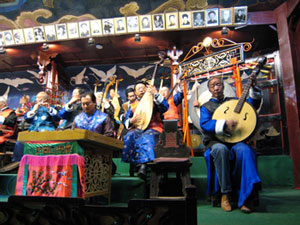
In Lijiang, China, the “Ancient Musicians” of the Naxi Orchestra again play the traditional music, banned during the Cultural Revolution.

The concert hall is unheated and cold, but the music is warm, beautiful and haunting. We are seated in one of the front rows of the hall, a beautiful building in the old town of Lijiang, located in a picturesque valley in China’s Yunnan province. Though it is January, there are plenty of tourists, most of whom are Chinese.

The Naxi Orchestra is made up of 20-24 members, many in their 80’s and 90’s, dressed in bright traditional costumes. Tonight, because of the cold, we catch glimpses of jeans and warm Western clothing beneath their silk brocaded Chinese gowns. They are playing traditional Chinese stringed instruments like the guzheng, guqin and erhu, accompanied by the dizi—the Chinese bamboo flute. Although they play some traditional Han music (Han are China’s largest ethnic group accounting for 90% of the country’s population), they specialize in dongjing, a type of Taoist temple music that has been lost elsewhere in China. The melodies evoke waterfalls, birdsong, and other sounds from nature.

Xuan Ke, the venerable Conductor, popular in China and worldwide, has a shock of dark hair and dark skin. Born in 1930, the musicologist and former village school teacher first learned about music from American Pentecostal missionaries. At the urging of his merchant father, he studied Western music at the Kunming Academy. He became passionate about exploring the instrumental music, chants and folk songs of the remote mountain villages in the foothills of the Himalayas.

Naxi Orchestra conductor Xuan Ke addresses the audience in the city of Lijiang, China.

After Chairman Mao Tse-tung’s victory in 1949, Xuan Ke became a conductor in Kunming. When the Red Army entered the city, his orchestra played Schubert’s Marche Militaire. In 1958, when Mao decided that artists and intellectuals could be a threat to him, Xuan Ke, who played western music and was fluent in English, was sent for “re-education” to a forced labor camp. He spent the next twenty years working in a tin mine. There he endured constant work and was tortured. Once the guards strung him to the roof beams by his hands, his arms extended in the manner of an orchestra conductor—or the curcified Christ. He still bears the scars and disfigurement on his hands and wrists. Many of the musicians in the orchestra suffered as well, but a good number were able to save their precious antique instruments from the Red Army by embedding them in walls or burying them in the ground.

After his release, Xuan Ke taught English and at the same time put his orchestra back together. Many of his friends had died, but some remained and the orchestra today is made up of white-bearded veterans and the young apprentices to whom they are imparting their unique knowledge of the ancient music. The orchestra has performed in more than twenty countries. At home, it plays every evening and the room is always packed.

After an earthquake struck Lijiang in 1996, the old town survived almost intact but the new town suffered a large amount of damage. It was then decided that all future building should be done in the same manner as the old town. In 1997, Lijiang, the only ancient Chinese city constructed without walls, was designated a UNESCO World Heritage Site.

The California Native invites you to visit this fascinating area of China and attend a performance of the Naxi Orchestra.