There is a local legend revolving around Chiapas, Mexico’s, Canyon del Sumidero. Legend states that the local tribes were fanatic about remaining out of bondage. So in order to escape slavery by the Spaniards, they committed mass suicide by diving into the canyon, believing that they would be free in the afterlife if they did so.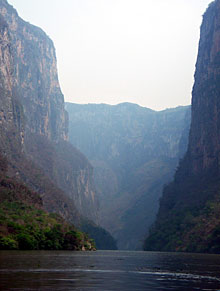
There is some historical fact associated with this legend. When the Spanish first came to Mexico, they conquered the Aztec empire, which was located to the north and west of Chiapas for the most part. Later, when Cortes sent tax collectors to Chiapas, they were met with fierce resistance. Eventually, in a fierce battle between indigenous forces and Spanish conqueror Diego de Mazariegos, many Indian warriors threw themselves into the Canyon del Sumidero, preferring death to slavery.
This canyon is located in extreme southeastern Mexico, in the central state of Chiapas. It was formed by a fault that still runs through the canyon, through which the Grijalva river still runs. The river and canyon are the primary feature of what is now known as Cañón del Sumidero National Park. The Mexican government named the site a National Park in 1980, in order to protect the area around it, as well as the flora and fauna. The canyon is one of Mexico’s most beautiful features, though it is not well known outside the country. It is the central tourist attraction for the state of Chiapas; important enough that it features on the state’s coat of arms.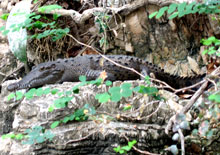
The park is formed by two features; the Canyon del Sumidero itself, and the plains that the canyon-forming Grijalva river runs through. A series of tremendous earthquakes thrust the plains in some places more than a kilometer above sea level millions of years ago. Some time after, the Grijalva river cut down through the basalt and granite, creating the canyon seen today.
A speed boat tour down the canyon and the Grijalva river leads to many beautiful sights. Lucky boaters might see some of the native American Crocodiles. One particular sight that any visitor would be lucky to see is what happens to the canyon during the rainy season. Nearby streams and trickles of water all lead down into the canyon and the sides of the canyon cascade with beautiful waterfalls.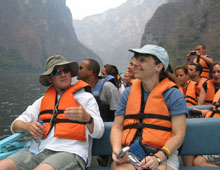
The indigenous group modern Chiapans are descended from is the Maya. It is only a small part of the Maya empire that once was, but thanks to the state’s powerful cultural identity and independence, they have never felt really bound to the rest of Mexico.
The California Native’s tours of Chiapas include a speed boat tour through this beautiful canyon.

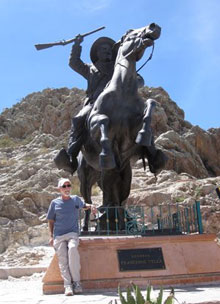 Pancho Villa, so the saying goes, was “hated by thousands and loved by millions.” He was a Robin Hood to many and a cruel, cold-blooded killer to others. But who was this colorful controversial hero of the Mexican Revolution and where did he come from?
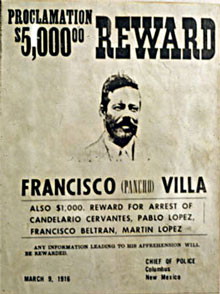 Pancho Villa was a natural leader and was very successful as a bandit, leading raids on towns, killing, and looting. He was also involved in more legitimate ventures, including being a contractor on the Copper Canyon railroad.
 On May 21, 2010, California Native owners Lee and Ellen Klein were guests of Mexico’s President Felipe Calderón at a luncheon he held in Mexico City at Los Pinos, Mexico’s official presidential residence.
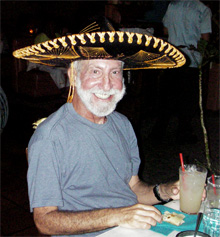 Most Americans think that Cinco de Mayo (the 5th of May) celebrates Mexican Independence Day. Not so. Mexican Independence Day is September 16. Then what is Cinco de Mayo?
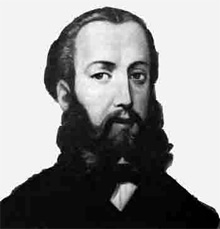 Napoleon enlisted England and Spain to join him in a mission to encourage Mexico to pay off its foreign debts. The mission began with the landing of French, English and Spanish troops at Vera Cruz. The French minister then demanded that Mexico pay 12 million pesos to France, an impossible amount, given the state of the Mexican treasury.
 Thanks to you and
 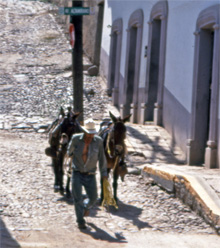 This is Batopilas, a small village located in Mexico’s Sierra Madres at the bottom of the deepest canyon in the vast complex of mountains and canyons known collectively as
 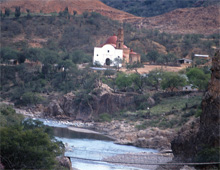 Three miles downstream from Batopilas, past an old suspension bridge, is a 400 year old Jesuit mission. The mission, recently restored, is known as the “Lost Cathedral” of Satevo, because over the course of time all records of it were lost by the Catholic Church.
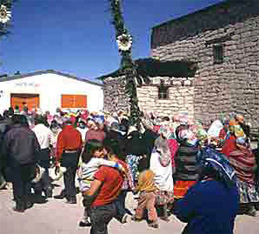 To begin to understand the Tarahumara ceremonies, one has to have a basic understanding of the Indians’ religion. The Tarahumara are outwardly Catholic, but their version of Catholicism is unlike any form we are familiar with.