
Located in the Central Mountain Range, not far from Costa Rica’s capital city of San Jóse, the town of Sarchí is the center of Costa Rica’s painted oxcart industry.
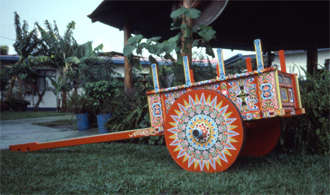 According to legend, around 1910 a farmer was suddenly inspired to spruce up the appearance of his oxcart. He painted the wheels with multi-colored designs. Others copied his designs and oxcart painting became a uniquely Costa Rican art form. At one time each district in the country had its own special design, and people could tell by looking at an oxcart what region it came from.
Until about thirty years ago, oxcarts were the principal means of transporting coffee beans and other agricultural products to market. Today some farmers still rely on this traditional method of transporting their goods. The father of former president Oscar Arias Sánchez made his fortune hauling coffee in oxcarts to the port of Puntarenas.
Today, the painted oxcarts are produced mainly for decorative purposes. In addition to the full-size carts, replicas are available for sale ranging from small, inexpensive table top models to larger carts that are designed to be used as planters or living room cocktail carts. Regardless of size and price, all of the oxcarts are beautifully handpainted in bright colors featuring motifs of butterflies, flowers and fruits, as well as traditional design patterns whose origin can be traced to designs brought to Spain from North Africa by the Moors.
The gift shops in Sarchí are also filled with other woodcrafts including furniture, chairs, desks, coffee tables, and polished wood serving dishes, as well as leather items, ceramic crafts, and jewelry.
Exploring the arts and crafts of a country offers travelers another way to learn about its people and culture. Costa Rica has a wide spectrum of art objects ranging from the inexpensive to museum-quality collector’s items. Goods offered for sale include wood crafts, ceramics, reproductions of pre-Colombian figurines and masks, leather accessories, hammocks, woven baskets, jewelry made of woods, silver, gold and jade, embroidered dresses, blouses, table linens, and, of course, replicas of the famous painted oxcarts.
In San Jose, Costa Rica’s capital, almost every craft item is available. However, as travelers visit the beautiful and diverse provinces of Costa Rica, they can purchase products reflecting the particular traditions and culture of the surrounding countryside.
One item that most visitors bring home is a bag or more of Costa Rican coffee beans. Sipping the rich flavor, and inhaling the wonderful aroma weeks after returning home helps recapture some of the adventures and sights of a Costa Rican vacation.
So how about it? Wan’na buy an oxcart?


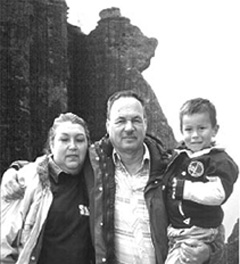 Born in a rural Ohio farming community, Doug has followed many diverse paths. He was an army sergeant, a NASA electrical technician, an editor, a deputy sheriff, a bodyguard, and now an inn keeper. His greatest passion is horses—he owns at least a dozen, and he brags that they are the best trained and equipped in Northern Mexico.
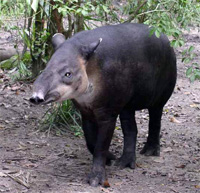 Tapirs are rather strange, primitive creatures. They are big animals—measuring about six to eight feet between their short little trunk and their stubby little tail, and weighing up to 700 pounds. Unlike elephants, who pick up food with their trunks, the tapirs move their trunks aside and browse like horses. Tapirs are the only animals native to the Americas which have four toes on their front feet and three toes on their hind feet.
 The Kingdom of Bhutan has set aside an area specifically for the yeti, the Sakten Wildlife Sanctuary—a sanctuary for a creature that local lore claims is invisible! While in Bhutan, I was told that not only is the yeti invisible, but his feet point backwards to avoid being tracked.
 At California Native, we are always exploring new and exciting destinations to develop unique itineraries to offer our fellow travel enthusiasts.

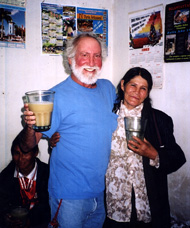 The strange-tasting drink, yellowish in color with a bubbly froth, is served warm for just a few coins, and is quite strong. It is not usually found in restaurants (a similar drink, chicha morada, made from blue corn, is sweet and sold everywhere like a soft-drink), but is sold by individuals, usually in the lower socioeconomic bracket, who have passed down the traditional recipes since pre-Inca times.