
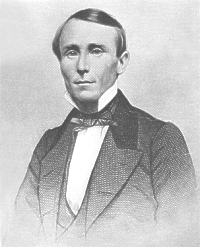
President of Lower California, Emperor of Nicaragua,
doctor, lawyer, writer—these were some of the titles claimed
by William Walker, the greatest American filibuster.
In the mid-nineteenth century, adventurers known as filibusters
participated in military actions aimed at obtaining control of
Latin American nations with the intent of annexing them to the
United States—an expression of Manifest Destiny, the idea
that the United States was destined to control the continent.
Only 5'2" and weighing 120 pounds, Walker was a forceful
and convincing speaker and a fearless fighter who commanded the
respect of his men in battle.
Born in 1824 in Tennessee, Walker graduated from the University
of Nashville at the age of 14 and by 19 had earned a medical
degree. He practiced medicine in Philadelphia, studied law in
New Orleans, and then became co-owner of a newspaper, the Crescent,
where the young poet Walt Whitman worked. When the paper was
sold, Walker moved on to California, where he worked as a reporter
in San Francisco before setting up a law office in Marysville.
When he was 29, his freebooting nature led him to become the
leader of a group plotting to detach parts of northern Mexico.
Recruiting a small army, he sailed to Baja California and conquered
La Paz, declaring himself president of Lower California. He then
decided to extend his little empire to include Sonora, and renamed
it “The Republic of Sonora.”
Marching on to the Colorado River, Walker found himself faced
with harsh conditions and a high desertion rate, forcing him
to retreat to California, where he surrendered to U.S. authorities
on charges of violating U.S. neutrality laws.
One result of this incursion was that Mexico sold a part of Sonora
to the United States—the transaction we call the Gadsden
Purchase. Acquitted of criminal charges, Walker next turned his
attention to Central America. Throughout this region, chaos reigned,
as forces known as Democrats and Legitimists fought each other.
The leader of the Democratic faction in Nicaragua invited Walker
to bring an army and join the struggle against the Legitimists.
In 1855, with his army of 58 Americans, later called by stateside
romantics,
“The Immortals,” he landed in Nicaragua.
Within a year, leading “The Immortals” and a native
rebel force, he routed the Legitimists and captured Granada,
their capital. His success roused concern in the other Central
American countries, especially Costa Rica, which sent in a well-armed
force to invade Nicaragua. Walker's army repelled the invasion,
but a poorly executed counter attack into Costa Rica failed,
and a war of attrition continued, in which disease killed more
soldiers on both sides than enemy bullets.
Other enemies plagued Walker. Cornelius Vanderbilt, the shipping
magnate, seeking control of the San Juan River-Lake Nicaragua
route from the Caribbean to the Pacific, armed Walker's enemies,
while the British navy, attempting to thwart American influences
in the region, regularly harassed efforts to supply him. In spite
of these factors, Walker had himself elected president of Nicaragua.
The United States briefly recognized his government but never
sent him aid. Soon the other countries of Central America formed
an alliance against him, and in mid 1857 he surrendered once
again to a U.S. naval officer and returned to the U.S.
Landing first in New Orleans, he was greeted as a hero. He visited
President Buchanan, then went on to New York, all the time seeking
support for a return to Nicaragua. But support waned as returning
soldiers reported military blunders and poor management.
Nevertheless he succeeded in raising another army, and returned
to Nicaragua in late 1857. Again thwarted by the British navy,
he abandoned his third Latin American invasion.
Still undaunted and seeking support for yet another venture,
Walker wrote a book, The War in Nicaragua. Knowing that his best
prospects lay in the South, he assumed a strong pro-slavery stance.
This strategy proved successful, and in 1860 he once again sailed
south. Unable to land in Nicaragua due to the ever-present British,
he landed in Honduras, planning to march overland, but the British
soon captured him and turned him over to the Hondurans. Six days
later, at the age of 36, he was executed by a firing squad. The
Walker saga had ended. This enigmatic man had come close to altering
the history of the continent. Had he been successful, he might
have brought several Central American countries into the United
States as pro-southern states, altering the balance in Congress
and postponing The Civil War.
Today Walker is far better known in Central America than in the
United States. Costa Ricans honor Juan Santamaria, a young drummer
boy who became a national hero by torching a fort in which Walker's
army was encamped, and a national park, Santa Rosa, commemorates
the battle where Walker's soldiers were expelled from Costa Rica.
Click Here for information
on our Costa Rica Tours.