Utopia at the Gateway to Copper Canyon

Topolobampo Bay
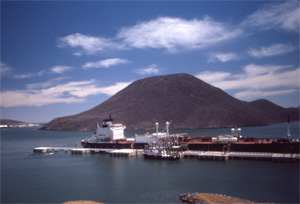
Commander George Dewey sailed a U.S. sloop-of-war into Mexico’s Topolobampo Bay (shown today) on a surveying mission in 1874.

In 1874, Commander George Dewey sailed the United States sloop-of-war Narragansett into Mexico’s Topolobampo Bay. This was the same George Dewey who, twenty-five years later, defeated the Spanish Navy at Manila Bay after giving his famous command, “You may fire when you are ready, Gridley.”

The mission into Topolobampo was a peaceful one; its goal was to survey the Pacific Coast of Mexico and Baja California. The survey was ordered by President Grant at the behest of Albert Kimsey Owen, a former railroad surveyor and city planner, who had grandiose plans to develop a great harbor at Topolobampo.
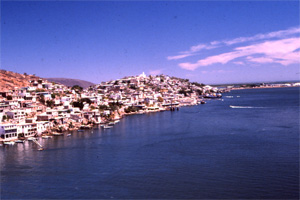
View of Topolobampo Bay.
Topolobampo, 15 miles west of Los Mochis, was the site of a 19th century utopian colony.

The harbor was only part of his plans. A railroad would be built from Topolobampo through Mexico and the United States to the Atlantic Ocean, facilitating trade between Europe, the United States, and the Far East. In addition, the area around Topolobampo would be populated with a utopian American colony.

Owen entered into an agreement to purchase 111,000 acres from a local hacienda owner and, with the help of Mexican president Porfirio Diaz, obtained concessions for the railroad and the colony. He then chartered a corporation, Credit Foncier, in New Jersey.
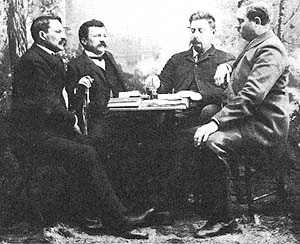
Albert Owen (far left) at Topolobampo.
Albert Kimsey Owen (far left) had grandiose plans to develop a great harbor and a utopian colony at Topolobampo.

People buying stock in Credit Foncier received the right to join the colony, which was to be run communally and without the use of money. Work was to be assigned according to each person’s ability, with credits awarded for labor. Individual accumulation of wealth was prohibited. Eight hours of work, eight hours of sleep and eight hours of culture or entertainment were to make up the daily routine. Colonists would build, own, and operate the railroad, telegraphs, banks, and water supply. Capital gained would be reinvested in the colony’s infrastructure.

Credit Foncier clubs sprang up in the United States and Europe. In late 1886 the first 27 colonists arrived from California, and within a short time the population grew to 2,000.

Activities were directed by Owen. A team made daily trips to the Rio Fuerte to gather fresh water. Several towns were founded, connected by paved roads which permitted bicycle travel. Irrigation ditches were dug. A school was opened. Community theater grew, and an Academy of Sciences, with ties to the Smithsonian Institute, was founded.

Governed by the principles of order, industry and courtesy, the colonists attained modest economic success from fishing, farming and hunting. But the colony was growing much faster than Owen had envisioned. It became top heavy—too many planners and not enough workers.

Benjamin Johnson, only 25 years old when he arrived at the colony, challenged Owen’s leadership and focused the colonies efforts toward developing a single cash crop—sugar. He received a concession to build a canal from the Rio Fuerte to what became Los Mochis, then convinced the Mexican government to evict most of the Owen colonists.

Owen left, but continued to work on building the railroad, convincing Arthur E. Stilwell, an American railroad owner, to join with him. In 1900 the Kansas City, Mexico and Orient Railroad, precursor to the Chihuahua al Pacifico line, was chartered. The same year the colony was abandoned, having lasted fourteen years.

Today, travelers flying into Los Mochis to begin their tour of Copper Canyon look down on the huge bay and the endless agricultural land, laid out in neat rectangular plots. Little remains of the Owen Utopia, but the area’s rich farmlands, and the Copper Canyon railroad are the results of his vision.

White Elephant Sale

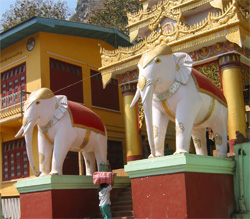
Statues of White Elephants
Statues of White elephants guard the entrance to a temple in Myanmar.

In Myanmar (Burma), the white elephant is highly respected as a symbol of power and prosperity and so it was only natural that a few months ago Myanmar’s government warmly welcomed two newly found white elephants. At the same time, the country was awarded chairmanship of the Association of Southeast Asian Nations for 2014, and U.S. Secretary of State Hillary Clinton’s visit ended 50 years of political isolation from the West. Coincidence? The people in Myanmar don’t think so.

The elephant has for centuries been a symbol of Southeast Asian countries. Maharajas sent them to battle like living tanks, and workmen used them as bulldozers. The rare “white” elephant, though, holds a special place in the lore of these countries.

A white elephant is unloaded
A white elephant is unloaded from a transport to take its place of honor near a temple in Myanmar.

While other elephants worked hard, white elephants were cherished by kings, kept in palaces, cared for by senior officials, and worried over constantly. Possession of these sacred beasts was very important. A king who had many white elephants would reign for a long time and his kingdom would prosper. If his white elephants died, it was an omen of disaster for the kingdom.

Burmese kings would hunt for these special beasts, and would present them to each other as marks of diplomacy. Sometimes they fought over them, but they always took great care of them—their rule depended on it.

As elephants were used less and less in warfare, elephant hunts became less common, and fewer white elephants were discovered. In Siam (now Thailand), the King decreed that any white elephant found must be given to him and he offered rewards for their discovery. Each time a white elephant was found, it was cause for public celebration.

When King Mongkut of Siam heard that America had no elephants, he offered to send several to President Lincoln, thinking that if conditions were right they would multiply and Americans would be able to “tame and use them as beasts of burden, making them of benefit to the country.” The President replied that the American climate was probably unsuitable, and Americans preferred to use steam power, but he thanked the king for his gift of two magnificent tusks.

Brahman texts list attributes which must be met to qualify the animal as a true “white” elephant—pearl eyes (the animal is usually an albino), white hoofs, a back which hangs down like the bough of a banana tree, white hairs on the body and tail, and ears which are larger than a regular elephant’s.

Today, in Laos, Cambodia, Viet Nam and Thailand, white elephants are pretty much nonexistent. In Myanmar, with the two new white elephants, the country now has at least five. They are considered sacred, and treated with the utmost respect and care. At certain times of the day, the public may view the elephants. No photos are allowed.

With its new found popularity, Myanmar is on its way to becoming a major tourist destination. Tourist numbers are going up and so are prices. Now is the time to visit this fascinating country while it is still pristine and take advantage of The California Native’s “White Elephant” Sale.

California Native, Ellen Klein, serving rice to monks in Myanmar.

Lonesome George, the Rarest Creature in the World, is No More

Last week, Lonesome George, considered the rarest creature on Earth because he was the last member of his species, died. George was a giant tortoise of a species found only on Pinta Island in the Galápagos. For the last forty years he has been living on Santa Cruz Island at the Darwin Research center. He was estimated to be around 100 years old, young for a Galápagos tortoise which sometimes live past the age of 200. Over the years attempts were made to breed him with females of closely related species but he never found a lady tortoise that interested him.

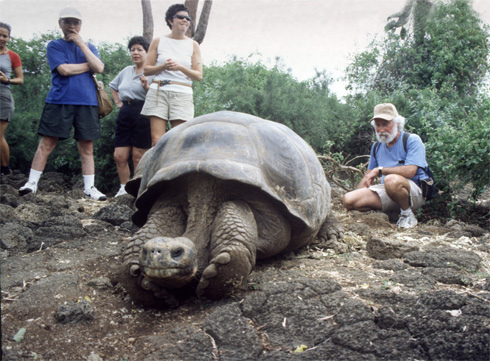
Lonesome George, the last of his species.
The California Native's Lee Klein (right) and guests visit Lonesome George.

The Galápagos Islands, home to the giant tortoises and many other unique species were first discovered in 1535 by Tomas de Berlanga, the bishop of Panama, when his ship drifted off course while on its way to Peru. He named the Islands Las Encantadas, “The Enchanted,” and marveled at the thousands of giant tortoises living there. Because of these tortoises, the Islands became known as the Galápagos—the Spanish word for tortoise.

Sailors—explorers, pirates and whalers, saw the huge tortoises, which weigh up to 550 pounds, as a convenient source of fresh meat, for the tortoises can survive long periods of time without food or water, and can live in the hold of a ship for up to a year. When British naturalist Charles Darwin visited the Galápagos in 1835, aboard the HMS Beagle, the islands’ residents showed him how to tell which island a tortoise belonged to by the shape of its shell. Pondering the causes for this localized diversity led Darwin to develop his Theory of Evolution.

At the time of his visit there were around a quarter of a million tortoises living on the islands. Today less than 15,000 remain. Of the original 15 subspecies, only eleven are left—three have become extinct and the fourth has only one individual left. Thousands of the animals were slaughtered by the crews of sailing ships and, when the islands were colonized in 1832, pigs, goats, rats and other animals also arrived, eating eggs and young tortoises and destroying nests and food supplies.

It is believed that the tortoises, who can float on the sea for several days, came to the Galapagos from the South American mainland. Once on the islands they encountered no enemies. Each of the islands presented its own unique environmental challenges, and the isolated tortoises evolved to take advantage of these differences—tortoises on islands with taller vegetation have longer necks.

Because of the tortoises extreme longevity, visitors to the Islands may unknowingly photograph some of the same tortoises that Darwin himself observed back in 1835.