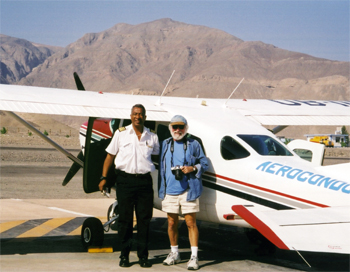
As our Cessna again circled over the giant figures on the ground I shot the final slide on my roll of film and, leaning at a 45 degree angle, attempted to reload my camera. Another pass over a monkey larger than a football field and we headed back to the dirt landing strip on Peru’s Nazca Desert. This was my first trip to Nazca, and the year was 1979.
The Nazca Desert is a high arid plateau which stretches 37 miles between the towns of Nazca and Palpa in southern Peru. Hundreds of square miles of this dry, rocky plain are marked with lines, triangles and other geometric shapes, some running for more than five miles in a straight line. There are also giant drawings including a monkey, a spider, birds, reptiles, and whales.
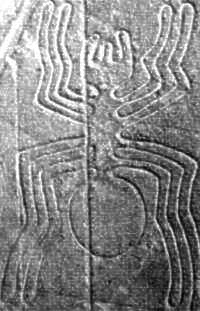
The desert markings, believed to have been made thousands of years ago, made little impression on occasional travelers who viewed them from ground level, but when they were spotted by aircraft in the 1930’s they caught the world’s attention. They have since been surveyed, mapped and studied. Only two questions remain—who made them, and why?
In his 1968 book, “Chariots of the Gods,” Swiss writer Eric von Daniken suggested that the lines were built by “ancient astronauts” as a landing field. Looking at the lines from the sky they do resemble an airport, but it doesn’t seem reasonable that advanced extraterrestrial spacecraft would require landing strips. Besides, Nazca’s soft, sandy soil is hardly suitable for an airport. Forgetting the “Twilight Zone” theories, we can imagine a more down to earth explanation. We know that the region has been inhabited for thousands of years—by the Paracas, 900–200 BC, by the Nazcas, 200 BC–600 AD, and by others. The figures are generally attributed to the Nazcas since they resemble those on Nazca pottery.
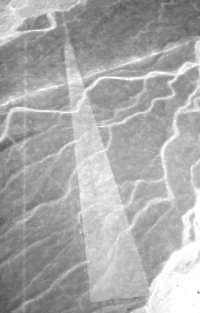
But why create figures which can be seen only from the sky? A reasonable explanation is that they were not intended to be viewed by humans but by gods. A local school teacher in the area explained his theory to me. The lines all point toward the Andes—the source of the water which flows into the area through underground aquifers. The figures, he believed, represent the bounty made possible by this water. The Indians probably conducted rituals on these giant drawings to thank the gods and ensure that the water would continue to flow.
They created the lines that extend for miles by placing two stakes in a row, sighting along them to place a third stake, then repeating the process. By moving the desert’s stones and scraping its surface coating, in the absence of rain, the lines have survived the centuries. Hopefully, they will survive many more centuries for future generations to marvel at.
Not far from the lines is the ancient Nazca cemetery at Chauchilla. The Nazcas buried their dead, along with many of their possessions, in underground vaults lined with mud bricks. The bodies were dressed in embroidered cotton clothes, placed in a fetal position, and coated with resin. The hot, dry climate mummified the bodies. Over the centuries the tombs were looted by huaqueros, grave robbers, who located the chambers by sticking poles into the ground.
On my first visit to the site, the scene was of a desolate desert, pockmarked with holes, and littered with human skulls and bones, broken pottery, with colored designs still vivid on their surfaces, and strands of mummy-cloth blowing in the wind. No other person was there except for the Peruvian school teacher, who was my guide, and two German tourists. While the Peruvian and I talked, the Germans were busy stuffing skulls into their backpacks for souvenirs.
Now, more than thirty years later, things are different at the ancient cemetery. The desecrated graves are roped off and trails lead to observation kiosks where mummies and artifacts are displayed. The two German tourists would no longer be able to take a long-deceased Nazcan home with them.