On the Road to Mandalay Where the Flyin’ Fishes Play–or Not

“On the Road to Mandalay, Where the flyin’ fishes play, An’ the dawn comes up like thunder outer China ’crost the bay.” – Rudyard Kipling
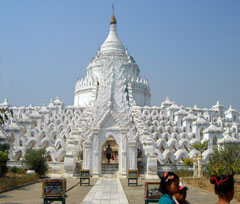
LLocated in Mingun (near Mandalay), the Hsinbyume Pagoda is built in circular terraces representing mountain ranges.
Located in Mingun (near Mandalay), the Hsinbyume Pagoda is built in circular terraces representing mountain ranges.

In 1892 Rudyard Kipling published Barrack Room Ballads, a collection of poems about the life of British soldiers stationed in colonial India. It included the poem “Mandalay,” in which a lovelorn soldier longs to return to Burma and his Burmese sweetheart. While the road to Mandalay may not necessarily lead to love, it does lead travelers to a fascinating experience of Myanmar’s culture and history.

The fabled city of Mandalay lies on the banks of the Ayeyarwady River. The last capital of Myanmar before the British took over in 1886, it is second only to Yangon (Rangoon) in size and lies in the center of the country. It was founded by King Mindon in 1857 in an empty area that, according to prophecy, would be the location of a town that would come into existence on the 2,400th jubilee of Buddhism. To fulfill this prophecy, the king moved his capital from Amarapura, dismantling the wooden buildings and royal palaces and loading them onto carts and elephants to relocate them seven miles south to Mandalay.

The city gets its name from Mandalay Hill, which rises more than 700 feet above the Mandalay Fort. Visitors can climb up two covered stairways that wind up the hill, stopping at the shrines, stupas and monasteries along the way. Near the top is a standing Buddha image pointing to the place where the city would be built according to the prophecy. Once on top, visitors are rewarded with sweeping views of the plains, the Palace and the Shan mountains in the distance.

The road to Mandalay is a route studded with ancient cities, where cars share the road with ox carts and markets teem with life. Although most of the significant buildings in the ancient royal capital of Amarapura were moved to Mandalay, some interesting structures still remain. The most picturesque is U Bein’s Bridge, the longest teak bridge in the world, which stretches three-quarters of a mile across Taungthaman Lake. A stroll across the busy bridge is a great way to experience the local ambiance. At one end of the bridge is the Maha Ganayon Kyaung monastery, where thousands of young monks live and study in a strictly disciplined setting. Each day at 11 a.m. they may be observed eating their main meal in complete silence.

A few miles south down the road is the ancient city of Ava (Inwa), which was the capital of the northern kingdom for almost 400 years, succeeding the nearby city of Sagaing. Both of these cities boast a number of interesting pagodas and historic sites.

One of the most interesting of the ancient cities on the road to Mandalay is Mingun, where in 1790 King Bodawpaya decided he would build the world’s largest pagoda. Despite employing thousands of slaves and prisoners to build it, he died before it was completed. What remains is the massive brick base that stands over 50 meters high. Although damaged by an earthquake, it is possible to climb the ruins for a wonderful view. The king also had a gigantic bell cast—weighing 90 tons, it hangs nearby and is the largest ringing bell in the world.

There is much to see on the road to Mandalay, but unlike the poem, there are no flying fishes and, alas, China is not across the bay.

Please join us on one of our California Native Myanmar Adventures.
Still Here and Doing Fine, Thank You!

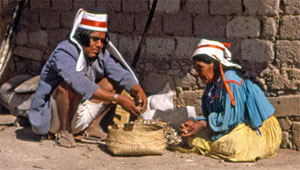
In Mexico's Copper Canyon, a Tarahumara man helps his wife with her chores.
In the village of Kirare, in Mexico's Copper Canyon, a Tarahumara man helps his wife with her chores. The California Native has been a leader in tours to Copper Canyon for almost 30 years.

Anthropologist Carl Lumholtz predicted that the Tarahumara Indians would disappear within a century. A hundred years later, these gentle people, who inhabit Mexico’s Copper Canyon, continue to be the most populous indigenous group in northern Mexico.

Spanish explorers had entered the Sierra Madre Mountains by the mid-16th century. Gold and silver were soon discovered and mines began operating. The Indians were pressed into the labor force, often enduring the harshest conditions.

The Jesuits established their first mission pueblo in 1611. Although many attempted to ease the burden of the Indians, a great deal of prejudice existed. An early Jesuit wrote, “They are inclined to idleness, drunkenness and other vices. They are ungrateful, dull and stupid…very cunning and alert in evil things…They have no sense of personal honor nor the honor of their daughters.”

Forced to live in artificially-created communities, the Indians were susceptible to a variety of diseases, and epidemics swept the area. As the demand for labor increased, the Spanish raided the mission pueblos. The Jesuits managed to protect some of their charges, but many Tarahumara fled, hiding deep in Copper Canyon. The expulsion of the Jesuits from the Americas, in 1767, ended their efforts to protect the Indians, and the Franciscans, who succeeded them, were not as effective.

Mexico attained independence in 1821 and soon established huge land grants in Tarahumara country. The Indians were uprooted again, and fled, often onto lands of other indigenous people. Fighting often resulted.

The Revolution of 1910-21 resulted in the re-creation of the pre-hispanic communal landholding system known as the ejido. The Tarahumara received some benefits from this, as much of this land has economic potential for lumbering, agriculture, and tourism. Around 60,000 Tarahumara still inhabit caves and simple dwellings in Copper Canyon.

The California Native has for many years assisted these people, donating clothing, school supplies and money. Some of our travelers have returned to volunteer in local clinics. Tourism is a positive factor, and visitors gain a new appreciation for these noble people who have survived and thrived despite Lumholtz’ dire predictions.

When Times are Slow It’s Time to Go

Now is the time to travel with The California Native

The economies of the world’s countries are slow. Travel and tourism are down. Hotels have plenty of space. Crowds are down. Now is the perfect time to take that trip you have been dreaming about for so long. Travel now before the crowds come back and the prices go up. Join us on a trip to one of the exotic destinations around the globe that we specialize in. Whether it’s Mexico’s fabulous Copper Canyon, the magical Himalayan Kingdom of Bhutan, or the rainforests of Costa Rica we are ready for your call.

Always wanted to come eyeball-to-eyeball with a flightless cormorant or a giant tortoise? Then the Galapagos is for you. How about enjoying a fantastic cruise through the Straits of Magellan, hiking on a glacier and sipping whiskey over-the-rocks of ancient glacial ice? Patagonia is the place, or travel back in time to visit the mighty empire of the Maya—the Yucatan is your destination. Perhaps you prefer to stroll or bicycle through the green hills and friendly villages of Ireland? These are just a few of the adventures that we have lined up for you.

Wherever your dream destination is, now is the best time to travel. When the times are slow it’s time to go.

Flying on a Dragon

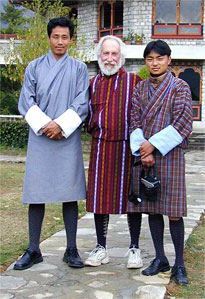
California Native founder Lee Klein with our driver and guide in traditional Bhutanese attire.
California Native founder, Lee Klein (center), along with our Bhutanese driver and guide, wears the traditional Bhutanese 'gho'.

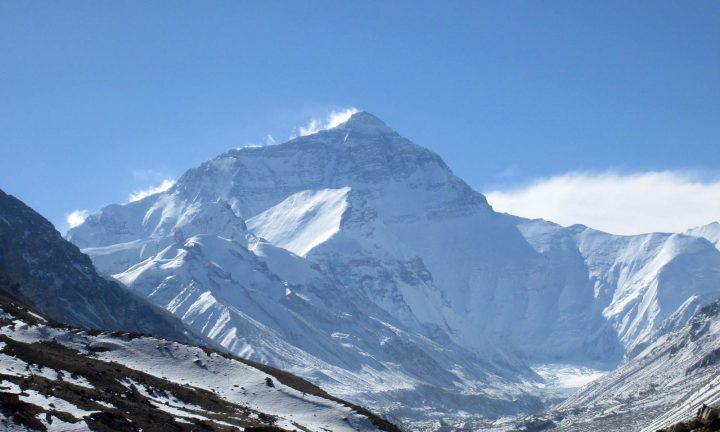
Soaring through the sky, on possibly the world’s most spectacular flight, the snow-covered peaks of the Himalayas come into view. On our left is Everest, the “top of the world,” accompanied by a vast panorama of the Earth’s highest mountains. We are headed for Paro, the only international airport in the Kingdom of Bhutan, aboard Druk Air, the Royal Bhutanese Airline. The word Druk means “Dragon,” and our flying dragon is the only airline allowed to enter the country.

As we approach Paro, our plane drops steeply down and enters a deep valley, weaving its way between the mountains in a breathtaking and slightly scary descent to a smooth landing at the little airport, originally built by the British military. And then we are there, walking across the concrete to the small terminal building and our first visit to the “Shangri-La” country of Bhutan.

Druk Air was established by Royal Proclamation in 1981 and began operations in 1983 when its first plane, an 18-seat German Dornier 228-220, landed at Paro carrying the Royal Flag of the Kingdom. The airline, whose fleet now consists of four aircraft, two British Aerospace 70 passenger BAe146-100’s and two new 124 passenger Airbus A319’s, is the smallest national carrier in the world.

All takeoffs and landings at Paro are by Visual Flight Rules (VFR). This means that the pilot must be able to see the runway and all of the surrounding hills. He cannot land or take off using instruments. No flights operate at night or in poor visibility. Flights can sometimes be delayed up to a day or two due to inclement weather. The airline operates from Paro to six cities: Bangkok and Calcutta, four times a week, Katmandu and New Delhi, twice a week, and Dhaka and Yangon, once a week. Flights from Bangkok make a stop to take on extra fuel in case they cannot land at Paro and have to return. Druk Air’s safety record is perfect—they have been flying for twenty-three years and never had an accident!

After going through immigration, (they have a photo on file of everyone scheduled to enter their country), and meeting our tour guide, we look back and see the airport staff closing the airport—after all, on most days there is only one flight in and one flight out of the country.

We invite you to join us on a California Native tour to Bhutan, this amazing little country at the roof of the world.

A Picturesque Paradise on the Road to Copper Canyon

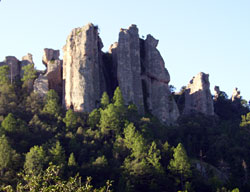
The valley of Paraiso del Oso, located just outside of Cerocahui.
The valley of Paraiso del Oso, located just outside of Cerocahui, is named for its rock formations, one of which looks like Yogi Bear.

Nestled in a picturesque valley surrounded by Mexico’s magnificent Sierra Madre Mountains, is the little village of Cerocahui, the most beautiful of all the mountain villages of southwestern Chihuahua State.

Cerocahui, with its old mission church, was founded in 1680 by the Italian Jesuit, Juan Maria de Salvatierra. It is said that Father Salvatierra, who founded many missions in the area, considered this to be his favorite.

Over the centuries, the 300-year old church, with its lovely stained glass windows, fell into disrepair. In 1948 it was extensively reconstructed. Services are now held there for the towns people and the local Tarahumara Indians, and the church also operates an Indian orphanage and boarding school.

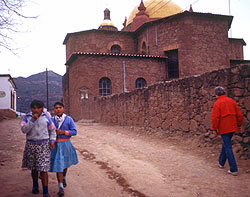
The little village of Cerocahui in Mexico's Sierra Madre mountains.
School girls and a visitor stroll by the old church in the Sierra Madre village of Cerocahui.

Walking around Cerocahui, which has a population of around 1500, you can find people with skills which seem to belong to a bygone era. There are cowboys, prospectors, blacksmiths, and a man who makes rawhide lariats.

Just a mile from “downtown” Cerocahui is the Paraiso del Oso Lodge, located in a picturesque valley, surrounded by large rock formations. The lodge is owned and operated by American Doug Rhodes, who takes pride in the delicious Mexican food served at his lodge and in the fine horses he offers to guests who wish to ride.

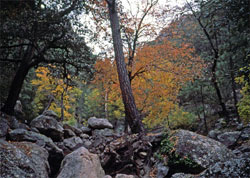
Autumn in Cerocahui.
Autumn is a beautiful time to visit Cerocahui on your trip through Mexico's Copper Canyon.

From the lodge, Doug offers a one-day tour down to the bottom of the canyon and the old silver mining town of Urique. Established in 1612, Urique was active eight years before the first pilgrims landed on Plymouth Rock.

Join us on one of our trips to Copper Canyon and enjoy the hospitality of this unique little village nestled in the Sierra Madres.