
Keep Those Cards and Letters Coming

Mailman

Back when I was a college student in the 70’s, traveling the world, I was rarely in touch with my family and friends. To talk on the phone, we had to schedule a time and I had to call collect. Even then it was very expensive and everyone talked fast so as not to rack up too big of a phone bill. Then there were those kiosks that charged a premium to be able to call overseas. It was a hassle.

So, most of the communication at that time with the family was by letter. That’s right, pen, light paper or aerogram*, and an “airmail” envelope and stamps. Written words! Friends got post cards. I always shopped long and hard to find post cards that most exemplified the destination. Some had multiple pictures, and some just some really beautiful view that I had actually seen. I also purchased postcards for myself at each destination so that, in case photos didn’t come out well, I’d still have pictures. The post cards went into the album with the photos.

Communication has changed dramatically for the traveler. How many actually write letters? Send Post cards? These days your every move can be documented for all to see in real time, at little to no cost. Between Facebook, online photo albums and blogs, all that’s needed is some free WiFi and a computer or Smart Phone, and you can communicate with the world. You never have to pick up a pen. And photos? If it didn’t come out well, just take another and another until you have the shot you want.

But what of the lost art of letters and postcards? Recently I went through some boxes of “memories” and found several letters and post cards I’d sent home during that college year. I spent hours reading them and reliving the fun times. It was wonderful. Now if I want to look back on a recent trip, there is not much to see except the digital photos, but with time I will forget where I was and all the little nuances that are not in the short caption.

Email letters can be printed and kept, but consider a post card or two as you travel—maybe even sent to your own address. What a wonderful way to remember your trip in years to come.

*The US Postal Service stopped printing aerograms in 2006.
Lost in the Galapagos

“The day was overpoweringly hot, and the lake looked clear and blue: I hurried down the cindery slope, and, choked with dust, eagerly tasted the water—but, to my sorrow, I found it salt as brine.” — The Voyage of the Beagle, Charles Darwin

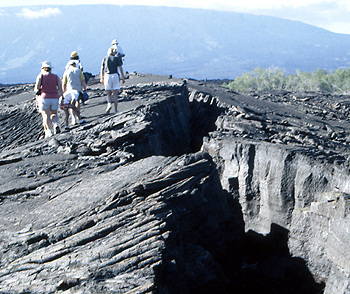
California Natives explore Isabela Island in the Galapagos.
California Natives hike over the volcanic terrain on the Galapago's Isabela Island (formerly called Albermarle Island).

The soldier looked again at the terrible landscape—thorny, dry vegetation, fields of sharp broken lava, and the volcanoes, following each other as far as his dry eyes could see.

Isabela Island, named after Queen Isabela of Spain, called Albermarle Island by the British, is the largest of the many islands and islets which make up the Galapagos. Larger, at almost 1,800 square miles, than all of the other islands put together. Six volcanoes form the backbone of the island, all but one of which are active, and the island, particularly the northern part, is wild and rugged.

In 1893, Don Antonio Gil settled on the island on a plantation he called Villamil. There he dabbled in agriculture and mining, rendered turtle oil, and exploited feral cattle for their hides. He also exploited the abundant tortoises, using their shells to decorate the path up to the plantation.

Thirty miles inland on the slopes of a mountain, he established a second plantation, Santo Tomas, primarily for mining sulfur from the fumaroles in the area.

Other plantations sprung up on the island as time went on because of it´s abundant resources. It was the custom in those days for plantations such as these to employ workers who were fugitives of the law. This made discipline on the plantations very harsh. Punishments could include death or exile, and some plantation owners traded workers for cattle.

As the plantations grew in size and number of workers, the owners petitioned the government of Ecuador for police and military protection, although there had been no trouble thus far on the island. In 1902 two small garrisons were dispatched to the island, consisting of a total of 12 soldiers. Nothing much happened, and the soldiers became terribly bored. So bored, in fact, that they decided to secretly leave the island.

In 1904, eleven of the soldiers quietly set out towards the interior of the island carrying neither water or supplies, certain they would be able to find a way back to the mainland. The owners of the plantations, realizing they were gone, searched for days but never found them.

After awhile, they gave up hope and had all but forgotten about the missing soldiers, when one of them, near death, reappeared at the plantation entrance. Once nursed back to health, he explained that the soldiers left thinking that such a big island should be filled with villages, and that they would be able to find sea transport back to Guyaquil. Overtaken by hunger and thirst, they began to hallucinate, and eventually separated. None, except the one survivor, was ever seen or heard from again.

There are so many strange stories, landscapes, and creatures on these islands which inspired Charles Darwin to discover the principles of evolution. Please join us our Galapagos Islands tours.

Blood, Gore, and a Mummy Mix-Up

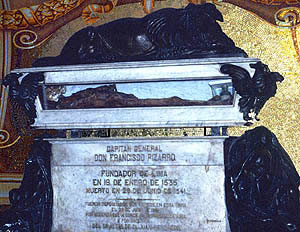
The mummy of Pizarro was an imposter.
At the cathedral in Lima, Peru, this mummy was mistakenly displayed for almost a century as the remains of Francisco Pizarro.

I first visited the Cathedral in Lima, Peru, in 1979, and saw the mummy of Francisco Pizarro. The mummy had been placed there back in 1891, when Peruvian officials, wanting to prominently display the “Founder of Lima,” had the body moved from the chapel in which it had lain for the previous 350 years.

But was this really Pizarro? Just prior to my visit, workers cleaning a crypt beneath the altar found two wooden boxes, one containing the bones of five people—one missing a head! The other box held a lead casket on which was inscribed in Spanish, “Here is the skull of the Marquis Don Francisco Pizarro, who discovered and won Peru and placed it under the crown of Castile.”

Francisco Pizarro died a violent death. On June 16,1541, while he was having dinner in his governor’s palace, a group of men, led by the son of his ex-partner, Diego de Almagro, broke in and stabbed him to death. As he lay dying from multiple sword wounds, he drew a cross on the ground in his own blood, kissing it, and crying “Jesus.” In 1892, his mummy was exhumed and displayed for almost a century in the Lima, Peru Cathedral, but was discovered to be an imposter when the underground crypt was discovered.

Pizarro had lived a cruel but exciting life. Born in poverty and illiterate all of his life, he sailed with several expeditions to the Americas, including Balboa’s journey to the Pacific. After settling in Panama, he formed a partnership with Almagro, a soldier, and Hernando de Luque, a priest, to explore the territory south of Panama, they discovered the Inca Empire. Pizarro then sailed to Spain to enlist the support of Emperor Charles V, from whom he received the charter to conquer and rule Peru. The

After the bloody conquest of the Incas, where 2000 Indians were slaughtered and Emperor Atahuallpa strangled, Pizarro alienated his partner, Almagro. This eventually led to armed conflict between the former partners, and Pizarro’s brother, Hernando, having Almagro garroted.

The skull in the lead box matched the headless skeleton and, when reunited, turned out to be a man approximately the right age and height for Pizarro at the time of his death. Additionally, the skeleton showed that the man had been murdered by multiple sword thrusts, unlike the mummy which, upon reexamination, showed no wounds, leading Peruvian and American scientists to conclude that the skeleton was indeed that of Pizarro. It is now believed that the mummy who had sat in for Pizarro for so many years, was a church official. He is now retired, and the “real” Pizarro’s bones have taken his place on display.

Costa Rica’s Bounty of Butterflies

Butterfly

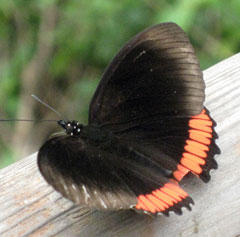
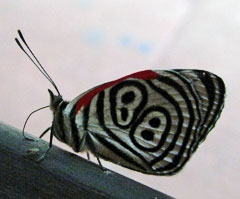
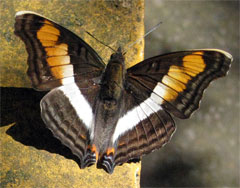
Throughout Costa Rica’s plentiful rainforests, beaches and mountains, visitors are enchanted by the number and variety of butterflies. Costa Rica boasts over 1000 butterfly species, more than the entire continent of Africa.

Flitting from flower to flower the butterflies are enchanting to watch, the brilliant colors of their wings lending joy to the day. These delicate wings are covered with tiny scales which reflect light passing through them to form bright colors and patterns. They serve to identify the butterfly to members of its own species as it seeks to carry out its sole mission in life, mating. The colors of some species, such as the Monarch, which are toxic when eaten, warn predators that these butterflies are not dinner.

Butterfly

The male butterfly spends his short time on earth cruising around looking for a female. With his antennae he can smell her perfume (pheromones) from over a mile away. At the back of his abdomen—remember, butterflies are insects so their bodies have three sections, a head, a thorax, and an abdomen—is a set of “claspers” to grab on to his lady love. When couples mate they face in opposite directions with their abdomens locked together. The female, if startled during the conjugal act, will fly up into the air carrying aloft her attached Don Juan. During her short lifetime she will lay about 100 eggs. Some species lay their eggs in clusters while others lay each egg on a different plant.

Butterfly

Upon hatching, the tiny caterpillars go into the world to eat. As adult butterflies are primarily sex machines, caterpillars are primarily eating machines, munching the night away, and remaining motionless during daylight hours to camouflage themselves from predators. The growing caterpillar sheds its skin four times, then searches for the perfect spot on the underside of a leaf to attach itself and prepare for the miraculous change from a crawling eating machine to a glorious flying butterfly.

The butterfly’s life is short, varying from species to species, but averaging about three months—two weeks as an adult butterfly.

Join us on a California Native tour to beautiful Costa Rica and witness this bounty of butterflies for yourself.