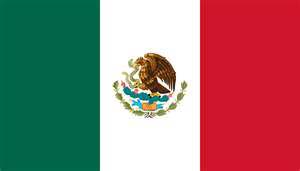
On February 24, Mexico celebrates Dia de la Bandera, or Flag Day, a civic holiday with parades and festivities to honor the Mexican Flag. On that date in 1821, the Plan de Iguala, which proclaimed Mexico as an independent country, was signed.
The green, white and red flag was adopted at that time and although it has undergone some revisions since, the basic design has remained. Its stripes are green for hope and victory (or Independence), white is for the purity of ideals (or Roman Catholicism), and red for the blood of national heroes (or for the Union).
In the center of the flag is the National Coat of Arms which features an eagle with a snake in it’s claws. According to legend, the Aztecs, who were the original inhabitants of Mexico, were told by their gods to find an eagle perched on a prickly pear cactus and holding a snake. At this location they would build their permanent city. The story goes that they saw this eagle on an island in the middle of a lake, and built their city, now known as México City, around the island.
Throughout all of Mexico, you will see that the most respected symbol among the Mexican people, is their national flag. ¡Viva México!
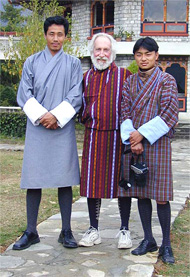
California Native founder Lee Klein wearing traditional gho with Bhutanese driver and guide.
Seated astride a flying tiger, Guru Rimpoche entered Bhutan in the year 747 AD, to conquer demons and introduce Buddhism in this isolated area of the Himalayas. In this far off kingdom, mythology and history intermingle and ghosts, yetis, and demons are part of daily life.
The name Bhutan is probably derived from the Sanskrit word Bhotant meaning “the end of Tibet” or Bhu-uttan meaning “high land.” The Bhutanese, however, refer to their country as Druk Yal, “Land of the Thunder Dragon,” and the Bhutanese flag, with its rampaging dragon, proudly reflects that.
Bhutan is nestled in the Himalayas between China and India. On its southwestern border is the Indian state of Sikkim. To its north is Tibet. Almost the entire country is mountainous. The southernmost part begins in the humid jungles of India’s Assam Plain, but soon climbs high into the Himalayas.
There is only one airport in the country and that is in Paro, a deep valley at 7,300 feet elevation, surrounded by 16,000 foot mountains. Only one airline flies into Paro, Druk Air, the Royal Bhutanese Airline. The flight to Paro is one of the most spectacular in the world. Flying over the Himalayas, the plane descends steeply between snow capped peaks flying through the narrow valley to land at the tiny airport.
Bhutan’s capital is Thimphu (pronounced “Tim – Pu”), a thriving metropolis of around 40,000. The population of the entire country is only 750,000.
The country is a monarchy, ruled by His Majesty King Jigme Khesar Namgyel Wangchuck, 31 years old, making him the world‘s youngest monarch.
Being a tiny country sandwiched between two of the largest countries in the world, Bhutan makes it a top priority to maintain its traditional culture. For all business, official, and religious occasions people dress in the traditional costume, men wearing the gho, a long attractive robe made out of wool or silk and tied about the waist, and women wearing the kira, an ankle length dress made from fine woven fabrics with traditional patterns. School children all wear their school uniform ghos and kiras. The schools, incidentally, are required to teach their students in English as well as the official language which is Dzongkha.
Houses and other buildings in Bhutan are built in the traditional style, as dictated by religion and law. The houses are generally two stories, constructed of wood and mud and elaborately decorated with carvings and paintings of Buddhist symbols. The roofs are made with wood shingles held in place by stones. On the top of every house is a colorful prayer flag.
The major towns are dominated by the dzong, a huge white fort which serves as a combination government headquarters and monastery. The system of dzongs began in the twelfth century and the newest dzong was constructed in 1998. There have been many fires in the dzongs over the years due to the hundreds of burning yak butter lamps.
According to the Buddhist religion, when a person dies he is reincarnated. When a great lama dies his reincarnation is identified and the child is taken and educated so that he may continue the good work of his previous incarnations. Lamas may marry, but only in every other lifetime.
On a recent trek in this beautiful country, I was accompanied by a Bhutanese guide, a Tibetan cook, two village lady “wranglers,” and four horses. As we headed up into the mountains, the clean air and pine forests reminded me of California’s Sierra Nevada. Unlike other Himalayan countries, Bhutan’s mountains have not been deforested. Soon, the sight of shaggy yaks grazing in the high meadows, the colorful prayer flags blowing in the wind at the top of each mountain pass, and the red-cloaked monks wandering the dirt paths, reminded me that I had come a long way from California—perhaps I had found the real “Shangri La.”
No date for Valentine’s Day this year? No problem if you are in Mexico.
Although St. Valentine’s Day probably started as a pre-Christian observance, it later became a minor religious holiday honoring St. Valentine. It was celebrated in Europe privately as a day near the end of winter and the beginning of Spring to express romance. It started to become a more public holiday in the U.S. in the mid 1800’s when a Massachusetts stationer started mass producing Valentine’s Day cards and selling them in her shop. It has grown and grown and is now celebrated in most countries of the world as a day of love and romance (seemingly not at all private!).
In Mexico, the day is called día del amor y la amistad, which means day of love AND friendship. It has evolved as a day to show appreciation for people you care about—and that doesn’t mean it has to be your significant other—it can be anyone you care about, from your teacher, your co-worker or best friend. Flowers, poems, gifts and food are exchanged as much with friends as with lovers. So, think about taking your significant other to enjoy the friendship of Mexico on Valentine’s Day or any time of year. Or join us on one of our tours to Mexico’s Copper Canyon or Yucatan.
Happy Valentine’s day to all our California Native friends!
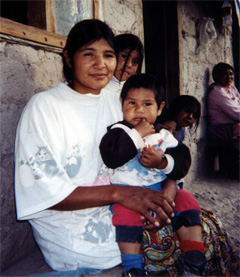
Deep in the heart of Mexico’s Sierra Madres, in the town of Creel, the center of Copper Canyon country, is the clinic of Santa Teresita. The lives of thousands of Tarahumara Indian children have been saved here because of the dreams and dedication of one man, Father Luis Verplancken.
Father Verplancken was a Jesuit priest who first visited the Tarahumaras in the late 1950s. He saw a great need for health care for these Indians who inhabit this remote area of mountains and canyons. At the time their children had an alarmingly high mortality rate.
Verplancken put his ideas into action by starting a traveling health care facility, housed in a 4-wheel drive station wagon. He quickly discovered that a little help went a long way—one dollar’s worth of penicillin, for example, could treat hundreds of children.
The word spread and by 1964, Verplancken and his volunteers received enough donations to establish a small hospital in an old railroad warehouse. The demand for medical care was so great that some Tarahumaras walked three days from their remote villages to reach the hospital.
A major obstacle that both the town and the hospital faced was the lack of a dependable water supply. With the help of more donations, a pipeline was built from the nearest fresh water source, which was four miles away over extremely harsh terrain. Three handcrafted pumping stations had to be constructed to lift the water 600 feet up to the level of the town. For the first time, Creel and the hospital had a dependable supply of fresh water.
In the mid-1970s, plans were drawn for a more modern hospital. With the help of his nephew, who was studying architecture at the time, Verplancken designed what today is known as the clinic of Santa Teresita. This clinic was literally “hand-made.” Along with a dedicated group of volunteers, Father Verplancken quarried the stone, crafted the brick and cut the trees.
The clinic opened in 1979, and houses a seventy-bed hospital with x-ray and laboratory facilities, a pharmacy, dental facilities and an outpatient clinic.
After 52 years of service to the Tarahumara community, Father Verplanken died of cancer, but the clinic lives on.
Today, the clinic still depends on volunteers and donors. Over 90% of the services and medications are provided free of cost, and the remainder are provided to the local residents at a token fee.
Many guests on California Native Copper Canyon tours have visited the clinic and donated money, medicines and supplies. One woman, after returning from a recent trip, sent four sets of crutches that she purchased at a garage sale in the United States.

 Deep in the heart of Mexico’s Sierra Madres, in the town of Creel, the center of