|
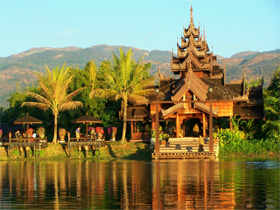
We appreciate it when our guests share their stories with us and allow us to post them on our blog for everyone to enjoy. Earlier this month, Nancy King and Richard Keltner, from San Francisco, traveled with us on our 11-day Myanmar (Burma) Explorer Trip. Here are Nancy’s reflections on the trip and a few of her beautiful photos: |
|||||
|
Dear Lee, We loved it! It was an incredibly well organized trip from our arrival in Yangon to when we left 11 days later. We had four guides and they could not have been more accommodating. They were educated, spoke excellent English and we had such good connection I found myself crying one time at parting (and we had no guide more than 2 -1/2 days). It is strange now in thinking I asked you about tipping because we wanted to give each a huge tip and did! And drivers couldn’t have been better as well, pulling over when I wanted a photo. The resort you put us in on Inle Lake was fabulous. I even had our boat man take us to the Princess Hotel, which is where my sister had stayed. I wanted to check out the gift shop. To my delight, our motor boat was stopped on the entry to the Hotel and a [leg rower] jumped in our boat to quietly do his one-leg rowing the entire inlet to the hotel. I did not like the Princess Hotel nearly as well as Inle Resort [where we stayed]. Yangon was very hot and humid in January but all the other cities were quite comfortable. Plus the car was always air conditioned as were the places we stayed. We were upgraded to a suite at the Trader’s Hotel and that was especially nice with the full window view of the city. The food was outstanding! Our guide ate with us and we let him order [for us] every time. Each guide handled it so smoothly. We loved having the guide and driver all to ourselves. I like the opportunity to really build a relationship among us. The excellent guides are important, as we spoke with others who had guides through someone else. They were such a strong part of our trip with our connections with them. I’m deeply into our trip and reliving it as I process my photos and edit them and get them ready to put in my 71st photo album of our life. Sincerely,
|
|
||||
Something to Kwai About
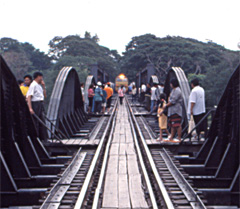
I stroll across the railway bridge whistling “Colonel Bogie’s March.” Others on the bridge give me strange looks as if thinking “Who is this weird man?” But I feel good and my whistling is appropriate, for this is the famous “Bridge on the River Kwai.”
Most of us first heard about the bridge through the 1957 film, based on Pierre Boulle’s French novel. Set in a World War II Japanese POW camp in Burma, it is a fictional account of a battle of wills between a harrassed Japanese camp commander and a doggedly-stubborn British colonel. The story climaxes when allied commandos blow up the bridge.
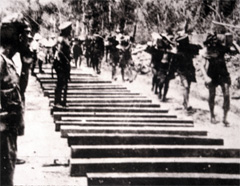
The true story is different. During the Second World War, the Japanese planned a railway from Bangkok to Rangoon to shorten the distance between Japan and Burma by 1,300 miles. The railway would cross some of the wettest and most inhospitable terrain in Southeast Asia and require the construction of 688 bridges, but they considered it critical to the war effort.
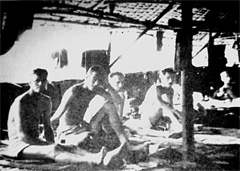
For labor they used 250,000 Asian forced-laborers, mostly Thai, and more than 60,000 Allied prisoners—30,000 British, 18,000 Dutch, 13,000 Australians, and 700 Americans. Estimated to take five or six years to build, the project, which began on September 16, 1942, was completed after only 16 months, and cost the lives of 16,000 POWs and 75,000 Asian workers. The deaths from cholera, beri beri, malaria, typhoid, exhaustion and malnourishment, earned the railroad the name, “The Death Railway.”
The Japanese actually constructed two parallel bridges across the River Kwai, just outside of the Thai town of Kanchanaburi—the first made entirely of wood, the second made of steel and concrete. The Allies destroyed both on February 13, 1945.
In the film the commandos detonated explosive charges fastened to the bridge’s supports. The real bridge was bombed. Failing to destroy the bridges with conventional bombs (some hitting POW camps) the American flyers brought in a new weapon, the AZON (Azimuth Only) bomb. The precursor of today’s “smart” bombs, it had a radio-controlled tail and ten times the accuracy of a conventional bomb.
After the war, engineers repaired the steel bridge over the River Kwai. It is still in use. Visitors to Kanchanaburi, Thailand, now walk across the bridge (the fortunate ones having the opportunity to witness me whistling the theme from the movie), and visit the Allied war cemetery and a museum run by Buddhist monks, featuring a reconstruction of a prisoner of war camp. The monks built the museum “not for the maintenance of hatred among human beings but to warn and teach us the lesson of how terrible war is.”
Bangkok, Thailand, is the cross roads of Southeast Asia. Most passengers traveling to our California Native destinations of Myanmar (Burma) and Bhutan stop in Bangkok before resuming their journeys, and it is well worth spending an additional day to visit Kanchanaburi with its memorials and famous bridge.
Join Us for Easter in Copper Canyon
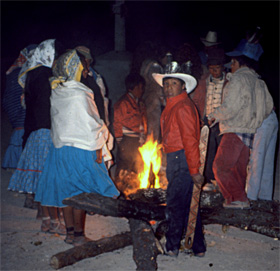 Now is the time to book your trip for Easter in Mexico’s Copper Canyon. The Easter, or Semana Santa, celebrations of the Tarahumara Indians make this time the high season of the year. Small towns which are sleepy most of the year are now alive with celebrations, 24-hours a day. The Tarahumara, who call themselves the Raramuri, celebrate for a week, with dancing, parades, bon fires, ceremonies in the churches and much drinking of tesguino, the Indians traditional corn liquor.
To begin to understand the Tarahumara ceremonies, one has to have a basic understanding of the Indians’ religion. Read our story about this unusual version of Catholicism practiced by these colorful cave-dwelling people.
Images of the World: Color it Yellow
Colors set our mood and add an important dimension to our feelings and memories of the places we visit. I thought it might be fun to group some of the photos from our library of California Native images by their predominant colors. This first collection is based on the color yellow.
“How wonderful yellow is. It stands for the sun.“—Vincent Van Gogh
|
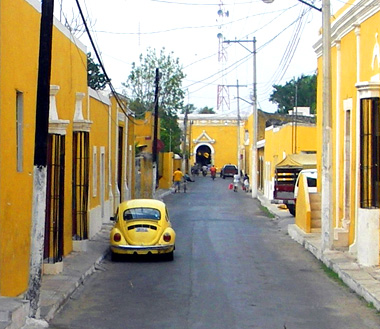
The delightful city of Izamal, located on Mexico’s Yucatan Peninsula, is a magical town whose buildings are all painted yellow. |
 |
|
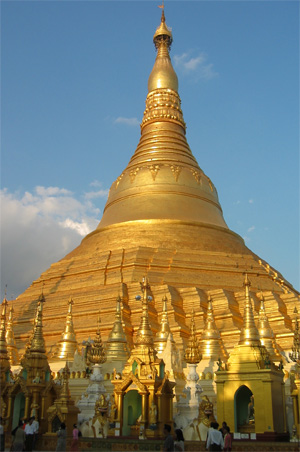
Built around the 6th century, the Shwedagon Pagoda is the most sacred Buddhist pagoda in Myanmar (Burma). It’s gilded stupa looks down on the city of Yangon (Rangoon). |
 |
|
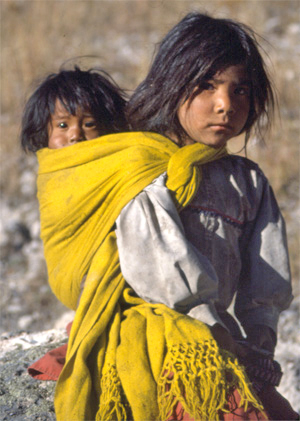
A young Tarahumara girl carries her little sister in a yellow shawl, in Mexico’s Copper Canyon. |
 |
|
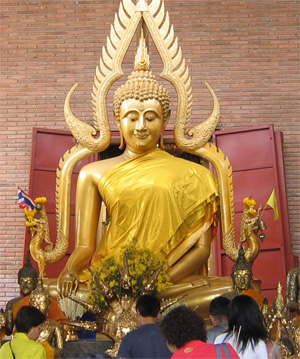
A smiling yellow buddha looks down at worshipers in one of the thousands of temples in Thailand. |
 |
 |
|
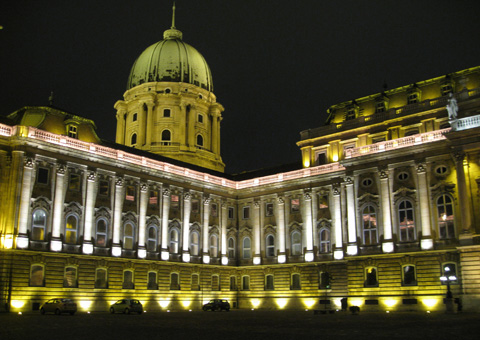
Shining yellow light into the night sky, Buda Castle, in Budapest, Hungary, overlooks the Danube River. |