The Saga of William Walker

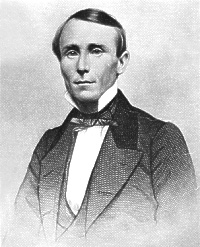
William Walker was the greatest American FilibusterPresident of Lower California, Emperor of Nicaragua, doctor, lawyer, writer—these were some of the titles claimed by William Walker, the greatest American filibuster.

In the mid-nineteenth century, adventurers known as filibusters participated in military actions aimed at obtaining control of Latin American nations with the intent of annexing them to the United States—an expression of Manifest Destiny, the idea that the United States was destined to control the continent. Only 5’2″ and weighing 120 pounds, Walker was a forceful and convincing speaker and a fearless fighter who commanded the respect of his men in battle.

Born in 1824 in Tennessee, Walker graduated from the University of Nashville at the age of 14 and by 19 had earned a medical degree. He practiced medicine in Philadelphia, studied law in New Orleans, and then became co-owner of a newspaper, the Crescent, where the young poet Walt Whitman worked. When the paper was sold, Walker moved on to California, where he worked as a reporter in San Francisco before setting up a law office in Marysville.

When he was 29, his freebooting nature led him to become the leader of a group plotting to detach parts of northern Mexico. Recruiting a small army, he sailed to Baja California and conquered La Paz, declaring himself president of Lower California. He then decided to extend his little empire to include Sonora, and renamed it “The Republic of Sonora.”

Marching on to the Colorado River, Walker found himself faced with harsh conditions and a high desertion rate, forcing him to retreat to California, where he surrendered to U.S. authorities on charges of violating U.S. neutrality laws.

One result of this incursion was that Mexico sold a part of Sonora to the United States—the transaction we call the Gadsden Purchase. Acquitted of criminal charges, Walker next turned his attention to Central America. Throughout this region, chaos reigned, as forces known as Democrats and Legitimists fought each other. The leader of the Democratic faction in Nicaragua invited Walker to bring an army and join the struggle against the Legitimists. In 1855, with his army of 58 Americans, later called by stateside romantics, “The Immortals,” he landed in Nicaragua.

Within a year, leading “The Immortals” and a native rebel force, he routed the Legitimists and captured Granada, their capital. His success roused concern in the other Central American countries, especially Costa Rica, which sent in a well-armed force to invade Nicaragua. Walker’s army repelled the invasion, but a poorly executed counter attack into Costa Rica failed, and a war of attrition continued, in which disease killed more soldiers on both sides than enemy bullets.

Other enemies plagued Walker. Cornelius Vanderbilt, the shipping magnate, seeking control of the San Juan River-Lake Nicaragua route from the Caribbean to the Pacific, armed Walker’s enemies, while the British navy, attempting to thwart American influences in the region, regularly harassed efforts to supply him. In spite of these factors, Walker had himself elected president of Nicaragua. The United States briefly recognized his government but never sent him aid. Soon the other countries of Central America formed an alliance against him, and in mid 1857 he surrendered once again to a U.S. naval officer and returned to the U.S.

Landing first in New Orleans, he was greeted as a hero. He visited President Buchanan, then went on to New York, all the time seeking support for a return to Nicaragua. But support waned as returning soldiers reported military blunders and poor management.

Nevertheless he succeeded in raising another army, and returned to Nicaragua in late 1857. Again thwarted by the British navy, he abandoned his third Latin American invasion.

Still undaunted and seeking support for yet another venture, Walker wrote a book, The War in Nicaragua. Knowing that his best prospects lay in the South, he assumed a strong pro-slavery stance. This strategy proved successful, and in 1860 he once again sailed south. Unable to land in Nicaragua due to the ever-present British, he landed in Honduras, planning to march overland, but the British soon captured him and turned him over to the Hondurans. Six days later, at the age of 36, he was executed by a firing squad. The Walker saga had ended. This enigmatic man had come close to altering the history of the continent. Had he been successful, he might have brought several Central American countries into the United States as pro-southern states, altering the balance in Congress and postponing The Civil War.

Today Walker is far better known in Central America than in the United States. Costa Ricans honor Juan Santamaria, a young drummer boy who became a national hero by torching a fort in which Walker’s army was encamped, and a national park, Santa Rosa, commemorates the battle where Walker’s soldiers were expelled from Costa Rica.

Tying the Knot

Sky written proposal beseeching the hand of Laurie (formerly Kraft) Pepitone.
Last month, Southern California residents looked up to see this sky-written proposal from Mike Pepitone.
Laurie Kraft and Mike Pepitone Get Hitched
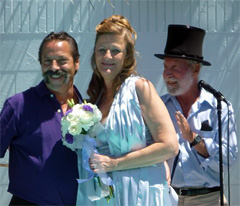
Mike Pepitone marries California Native Operations Chief, Laurie Kraft, while Lee Klein (with California Native Official Wedding Hat) officiates.

On August 21, a beautiful Saturday afternoon, California Native’s Operations Manager, Laurie Kraft, married her longtime sweetheart, Mike Pepitone, at a poolside ceremony at their home in Torrance, California. California Native President Lee Klein performed the ceremony. The day was highlighted by a long awaited proposal written in the clear blue sky by five sky-writing airplanes.

A native-born Californian, Laurie has been with The California Native for over 18 years. Her family, including sons Jimmy and Jason, came down from Northern California and Washington for the event. Mike, who is an aircraft mechanic for Federal Express, welcomed his mother and family from their native Chicago.

We wish them a very happy and successful married life together.

Orchids: The Macho Flowers

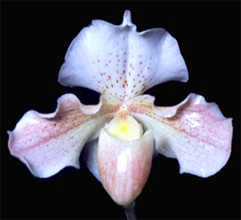
Glistening orchids cling to the towering trees surrounding us in the swirling mist of the Costa Rican cloud forest. More than 1,200 species of these beautiful blooms can be found in this enticing little country which has made the orchid its national flower.

In Costa Rica, orchids are the national flower.According to legend, orchids were given their name by the Greek philosopher Theophrastus, who was a student of Aristotle. The rounded paired bulbs of one common Mediterranean orchid looked like male organs to him so he named the plant orchis, the Greek word for testicle. In medieval Europe, aphrodisiacal powers were attributed to the plants and their dried pulverized tubers were used in love potions. Potions made from younger, firmer tubers were believed to result in the conception of sons, while potions made from older, softer tubers resulted in daughters.

Orchids cover a full spectrum of colors and patterns, from delicate pastels to vibrant full-bodied hues, and range in size from tiny plants an inch high with flowers so small that we can barely see them, to 50 foot long vines with blossoms spanning more than a foot—some bloom only for a day while the blossoms of others last for weeks.

But what actually is an orchid and why do people find them so fascinating? We looked into the nature and history of these exotic plants and came up with some fascinating facts.

Orchids are the largest family of flowering plants (almost 30,000 wild species have been classified) and also the most diverse. Although they can be found in a wide range of habitats—one is semiaquatic and only its blossoms poke above the water surface, while another grows and blooms entirely below the ground—the greatest diversity of orchids can be found in tropical cloud forests. Most of these tropical orchids are epiphytes—air plants, which grow on the trunks and limbs of trees. Although they grow on the trees, they are not parasites and only use the tree as a place to anchor where they can receive light high above the forest floor—biologists have recorded almost fifty different orchid species growing on a single tree.

An orchid seed has no food source of its own, but each species has a symbiotic relationship with one particular fungus—without that fungus the seed cannot grow.

Just as the colors and sizes of orchids have so much variety, their scents also cover a wide range—some have no scent at all, others give off musky decaying smells, and one has the delightful scent of vanilla—in fact, it is vanilla. The vanilla plant is the only fruit produced by the orchid family that humans can eat. Centuries ago, the ancient Aztecs used vanilla to flavor their chocolate drinks. When the Spanish conquistador Hernando Cortez was offered the drink by the Emperor Montezuma, he was so impressed that he brought it back to the King of Spain and it soon became a favorite with the royalty of Europe.

In addition to being designated as the national flower of Costa Rica, the orchid is also the national flower of Thailand, Singapore, Columbia, Panama, Indonesia, Brazil, Guatemala, Honduras, Belize, and the Cayman Islands—a very popular flower indeed.

Additional Date Added for Our Copper Canyon 8-day Special Tour

Due to the popularity of our Copper Canyon Tours, we occasionally find the need to add additional dates. Last month we added another date for our 11-day Ultimate Tour in October and this week we are adding an additional 8-day Special Tour to our Fall schedule.

Tarahumara Weaver in Mexico's Copper Canyon
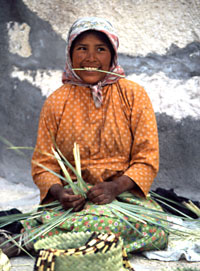
In Mexico's Copper Canyon a young Tarahumara lady smiles as she weaves a basket.
Our newly scheduled 8-day trip begins on October 16th and returns home on the 23rd.

This exciting trip is similar to our 7-day Classic Tour but adds the adventure of traveling from Creel down to the village of Batopilas in the canyon bottom. During our two-night stay in Batopilas, we hike or ride to the “Lost Cathedral” and explore the many sights of this unique little town where time seems to have stopped in the 19th century. The itinerary of the trip is as follows:

October 16: We fly to the city of Los Mochis, then travel to the small colonial city of El Fuerte, where we spend the night and begin our Copper Canyon Adventure.

October 17: In the morning we board the first-class Copper Canyon train and travel up into the Sierra Madre Mountains, passing through 86 tunnels and crossing 37 bridges. This is one of the most spectacular train rides in the Western Hemisphere. After lunch we arrive at Divisadero and stay at a picturesque lodge located right on the edge of the canyon. Here we make our first contacts with the cave-dwelling Tarahumara Indians. In the afternoon we hike along the canyon rim for magnificent views. Dinner is at the lodge’s dining room, with its majestic view of the canyon.

October 18: After breakfast we hike to Tarahumara caves and spectacular canyon views. Usually our guides can make arrangements with the Indians to put on demonstrations of their famous foot races and folk dances. In the afternoon we board the train for the ride to Creel, a lumber town high in the Sierra Madre Mountains, where we spend the night.

October 19: We travel from Creel to the little town of Batopilas. We pass through mountains and valleys, and after reaching the Tarahumara community of Kirare we head down the long, winding dirt road that leads to the bottom of the canyon. We spend the next two nights in a charming little Mexican hotel in this village that seems suspended in time somewhere in the nineteenth century.

October 20: We hike or ride to the “Lost Cathedral” of Satevo and explore the area surrounding Batopilas.

October 21: Today we return to Creel. En route we hike to Cusarare Falls and a cave with petroglyphs.

October 22: Traveling to the city of Chihuahua, we stop at a Mennonite settlement for a homemade lunch, arriving in the afternoon at our deluxe hotel. After checking in we tour the city of Chihuahua—the State Capital with its murals, the State Museum and the home of Pancho Villa. This evening we enjoy our traditional farewell banquet.

October 23: We travel by van from Chihuahua to El Paso where we fly home, sad to leave but returning home with wonderful memories of this remote area of Mexico and the unique people who make it their home.

What’s included: These trips are fully escorted by our experienced bilingual guides. The price includes transportation and accommodations: one night in El Fuerte, one night in Divisadero, two nights in Creel, two nights in Batopilas and one night in Chihuahua; excursions, tips and most meals. Round-trip airfare from Los Angeles, Phoenix or El Paso is also included. Check with us for discounted air rates from other U.S. and Canadian cities.

Price per person (double occupancy): $2520

Space is limited to 14 passengers, so please join us now!

The Yucatan, Yes You Can!

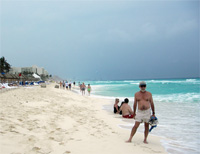
Beach at Cancun, Mexico
The beaches at Cancun give the traveler a chance to unwind at the beginning of a trip exploring Mexico

When you travel with us on our Yucatan Explorer Trips, you now have the option of beginning and ending your vacation in either city, Cancun or Merida.

With the large number of airlines flying into Cancun daily, starting your Yucatan adventure in Cancun allows you to take advantage of the competitive airfares and direct flights from the U.S. and Canada.

Cancun is renowned for its beaches, restaurants and nightlife, with all the glitter of an upscale beach resort. Merida, on the other hand, is a cosmopolitan but at the same time tranquil and charming colonial city.

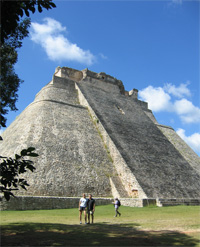
Pyramid of the Magician at the ruins of the Mayan city of Uxmal
Abandoned for more than ten centuries, the Pyramid of the Magician is the tallest structure at the Mayan ruins of Uxmal.

The Yucatan Peninsula is the homeland of the Mayan people, whose mighty empire lasted over a thousand years. Throughout the peninsula are the amazing archaeological ruins of their great cities. In addition, the Yucatan has lovely colonial cities and beautiful Caribbean beaches.

All of our Yucatan tours visit the Mayan ruins of Chichén Itzá, Uxmal, El Balam and Edzna, as well as the city of Campeche—its fort was built by the Spaniards as defense against the Caribbean pirates.

The tours which begin in Cancun also visit the ruins of the Mayan port city of Tulum, built alongside a beautiful Caribbean beach. and the archaeological site of Coba.

If you are looking for more an even more extensive trip, you can include Chiapas and/or Copper Canyon in your Mexico vacation.