This year in Mexico is a year for celebration. It is the bicentennial of Mexico’s War of Independence as well as the centennial of the Mexican Revolution. Two hundred years ago the first of these events set our neighbor on the path to becoming the 14th largest independent nation on Earth, as well as the world’s largest Hispanic country. It was the inspiration and leadership of one man which led to Mexico’s throwing off the shackles of Spain after almost three centuries.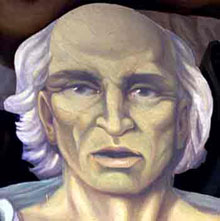
That man was a 57-year-old priest whose parish was in the city of Dolores, Guanajuato. The date was September 16, 1810. Early that morning Father Miguel Hidalgo y Costilla had the church bells rung to summon the townspeople to the church, where he told his followers that the time had come to expel the Spaniards who had misgoverned Mexico for so long. His speech, known as the Grito de Dolores, the “Cry of Dolores,” set off the Mexican War of Independence, which resulted in Mexico’s becoming an independent country.
Hidalgo was born in 1753 on the hacienda where his father was administrator. At twenty years of age he received his Bachelor of Theology degree and lectured in philosophy and theology at San Nicolás Obispo and, after being ordained as a priest, became rector of the school. His ideas and conduct were extremely liberal, which led to his being dismissed from that post, and twice being investigated by the Inquisition, who accused him of reading prohibited books, advocating doctrines of the French Revolution, doubting the virgin birth of Mary, gambling, and keeping a mistress. His last clerical position was that of parish priest in the little town of Dolores.
Hidalgo worked hard to improve the lives of his parishioners, mastering their Indian language and teaching them crafts and skills to improve their economic condition. He also introduced winemaking and silk culture, two industries which the government declared illegal in the colonies, and one day government officials came to the village and destroyed the vines and mulberry trees.
Late in the eighteenth century it became fashionable among cultured criollos, persons of Spanish descent who were born in Mexico, to form literary societies, which met for tea and cakes and discussed the classics. They also smuggled into the country books which were banned by the Church, such as the works of Rousseau, Voltaire, and Descartes. The literary societies gradually became political societies. Father Hidalgo belonged to one of these societies whose members were plotting a revolution to separate Mexico from Spain.
The group selected Hidalgo to lead the movement, and thus on the morning of September 16th, 1810, Hidalgo, with his “Cry of Dolores” launched the revolution, and the rebel army set forth, armed with machetes, swords, knives, clubs, axes, and a few muskets. As they passed through each town they opened the local jails and recruited the prisoners for their cause. Eventually their numbers grew to sixty thousand.
After six months of fighting, Hidalgo fell into a royalist trap and was captured. Because he was a priest, he was subjected to a lengthy hearing by the Inquisition, after which he was found guilty of heresy and treason, defrocked, and, on July 30, 1811, executed by a firing squad in the city of Chihuahua. His head, along with those of three other revolutionary leaders, was cut off and sent to Guanajuato, where it was put on a pole and displayed for a decade.
After Hidalgo’s death, the revolutionary movement continued until September 28,1821, when Mexico finally became an independent nation.
In Mexico, Hidalgo is credited with arousing the spirit of rebellion against the Spanish oppression. Because of his patriotism, his championing of human rights and his personal courage, he is considered by Mexicans to be the father of their nation and the symbol of Mexican independence.
Each year on September 15, Independence Day is celebrated throughout Mexico, with parades, fireworks, and the cry of “Mexicanos, Viva Mexico!”
 I can personally say that this program is wonderful. This last June, my nephew was severely wounded in Afghanistan. He was taken to Germany, where he under went surgery before being transferred to United States. The Fisher House Foundation, through the ”Hero Miles” program, flew his mother, father and sister to Washington DC to be at his bedside as he underwent several more surgeries. It does make a world of difference to these young men and women to have their families beside them while they go though such an extremely difficult time in their lives. The family presence really aids with the recovery process.