
The Village of Batopilas in Mexico’s Copper Canyon is a Step Back in Time

A dusty cowboy rides his horse down the sunbaked-earth main street, his pistol at his side. A small group of Indians, clad in bright colored blouses, breech cloths and headbands, pack their burros for the long journey back to their remote village, while nearby a group of children play tag around the bougainvilleas in the town square.
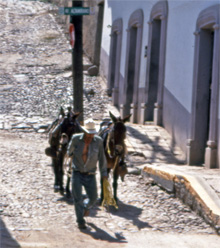
Cowboy walking horses up quiet street in BatopilasThis is Batopilas, a small village located in Mexico’s Sierra Madres at the bottom of the deepest canyon in the vast complex of mountains and canyons known collectively as Copper Canyon. Today Batopilas is a sleepy little village, but it was not always this way. At the turn of the century it was one of the richest silver mining areas in the world, but after that period, time seems to have stood still.

The Spaniards first mined ore in Batopilas in 1632, and the mines continued to produce for the next three hundred years. The peak mining period was reached during the late 1800’s when an American named Alexander Shepherd developed the mines to their highest level of production—a level which ranked them among the richest silver mines in the world.

The mining operation at that time employed 1500 workers, and the total length of tunnels was more than 70 miles. Shepherd did much to improve the town, building bridges, aqueducts, and a hydroelectric plant, which made Batopilas the second city in Mexico to have electricity—second only to Mexico City itself. His headquarters was known as the Hacienda de San Miguel—a complex of adobe buildings which included the family residence, the business offices and a mill and reduction plant. He later constructed the Porfirio Diaz tunnel—a tunnel bored through the base of a mountain, where a train hauled out ore which was dropped down shafts from the tunnels above. The train had to be dismantled and hauled in almost 200 miles by burro and human labor, because there was no road to Batopilas. In fact, the road to Batopilas was not built until the 1970’s, almost a century later. The tunnel is still there, now deserted except by the bats.

Today there is no large-scale mining in Batopilas, though a few old prospectors still pan gold and silver from the river or extract small quantities of ore from the abandoned workings.
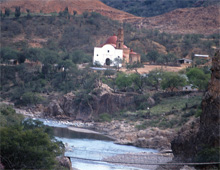
View of Satevo's 'Lost Cathedral', near BatopilasThree miles downstream from Batopilas, past an old suspension bridge, is a 400 year old Jesuit mission. The mission, recently restored, is known as the “Lost Cathedral” of Satevo, because over the course of time all records of it were lost by the Catholic Church.

Most of the buildings in Batopilas were built during the Victorian Era, but some date back to the 17th century. Many of the businesses have no signs on them—after all, in a town the size of Batopilas everyone knows where everything is. In the general store the counters are the old-fashioned high ones, worn smooth and wavy from a century of customers resting their elbows on them.

Evening is a special time in Batopilas. As the twilight spreads over the little town square the residents gather to visit with their neighbors, share the events of the day, and relax. Meanwhile, the youngsters play basketball until it is time for bed.

Traveling to Batopilas is an adventure in itself. Beginning in Creel, the road travels up and down through mountains and valleys and finally, just outside of the Tarahumara Indian village of Kirare, heads straight down along a windy, twisted, one-lane, “E-ticket ride” dirt road to the bottom of the canyon. From there it hugs the side of the canyon as it follows the Rio Batopilas down river for another hour, finally arriving in Batopilas after 5½ to 8 hours, depending on whether you travel by car or take the local bus. The local bus is a rickety old school bus which makes the trip down from Creel every other day. For the return trip, the bus departs Batopilas at 4:30 a.m. so that it can reach the rim of the canyon before the radiator boils over.

The journey to Batopilas is a breathtaking trip, but is not suitable for all travelers as the road down may make the faint-of-heart wish they had stayed at home. The best time to make the journey down is in the winter time, because Summer temperatures can soar above 100° Fahrenheit
Pack Your Easter Bonnet and Celebrate the Holiday in Mexico’s Copper Canyon

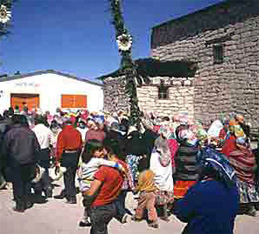
Easter in Copper Canyon is the most colorful time of year. Small towns which are sleepy most of the year now are full of tourists—both Mexican and foreign—who have come to see the Easter celebrations of the Tarahumara Indians. The tourists cluster with their cameras in the Indian villages, but most of them have little idea of what is going on.

Easter (or Semana Santa) is the major holiday of the year for Copper Canyon's Tarahumara IndiansTo begin to understand the Tarahumara ceremonies, one has to have a basic understanding of the Indians’ religion. The Tarahumara are outwardly Catholic, but their version of Catholicism is unlike any form we are familiar with.
In 1602, the Jesuits brought Christianity to the Indians, who adopted it, but interpreted and modified it to conform to their own customs and ideas. In 1767, King Charles III of Spain expelled the Jesuits from the New World, and the Tarahumara, on their own now, continued to develop their religious beliefs and rituals. Their resulting theology is as follows:

God is the father of the Tarahumara and is associated with the sun. His wife, the Virgin Mary, is their mother and is associated with the moon. God has an elder brother, the Devil, who is the uncle of the Indians. The Devil is the father of all non-Indians, whom the Tarahumara call chabóchi, “whiskered ones.” At death, the souls of the Tarahumara ascend to heaven while those of the chabóchi go to the bottommost level of the universe.

The well-being of the Tarahumara depends on their ability to maintain the proper relationship with God and the Devil. God is benevolent, but they must not fail to reward His attentions adequately. The Devil is the opposite, and will cause the Indians illness and misfortune unless they propitiate him with food. God is pleased by the dancing, chanting, feasting, and offerings of food and corn beer, that are a part of all Tarahumara religious festivals. The Devil is also pleased because the Indians bury food for him at these fiestas.

Of all the religious ceremonies throughout the year, The Easter celebrations are the most important. Hundreds of men, women, and children converge on the local church from villages as far away as fifteen miles. These celebrations are for socializing and having a good time, but the Indians also expect their efforts to please God so that He will give them long lives, abundant crops, and healthy children.

The Easter rituals concern the relationship between God and the Devil. Although God and the Devil are brothers, and occasionally get along, the Devil is usually bent on destroying God. Most of the time God fends the Devil off.

But each year, immediately prior to Holy Week, the Devil succeeds by trick or force in rendering God dangerously vulnerable. The Easter ceremonies are intended to protect and strengthen God so that He can prevent the Devil from destroying the world.

Each of the men and boys of the community takes part in the ceremonies as a member of one of two groups. The first group, the Pharisees, are the Devil’s allies, and carry wooden swords, painted white with ochre designs. The second group, the Soldados, the Soldiers, are allied with God, and carry bows and arrows.

The celebrations begin on the Saturday prior to Palm Sunday, with speeches and ritualized dances. The Pharisees, their bodies smeared with white earth, and the Soldados dance to the beating of drums and the melody of reed whistles. About midnight, a mass is held in the church. Shortly after sunrise, bowls of beef stew, stacks of tortillas and tamales and bundles of ground, parched maize, are lifted to the cardinal directions, allowing the aroma to waft heavenward to be consumed by God. The food is then distributed among the people. At mid-morning the Soldados and Pharisees set up wooden crosses marking the stations of the cross, a mass is held, and the priest leads a procession around the churchyard, with the participants carrying palm branches.

Three days later, on Holy Wednesday, the ceremonies resume, and for the next three days there are processions around the church. The point of the processions is to protect the church and, by extension, God and God’s wife.

On the afternoon of Good Friday, the Pharisees appear with three figures made of wood and long grasses representing Judas, Judas’s wife, and their dog. To the Indians, Judas is one of the Devil’s relatives, and they call him Grandfather and his wife Grandmother. Judas and his wife wear Mexican-style clothing and display their oversized genitalia prominently. The Pharisees and Soldados parade the figures around the church, dancing before them. The Pharisees then hide the figures away for the night.

On Saturday morning, the Soldados and Pharisees engage in wrestling matches, battling symbolically for control of Judas. The Soldados then take possession, shoot arrows into the three figures and set them afire. The people retire to continue the celebrations at the many tesguino drinking parties.

Wan’na Buy an Oxcart?

Located in the Central Mountain Range, not far from Costa Rica’s capital city of San Jóse, the town of Sarchí is the center of Costa Rica’s painted oxcart industry.

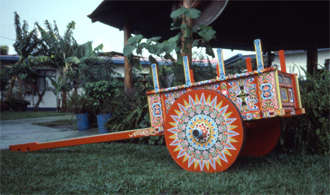
Decorated oxcart in Costa RicaAccording to legend, around 1910 a farmer was suddenly inspired to spruce up the appearance of his oxcart. He painted the wheels with multi-colored designs. Others copied his designs and oxcart painting became a uniquely Costa Rican art form. At one time each district in the country had its own special design, and people could tell by looking at an oxcart what region it came from.

Until about thirty years ago, oxcarts were the principal means of transporting coffee beans and other agricultural products to market. Today some farmers still rely on this traditional method of transporting their goods. The father of former president Oscar Arias Sánchez made his fortune hauling coffee in oxcarts to the port of Puntarenas.

Today, the painted oxcarts are produced mainly for decorative purposes. In addition to the full-size carts, replicas are available for sale ranging from small, inexpensive table top models to larger carts that are designed to be used as planters or living room cocktail carts. Regardless of size and price, all of the oxcarts are beautifully handpainted in bright colors featuring motifs of butterflies, flowers and fruits, as well as traditional design patterns whose origin can be traced to designs brought to Spain from North Africa by the Moors.

The gift shops in Sarchí are also filled with other woodcrafts including furniture, chairs, desks, coffee tables, and polished wood serving dishes, as well as leather items, ceramic crafts, and jewelry.

Exploring the arts and crafts of a country offers travelers another way to learn about its people and culture. Costa Rica has a wide spectrum of art objects ranging from the inexpensive to museum-quality collector’s items. Goods offered for sale include wood crafts, ceramics, reproductions of pre-Colombian figurines and masks, leather accessories, hammocks, woven baskets, jewelry made of woods, silver, gold and jade, embroidered dresses, blouses, table linens, and, of course, replicas of the famous painted oxcarts.

In San Jose, Costa Rica’s capital, almost every craft item is available. However, as travelers visit the beautiful and diverse provinces of Costa Rica, they can purchase products reflecting the particular traditions and culture of the surrounding countryside.

One item that most visitors bring home is a bag or more of Costa Rican coffee beans. Sipping the rich flavor, and inhaling the wonderful aroma weeks after returning home helps recapture some of the adventures and sights of a Costa Rican vacation.

So how about it? Wan’na buy an oxcart?