Carving Copper Canyon

Long ago, about a hundred million years, a huge plateau arose in an area that is now part of northern Mexico. Seventy million years passed before volcanoes erupted and flooded the plateau with molten rock. Rivers then sliced this lava-covered plateau into deep twisting canyons—the largest area of canyons in North America.
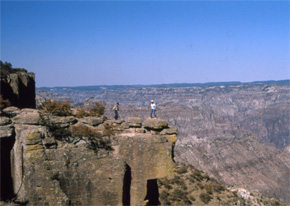
View of Copper Canyon's Balancing Rock
At the interface between the volcanic layers and the old plateau are rich mineral deposits. The depth of the canyons exposes this interface, making the gold, silver, and copper accessible for mining. It is from the abundant copper ore, previously mined here, that the area derives its name—Copper Canyon.

The first people to mine the ore were the Spaniards, in 1632. Over the centuries, hundreds of mines were worked, peaking at the end of the 19th century when 20 million ounces of silver were extracted from the mines at Batopilas, making Copper Canyon one of the richest silver mining areas in the world.

The longest term residents of the canyon are the Tarahumara Indians. No one knows how long they have lived here, but archaeologists have found artifacts of people living in the area around 3000 years ago.

Francisco Vasquez de Coronado’s expedition, which passed through the Sierra Madres in 1540, in search of the legendary Seven Golden Cities of Cibola, may have been the first contact between the Tarahumara and Europeans.

Then, in 1607, the Jesuits established the first of their 29 missions to be built in the canyons and introduced the Tarahumara to Catholicism, domestic animals and the plow. When the Spaniards discovered the rich mineral wealth in the canyons, they forced the Indians to work as slaves in the mines. This led to many bloody revolts throughout the 17th century.

The influence of the Jesuits came to a halt in 1767 when the King of Spain expelled their order from the New World. The Franciscans took over from the Jesuits, but the Indians were pretty much left alone until the Jesuits returned in 1900.

Today the Tarahumara number around 50,000. They live in caves and small cabins and practice subsistence farming. The majority practice a form of Catholicism liberally intermixed with their traditional beliefs and ceremonies. Among the peoples of North America, they are considered to be the least touched by modern civilization and the most unmixed of any of the Indian tribes of Mexico.

I first became aware of Copper Canyon about twenty-five years ago when a travel writer friend of mine returned from a journey to Northern Mexico.

“Lee, you have to go to Copper Canyon,” he insisted. “It’s magnificent!!” After seeing his slides I became excited and put together our first Copper Canyon trip. Since then, we have introduced thousands of people to this beautiful area of mountains, rivers and canyons, and the unique people who make it their home.
Smarter Than the Average Bear

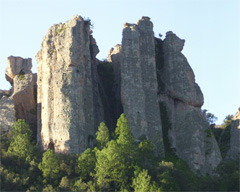
As our California Native group saunters up to the door of the Paraiso del Oso Lodge, we are greeted by three dogs, a cat, and a large white goose known as “Pancho.” The lodge is located in a secluded valley in Mexico’s Sierra Madre mountains, surrounded by large, volcanically formed spires, one of which resembles Yogi Bear wearing his hat—hence the name Paraiso del Oso, Spanish for “Bear’s Paradise.”

Rock formations above Paraiso del Oso Lodge
We are met by Doug Rhodes, a smiling cowboy who boldly exclaims, “I’m glad y’all made it. Welcome to the Paraiso Del Oso.”

Doug is the owner and founder of the lodge, located halfway between the town of Bahuichivo and the farming village of Cerocahui. Established in 1679, Cerocahui now has around 600 inhabitants, mostly Tarahumara Indians and mestizos.

Doug, or “Diego” as he is referred to in Mexico, was once a tour guide in Copper Canyon. As he tells it, he became so frustrated by the region’s lack of reliable hotels, that he searched until he found a remote spot ideal for exploring the area’s rich flora, fauna, and natural history. Here he built his lodge and ranch.

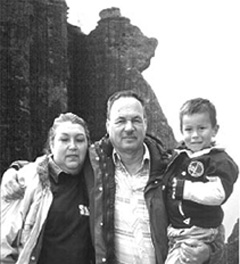
Doug Rhodes with wife, Ana Maria, and their grandson, below the 'Yogi Bear' rock formationBorn in a rural Ohio farming community, Doug has followed many diverse paths. He was an army sergeant, a NASA electrical technician, an editor, a deputy sheriff, a bodyguard, and now an inn keeper. His greatest passion is horses—he owns at least a dozen, and he brags that they are the best trained and equipped in Northern Mexico.
Diego is married to Ana Maria Chavez Gutierrez, a native Cerocahuian, whose family has a long and rich history in the area. Her grandfather was a famous miner who fought alongside Pancho Villa in the Mexican Revolution.

Diego and Ana contribute much to the area, furnishing outreach services to local Tarahumara families, and other community services including an annual Christmas party for local children.

At the Paraiso, guests can hike, ride horses, bike, explore historical towns, go birding, or just settle down with a good book in front of the large fireplace, sip a margarita, and relax.

What Has 4-toes in Front, 3 in Back, a Trunk, and Looks Sort of Like a Pig?

Need a clue? It is also related to the horse and rhinoceros. Give up? It’s a tapir.

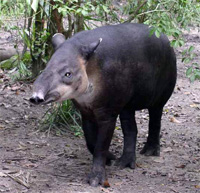
Tapir in Costa RicaTapirs are rather strange, primitive creatures. They are big animals—measuring about six to eight feet between their short little trunk and their stubby little tail, and weighing up to 700 pounds. Unlike elephants, who pick up food with their trunks, the tapirs move their trunks aside and browse like horses. Tapirs are the only animals native to the Americas which have four toes on their front feet and three toes on their hind feet.
In ancient times, tapirs were found throughout North America and tropical Eurasia. When the weather cooled down the European tapirs became extinct. The North American tapirs migrated south across the isthmus of Panama. Today tapirs are found only in Central and South America, and Southeast Asia.

There are only four species of tapirs—the Malayan tapir in Asia, the Brazilian tapir in the rain forests of South America, the mountain tapir in the high northern Andes, and the Baird’s tapir in Mexico and Central America.

The Baird’s tapir, which we can see on our California Native trips to Costa Rica, is the largest land mammal native to this region.

Tapirs are timid, inoffensive creatures who generally live in swamps or near wet areas, feeding on water plants and browsing on forest foliage. Their splayed feet help them walk in muddy and soft ground. They are good swimmers and can also dive and walk along the river bottom. Traveling on land the tapir does not always follow a beaten trail but instead doggedly pushes his way through the jungle with his head carried low.

People hunt tapirs for their flesh and hides. The thick hides are used to make whips and bridles. The flesh is considered excellent food. In some areas, natives believe they can cure epilepsy by grinding down the tapirs’ toenails and taking them in powdered form. As a result of both hunting and the cutting of forests, tapirs have become rare in many areas.

Aside from humans, the jaguar in Central and South America and the tiger and leopard in Malaya are the tapirs’ only enemies. Despite their bulk, tapirs are fast and, if there is water nearby, can usually escape predators. In addition, tapirs are extremely muscular, with very strong jaws. If cornered, the peaceful tapir can put up quite a fight.

Tapirs tend to feed in the early or late hours of the day, often before the sun comes up and after it sets, although you can occasionally see a tapir at any hour.

Like dogs, tapirs are territorial and mark their territories and daily routes with urine, but unlike dogs, tapirs are solitary and it is unusual to see more than two or three of them together.

A pregnant tapir carries her baby for thirteen months and her single offspring weighs 15-20 pounds at birth. Baby tapirs have striped-and-spotted coats for camouflage. They can look forward to a lifespan of about thirty years of happily chewing their way through the forests and swamps.

Burma Begins at Bagan

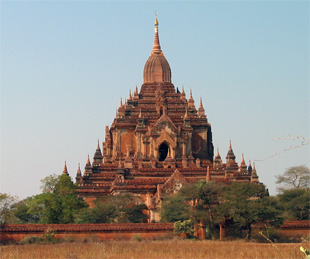
“Close your eyes and point in any direction,” our Burmese guide challenged, “When you open them, you will be pointing at a spire.” Sure enough, no matter which way we pointed there were hundreds of spires on the stupas and temples that spread across the almost treeless plain.

In Myanmar (Burma), the ancient city of Bagan has hundreds of templesLocated on forty square miles on the east bank of the Ayeyarwady River, 300 miles north of Yangon (Rangoon), Myanmar’s Bagan stands as one of the two most preeminent ancient religious sites in Southeast Asia along with Angkor Wat in Cambodia.

It was in Bagan that the Buddhist religion took hold in Myanmar, influencing the society, its art and architecture.

Historically, Bagan was formed from 19 villages at a time when the region was beginning a transition from its Hindu origins to the Buddhist beliefs that are still a major force today. Manuha, the king of Thaton, a Mon kingdom to the south of Bagan, sent a monk to convert King Anawrahta of Bamar (the origin of the name Burma) to the new religion. Once converted, King Anawrahta asked for a number of sacred scriptures to be brought to him. The monk was unsure of the king’s sincerity, so he refused the request. In response, King Anawrahta attacked and conquered Thaton in 1057 AD, and brought back to Bagan classic Buddhist scriptures, as well as artisans, craftsmen and architects.

Thus began the golden age of Bagan, highlighted by the building of thousands of pagodas. Over 13,000 of these religious structures were built. Two and a half centuries later, in 1287 AD, Bagan was conquered by Kublai Khan and began to decline.

For many years the region was considered to be inhabited by bandits and nats (spirits). Once the British came to the area in the 18th century, and ensured their safety, Burmese people began to move back to the region.

Over time, floods, earthquakes, vandals and nature have reduced the number of pagodas, but over 2,200 still stand today, many in very good condition. There is beautiful detail on the exteriors and interiors and exceptional murals.

A trip to Myanmar is a wonderful experience—super-friendly people, a cultural mix of British colonialism and Buddhist tradition, magnificent temples and beautiful landscapes, but the true splendor of the country begins at Bagan.