
Above the Clouds in Copper Canyon

Surrounded by pine trees in Mexico’s Sierra Madre Mountains, the Lodge at Norítari is a favorite relaxing place for California Native guests. In Rarámuri, the language of the Tarahumara Indians, Norítari means “Place Above the Clouds.”

The lodge is the realization of Lauro and Soledad Marquez, who live here with their daughter, Solecito, a Nahuatl Indian, whom they adopted at birth. Lauro was formerly an engineer with INEGI, the Mexican Government Institute for Statistical and Geographical Information. He met Soledad when she was working for the Acapulco city government. A few years before, she had taught in the Sierras and was enchanted by the beauty of the area and the friendliness of its people.

The couple purchased the land in 1995 and three years later began construction of the lodge. Presently they have nine log cabins (cabañas) with two rooms each, which Sol has decorated with colorful furniture and crafts from all over Mexico. Each room has a large fireplace—it gets cool at 7,800 feet in the Sierras.

Geese and turkeys clamor at visitors on the paths hiking to nearby lakes, while horses and cows graze peacefully in the meadows.

On the old-fashioned porch, which wraps around two pine trees, you can relax with cafe de olla, a cinnamon bark tea to which coffee grounds are added. Then Sol prepares a gourmet dinner: zucchini squash soup, cinnamon beef with sopes, and local baked apples in a delicious sauce. Lauro tends the bar and offers his private-label mescal.

The next day we drive to Basaseachic Falls—at 811 feet it is one of Mexico’s highest. The view of the falls is spectacular.  From an observation point we enjoy picnic lunches. After lunch, hikers have the opportunity to stretch their legs, while the others chat and soak in the beautiful scenery. When the hikers return, we head back to Norítari for another fine dinner at our “place above the clouds.”
A Whale of a Time in Baja

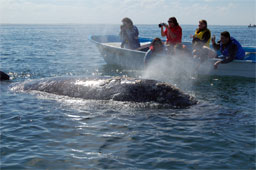
Our tiny boat bounced as the giant whale broke the water’s surface and rested close enough for us to touch. As she breached, the cameras clicked furiously. Our skipper pointed to more enormous whales—they were all around us!

Visitors pet a baby California Gray Whale in Magdalena BayAfter a summer spent in the frigid waters of the Chukchi and Bering Seas, feasting on immense quantities of small crustaceans, the California Gray Whales begin their annual migration south to Mexico’s Baja California. Swimming 5000 miles along the North American coast, they arrive in the warm, protected bays to breed, give birth, and rear their infants.
During the long southbound journey the whales court and mate. After a gestation period of thirteen months a female whale gives birth to her calf. Newborn Grays are about 15 feet long and can weigh up to 1500 pounds!

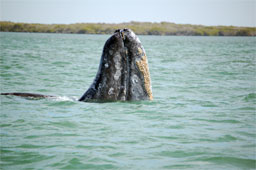
A California Gray Whale raises his head to take a look in Baja's Magdalena Bay

Another female, called an “auntie,” often assists the mother with her calf, so the whales are often spotted in groups of three. The calf nurses on its mother’s milk, ten times richer than cow’s milk. By swimming against the current in the lagoon, the young whale builds up its muscles, and by Spring it is fat (around 3000 pounds), mature (at least 19 feet long), and ready for the long northward journey.

One area the whales prefer is Magdalena Bay. This narrow section of calm waters between the coast of Baja and Magdalena Island may harbor fewer gray whales than other lagoons, but here they are densely congregated, creating a wonderful place to watch them swim and play.

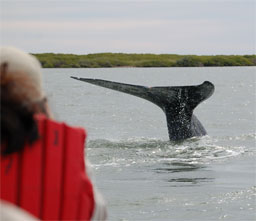
A California Gray Whale dives tail up into Baja's Magdalena BayEasily accessible from La Paz and Loreto, Lopez Mateos and San Carlos are two coastal towns where pangas, small motor boats, depart for whale watching. Skimming along the water with frigate birds soaring overhead and whales breaching in every direction is an unforgettable experience.
Magdalena Bay is also home to a variety of fish and shellfish, as well as bottlenose dolphins. In the dense thickets of mangroves, which dominate Magdalena Island, many species of birds can be found. A pack of coyotes inhabits the island, and from the boat they can be seen on the beach feasting on fish which they have learned to eat as they adapt to island life.

An invigorating boat trip like this is sure to build up a whale-sized appetite. Returning to shore, the day concludes by feasting on freshly-caught local seafood at one of the nearby restaurants. Baja offers many activities and is also an excellent gateway for tours to Copper Canyon.

Costa Rica’s Curious Critters

From a place like no other in the world, come animals like no others in the world.  A few of the animals that can be spotted on California Native Costa Rica Explorer tours are the Jesus Christ Lizard and the Two- or Three-toed Sloth.

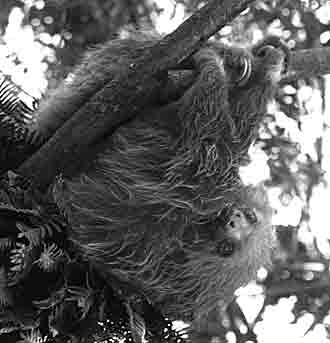
In Costa Rica, a two-toed sloth hangs lazily in a tree.Hanging upside-down from the branches of trees in Costa Rica’s lush rain forests, sleep the two and three-toed sloths. The Spanish word for sloth is perezoso, meaning “lazy”, and  sloths, who sleep around eighteen hours a day, live up to their reputation.
Because of their “lazy” or slow-moving nature, sloths live high in the forest canopy, which camouflages them from predators. They spend most of their time in the trees. By adulthood sloths are about as big as a medium sized dog. Their permanent smiling expression gives them almost human-like characteristics. These fascinating creatures can live up to thirty years. They begin reproducing at about age three and bear one baby a year.

Costa Rica is a wonderful place to observe and photograph sloths, because of the abundance of cecropia trees, which are the sloth’s favorite food. The leaves of these trees are spread out enough to make “sloth-watching” easy.

Basilisks are the other curious creature can be found on many Costa Rican rivers.  Here, you’ll see strange-looking lizards go charging from the banks, standing on their hind legs, running across the river—literally “walking on water.”

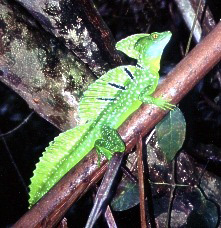
Costa Rica's 'Jesus Christ' lizards can walk on water.Basilisks, aka “Jesus Christ lizards” refer to the legendary monsters whose breath and glances were fatal to those unfortunate enough to encounter them. Basilisks are quite large, as lizards go, up to three feet long, and the males have large crests on their heads, backs, and tails. This, and the fact that they run on two legs, makes them look like little dinosaurs.
The name Jesus Christ lizard refers, of course, to their ability to walk on water. They do this by running very quickly over the water’s surface on their large hind feet, which have flaps of skin along each toe. This ability is best developed in young lizards, who can run twenty yards or more over the water without sinking. The ability to “walk on water” helps the basilisks catch food and escape from predators.

Basilisks eat almost everything, including insects, shrimp, scorpions, other lizards, snakes, fish, small mammals, birds, flowers and fruit.

Their only natural enemies are raptors, opossums and snakes, who view the basilisks as potential dinners. To protect themselves while they sleep, the basilisks bed down in vegetation overhanging water, and, when the vegetation is disturbed, dive to safety.

Come with us to Costa Rica and meet the Jesus Christ lizards as well as the many other exotic birds and animals that dwell in the forests and rivers of this magical little country at the center of the Americas.

The Eagle has Landed in Mexico’s Copper Canyon

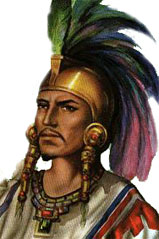
Cuauhtemoc may have only been an Aztec ruler for the short period between 1520 to 1521, but the myths surrounding him are time tested. The name Cuauhtemoc translates from the ancient Nuahtl to mean “Descending Eagle.” He rose to power at the early age of 18 just as his homeland Tenochtitlan was being invaded by Spanish explorers.

After a brutal battle lasting nearly eighty days, Cuauhtemoc went to recruit new warriors to fend off the attacking Spanish during which time he was caught by Hernan Cortes himself. It is believed that Cortes took mercy on the Aztec who, in lieu of his capture, asked bravely to be killed with his own knife. Impressed by his courage, Cortes spared Cuauhtemoc.

However, Cortes’ motives would not prove to be so noble. He had Cuauhtemoc tortured in hopes that he would reveal the location of hidden gold sought after by the Spaniards. Cuauhtemoc’s feet were put to the fire but he refused to give up any information the royal treasurer, Aldrete, demanded. Only later would Cortes learn the gold he and his men hunted were not in quantities they had imagined.

Cortes eventually had Cuauhtemoc hanged. While on an expedition to Honduras, Cortes had taken Cuauhtemoc along with him fearing that he would lead a rebellion if he were not under careful supervision.  During the trip, Cortes’ suspicions grew into fear that the leader of the Aztecs would strike and so had him killed. Cortes’ worried with good cause. Cuauhtemoc’s boldness against the invading forces was legendary.

Today, the legacy of Cuauhtemoc can be seen throughout Mexico in names and in statues. The city of Cuauhtemoc, in the area just outside of Copper Canyon, is modern and lies en route to the state capital of Chihuahua. Cuauhtemoc is now the home of several thousand Mennonites who came to the area shortly after the Mexican Revolution to farm lands which were formerly owned by William Randolph Hearst. The Mennonites live in a series of numbered “campos” just outside of the city and still preserve their traditional pious lifestyle. They are very prosperous farmers and market their crops throughout Mexico along with their famous cheese.