The Hills Are Alive in Costa Rica!

There is nothing like standing at a safe distance while watching glowing-hot boulders being pitched into the night sky.

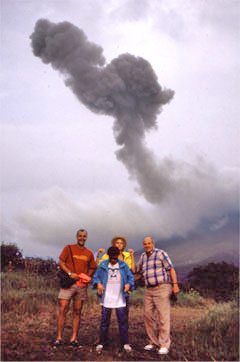
California Native tour group poses by Costa Rica's Arenal Volcano
California Native tour group poses by Costa Rica’s Arenal Volcano

The Arenal Volcano, situated near the town of La Fortuna, rises nearly 4,200 feet above the surrounding landscape, making it visible from almost anywhere. Arenal is the youngest and most active of all of Costa Rica’s volcanoes. Major eruptions occured in 1968 and 2000, but smaller eruptions happen more frequently–and on some days as frequent as every 15 to 20 minutes. Belting out its thunderous boom, the Arenal is a highlight for visitors touring the country.Costa Rica, located at the center of the America’s along the Pacific Ring of Fire, has five active volcanoes.

The Poas Volcano, located near the crafts-town of Sarchi, rises 8,884 feet above sea-level and is home to an impressive array of flora and fauna. The main crater is 950 feet deep and quite active with steaming geysers and frequent lava eruptions. At Poas, the last significant eruptions occured during the time between 1952 to 1954.

The California Native offers tours of Costa Rica which visit both of these living reminders of the raging powers beneath our feet.

Discover Machu Picchu

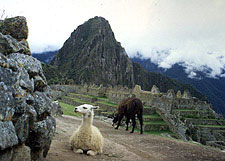
Machu Picchu
Machu Picchu, ‘Lost City’ of the Incas

Suddenly we found ourselves standing in front of the ruins of two of the finest and most interesting structures in ancient America. Made of beautiful white granite, the walls contained blocks of Cyclopean size, higher than a man. The sight left me spellbound.

When Hiram Bingham went looking for the legendary Inca city of Vilcabamba, the last refuge of the Inca kings, he did not suspect that his journey would lead him to discover the most spectacular archeological site in the Americas—Machu Picchu.

When the expedition from Yale University, of which Bingham was the director, entered the Urubamba Canyon, in July of 1911, a peasant told him of the ancient ruins at the top of a hill called Machu Picchu. Bingham accompanied him up the dense jungle-covered slope to the top, where a child guided Bingham to the ancient stone structures buried beneath tropical vegetation. Bingham was so impressed that he wrote in his diary, “would anyone believe what I have found?”

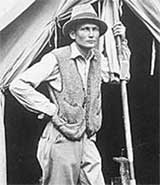
Hiram Bingham Discovers Machu Picchu
Hiram Bingham in 1911

It is hard to imagine a more spectacular setting—an ancient stone city 1,300 feet above a frothing whitewater river, surrounded by jungle-covered peaks and brilliant orchids.

Of the two surrounding peaks, the first is named Huayana Picchu, which translates to “young peak” and is the one most often seen in photographs. The second peak is called Machu Picchu or “older mountain.” The original name of the city has long been forgotten.

Until Bingham’s discovery, Machu Picchu had been unknown to the outside world for nearly 400 years. It was a mystery how all knowledge and records of an entire city disappeared. It is now believed that Machu Picchu was not a city at all, but a royal estate and religious retreat, built around 1460 and located off the main routes. It could only be reached by paths accessible to those traveling by royal decree. The Incas had no written language. Their history was kept by verbal historians, who, following the collapse of the Inca state, were unemployed. Few of the Inca people ever knew that Machu Picchu even existed. As the Spaniards advanced into Peru, around 1527, half of the population died of small pox. This was followed by civil war and the abandonment of Machu Picchu. Thus, this magnificent “stone city” disappeared.

A Visit With Mrs. Pancho Villa

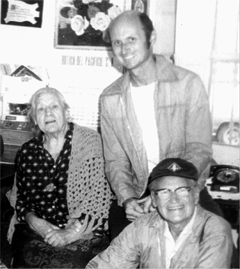
Sitting in her simple wooden chair, Doña Luz Corral de Villa, widow of Pancho Villa, began a rambling discourse on her life with the famous—or infamous—bandit, general, and hero of the Mexican Revolution.

The year was 1974, seven years before her death, when I first met Mrs. Villa. My father and I were touring Copper Canyon, and we were introduced to her at her home in the city of Chihuahua.

Sharing her memories with us, eighty-two year old Doña Luz told us of her life as a child, living with her widowed mother in the town of San Andres. One day, when she was a teenager, Villa and his soldiers rode in and demanded monetary contributions from the townspeople. Her mother asked to be excluded, and Villa visited her small store to see if she was really as poor as she claimed to be. There he met Luz. The courtship was very brief, and over the objections of her mother, Luz married Villa. The attending priest asked Villa to make his confession. The General refused, stating that it would take days to list all his sins.

Luz was not the only woman in Villa’s life. He was linked with several in bogus marriages, but later Luz was able to produce a valid certificate proving that she was his only legal wife.

The couple had one child, a daughter, who died within a few years. Luz had no other children, but she took in children Villa had fathered with other women. Perhaps she felt that he would always return to her, knowing that several of his children were with her. Villa built the quinta (manor) during the Revolution, and Luz lived there until her death in 1981. Villa was assassinated in 1923, and several of his “wives” claimed the manor. The marriage certificate might not have been sufficient to safeguard her claim, but Luz had an important ally, Alvaro Obregon, President of Mexico. During the Revolution, Obregon had visited the Villas at the quinta. There Villa had plotted to have Obregon killed, but Luz had interceded, saving the future president’s life. The favor was not forgotten, and Obregon used his considerable influence to protect Luz’s claim.

Eventually the house became a museum, with Luz the resident caretaker, and she tried personally to meet each visitor. Luz traveled through Mexico and the United States, and in Los Angeles received the key to the city.

Shortly before her death she wrote a book about her life with Villa, Pancho Villa: an Intimacy, published by Centro Librero La Prensa, in the city of Chihuahua. In it she loyally defends Villa against most of the accusations against him for his many excesses while leading the Army of the North. While this book must be read with a skeptical eye, her account provides interesting insights into Villa and the Revolution.

The above story was written by Don Fuchik (1941-2004). A long-time travel consultant and guide for The California Native, Don was also my close friend for 51 years. Don held a Master’s Degree in Latin American history and received grants from the National Endowment for the Humanities for his studies of this region.
Lee Klein