The California Native Announces Stimulus Package

With the economy being at its lowest point since the Great Depression, our government is trying to give it a jump-start with a number of stimulus packages. We at California Native are announcing our own stimulus package:
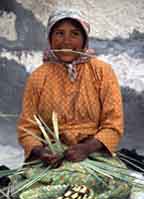
In Mexico's Copper Canyon, a young Tarahumara weaver modestly smiles.
We are giving a $100 discount to each person signing up for any of our trips to Mexico’s Copper Canyon. This offer applies to each person that you sign up, and you can join a small group tour or enjoy one of our independent adventures.

To qualify all you have to do is mention this offer at the time you sign up. Hurry, our stimulus package is valid only until April 15, 2009, but you can travel at any time. Yes You Can!

Pizza: The Universal Food

Traveling around the world, an important part of the experience is tasting the local cuisine. From Mexico to China, from Hungary to Bhutan, no trip is complete without sampling the regional specialties.

But on a long trip, after days or weeks of eating the local dishes, I always develop a craving for the universal comfort food—pizza. And so, I make it a part of each of my journeys to try the local pizza, the one food, besides a ham-and-cheese sandwich, that can be found almost everywhere.

In Mandalay, Myanmar (Burma), we found excellent pizza at the Rudyard Kipling Bar & Grill. In LeJiang, Yunnan Province, China, after many days of Chinese banquets for lunch and dinner, in spite of protests by our Chinese host, we headed for the nearest pizza parlor and enjoyed our pizza and beer feast.

Traveling through Thailand, we discovered excellent pizza was at the Slow Food Italian Restaurant in Chang Mei, where the proprietor, an Italian expat in a wheelchair, greeted each guest. All of his staff were also wheelchair bound or disabled.

On a dark and stormy night, in a remote corner of Mexico’s Sierra Madre Mountains, Doug Rhodes, the owner of the Paraiso del Oso Lodge, outside of the little village of Cerocahui, in Mexico’s Copper Canyon, proudly served us what he declared was the “best pizza in Northern Mexico.” Kerosene lanterns lighted the dining room and the pizza was covered in generous portions of olives, which my wife, Ellen, hates, and had great difficulty trying to remove in the dim light. I, however, tended to agree with Doug’s assessment.

Last year, while visiting Budapest, Hungary, we enjoyed the pizza at Al Capone’s, a chain of pizza parlors in Eastern and Western Europe, which is now owned by Australian pizza giant Domino’s Pizza.

Wherever in the world we go we are not that far from home when we can take a break from the ethnic food and enjoy a great pizza. My favorite toppings are ham, pineapple, mushrooms and olives. What are yours?
Copper Canyon: Which Direction is Best?

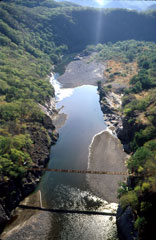
View from the Copper Canyon train as it crosses the Rio Fuerte.
View from the Copper
Canyon train as it crosses
high above the Rio Fuerte.

Guests often ask why we run our Copper Canyon trips from west to east, beginning in El Fuerte and ending in Chihuahua, instead of the opposite direction. The answer is simple: It’s the best way to enjoy the sights!

One of the highlights of touring Copper Canyon is the ride on the Chihuahua al Pacifico Railroad—the famous Copper Canyon train. One of the world’s most scenic train rides, the route climbs from sea level to over 8,000 feet, passing through 86 tunnels and crossing 37 bridges along the way.

The tracks run from Los Mochis to Chihuahua City. Every morning a train is scheduled to leave from Los Mochis at 6:00 a.m. for Chihuahua, while a second train is scheduled to depart Chihuahua for the trip to Los Mochis. Notice that I say scheduled—it is not unusual for either train to lose two to four hours along the way. The two trains travel the same route in opposite directions and pass each other along the way.

The most scenic portion of the train ride is between El Fuerte and Creel. Shortly after leaving El Fuerte Station the train abandons the lowlands of Sinaloa and begins its ascent into the Sierra Madre Mountains. The vegetation changes as the elevation climbs and the views of the mountains, rivers, waterfalls and Tarahumara Indian homesteads are spectacular. At one point the train enters a tunnel, makes a U-turn in the mountain, and exits the tunnel with the canyon on the other side.

The midpoint of the trip is just west of Creel, after crossing the continental divide. After that, the train descends and the track parallels the highway, passing through industrialized farmland until it finally arrives in Chihuahua City.

One of my favorite spots to photograph the train ride is while we are crossing the Rio Fuerte Bridge, the longest bridge on the route. With the morning sun reflecting off the water, it is just gorgeous! The eastbound train crosses this bridge around ten in the morning while the westbound train arrives there approximately eight at night—dark during most times of the year. Starting trips at El Fuerte allows you to see the most scenic portions of the train ride during daylight hours.

In Southeast Asia, the New Year Begins in April

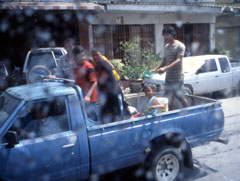
During Songkran, the Southeast Asian New Year, people cruise the street in pickup trucks loaded with kids throwing water.
Chauffeured by their parents, kids
patrol the streets with buckets and
water guns, soaking all in range.

While our year begins on January 1, in Southeast Asia the year begins on April 13.  This is the first day of Songkran, also known as the “Water Festival” and the celebrations last for three days. Songkran celebrates the vernal equinox and is a favorite holiday in Thailand, Myanmar (Burma), Laos and Cambodia.

It’s a time for fun, especially if you’re a kid, and in the villages and towns, people in pickup trucks slowly cruise the streets, their truck beds loaded with kids equipped with buckets of water and “Super Soaker” water guns.  Water is constantly flying and everyone is wet, but nobody minds, since this is the hottest time of the year. In one city I watched the local kids and police fighting it out with squirt guns.

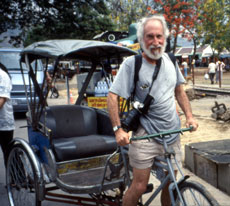
Soaking wet California Native founder, Lee Klein, pedals his rickshaw back into the melee of Songkran's Water Festival.
Soaking wet California Native
founder, Lee Klein, pedals his
rickshaw back into the melee of
Songkran’s Water Festival.

During the time of Songkran, many community events and parades are held, both secular and religious, including the Miss Songkran beauty pageant. It also is a traditional time for family gatherings.

As a tourist, it is a wet but great time to visit.